

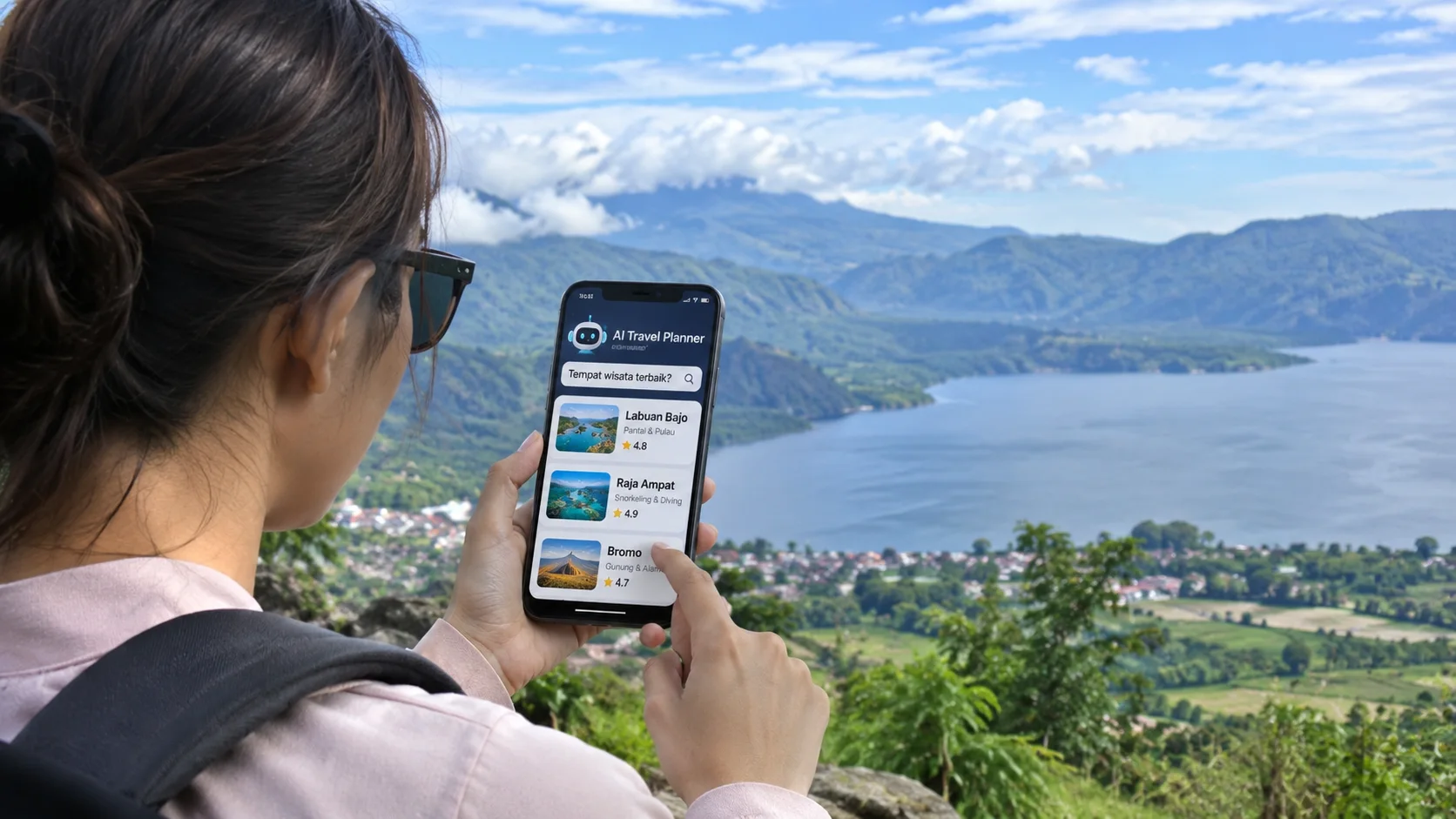
JurnalPost.com — Have you ever searched for travel recommendations online, only to find specific destinations repeatedly appearing across various digital platforms? From hotel and restaurant suggestions to popular tourist spots, everything seems tailored to your personal needs and tastes.
This phenomenon is inseparable from the development of artificial intelligence or Artificial Intelligence (AI), which is playing an increasingly significant role in the tourism industry.
AI technology is no longer just a tool for finding information. Algorithmic systems are beginning to influence how travelers choose destinations, plan trips, enjoy experiences, and even provide reviews after their journeys conclude.
However, behind this convenience, a more fundamental question arises: are travelers truly making their own choices, or are their decisions increasingly being directed by algorithms?
AI Does Not Make Decisions Directly
The influence of AI on traveler decisions does not always occur through the direct replacement of human roles.
Instead, this technology works by shaping the information environment that a person accesses before a decision is made.
When travelers search for a vacation destination, for example, algorithmic systems can filter and rank various options based on search history, user preferences, location, and previous interaction patterns.
The information displayed does not always reflect all available choices. Some destinations receive more prominent placement, while other options may remain invisible or rarely recommended.
This situation is known as choice architecture , which refers to the way information is organized and presented to influence a person's decision.
In other words, before travelers consciously begin comparing various destinations, AI potentially determines which options are the easiest for them to find.
Travelers still feel they have the freedom to choose, but the range of options they see has already been influenced by algorithmic mechanisms.
Algorithms Shape Traveler Expectations
In conventional travel patterns, traveler expectations are usually formed through information obtained before departure.
This information can come from travel brochures, recommendations from friends, family experiences, or explanations from travel agents.
After visiting a destination, travelers then compare their initial expectations with the actual experience.
However, in an AI-based digital environment, this process becomes more complex.
Algorithms not only influence expectations before the trip but can also continue to provide recommendations while the traveler is at the destination.
For instance, when someone visits a city, a travel app might recommend restaurants, entertainment venues, tourist attractions, or activities based on the user's location and preferences.
The resulting recommendations have the potential to change travel plans while simultaneously setting new standards for what is considered an appealing travel experience.
As a result, traveler expectations and evaluations are no longer entirely separate. Both can be formed through repeated interactions with the same digital system.
AI Personalization: Helpful or Restrictive?
One of the advantages of AI in tourism is its ability to provide personalized recommendations.
Travelers who enjoy nature, for example, can receive recommendations for mountains, beaches, or conservation areas deemed suitable for their preferences.
Meanwhile, users who frequently search for culinary tourism might receive more information about restaurants, traditional markets, or local specialties.
This personalization provides convenience because travelers do not need to manually browse through all available information.
However, the effectiveness of AI recommendations still depends on how travelers evaluate the information provided.
Several aspects influence user acceptance, such as the relevance of the information, alignment with expectations, and the level of control the traveler has over those recommendations.
When recommendations are perceived as relevant and transparent, technology can increase user trust and comfort.
Conversely, if the system is too aggressive in directing choices or does not provide explanations regarding the use of personal data, travelers may feel suspicious and lose trust.
This condition shows that AI development should not focus solely on the ability to provide accurate recommendations, but must also pay attention to transparency and user freedom.
Understanding Teleological Inversion in Travel Decisions
One interesting phenomenon in the relationship between AI and traveler behavior is teleological inversion .
This concept describes a situation where the logic of algorithmic optimization gradually begins to influence the goals the user wants to achieve.
In the context of tourism, travelers might initially use a digital app to find a destination that matches their desires.
However, when they continuously receive specific recommendations, their preferences and travel goals may change to follow the information highlighted by the system.
For example, someone who initially wanted to enjoy a quiet village atmosphere might end up more interested in visiting a popular destination after repeatedly seeing recommendations and digital content about that place.
This change in choice is not always recognized as the influence of an algorithm.
Travelers may feel that the decision came entirely from their own desires, even though their preferences have been influenced by information curated by technology.
Thus, travel decisions can be understood as the result of an interaction between humans, algorithms, digital platforms, and data infrastructure.
The Role of AI in Three Stages of Travel
The use of AI in tourism can be viewed through three main stages: before the trip, during the stay at the destination, and after the trip ends.
1. Before the Trip: AI Helps Design Vacations
In the pre-trip stage, AI functions as both an information source and a planning tool.
Travelers can utilize technology to search for destinations, compare accommodation prices, choose travel packages, organize itineraries, and estimate costs.
AI systems can also help process information regarding weather, transportation conditions, and various factors that could potentially affect the trip.
This convenience allows travelers to obtain recommendations that are more aligned with their needs.
However, users still need to verify the accuracy of the information, especially regarding prices, schedules, travel policies, and current conditions at the destination.
2. During the Trip: Recommendations Based on Actual Conditions
When travelers arrive at their destination, AI can help provide information based on changing conditions.
Technology integrated with real-time data can be used to monitor visitor density, traffic conditions, user location, and alternative travel routes.
For example, when a tourist attraction becomes crowded, an app can recommend other destinations that are easier to access.
Such recommendations have the potential to increase travel comfort while helping travelers adjust their activities.
Nevertheless, these benefits depend on the availability and quality of the data used by the system.
3. After the Trip: Reviews Become Learning Material for Algorithms
The role of AI does not stop after the traveler completes their trip.
In the post-trip stage, various digital platforms can utilize reviews, ratings, photos, and interaction history to develop future recommendations.
Technology can also be used to help organize travel documentation or present travel experiences in a personalized way.
User behavior data can then become part of the recommendation system's learning process.
Thus, one person's travel experience has the potential to influence the information presented to other users in the future.
This process forms a continuous cycle between traveler behavior, data collection, and algorithmic curation.
Travelers Still Need to Maintain Control
The development of AI brings great opportunities for the tourism industry, especially in improving service efficiency and providing more personalized experiences.
However, the convenience of technology also presents challenges regarding freedom of choice, algorithmic transparency, and personal data protection.
Travelers need to understand that digital recommendations are not the only picture of available travel options.
The destinations that appear most frequently in recommendations are not necessarily the best choices for everyone.
Therefore, the use of AI should be balanced with the ability to evaluate information critically, compare various sources, and consider personal needs and values.
Ultimately, technology should help humans make better decisions, not unconsciously dictate the direction of their travels.
Amidst the advancement of artificial intelligence, meaningful travel experiences still require human elements: curiosity, the freedom to explore, and the ability to discover experiences beyond the choices presented by algorithms.









Comments 0
Write a Comment Share your response