

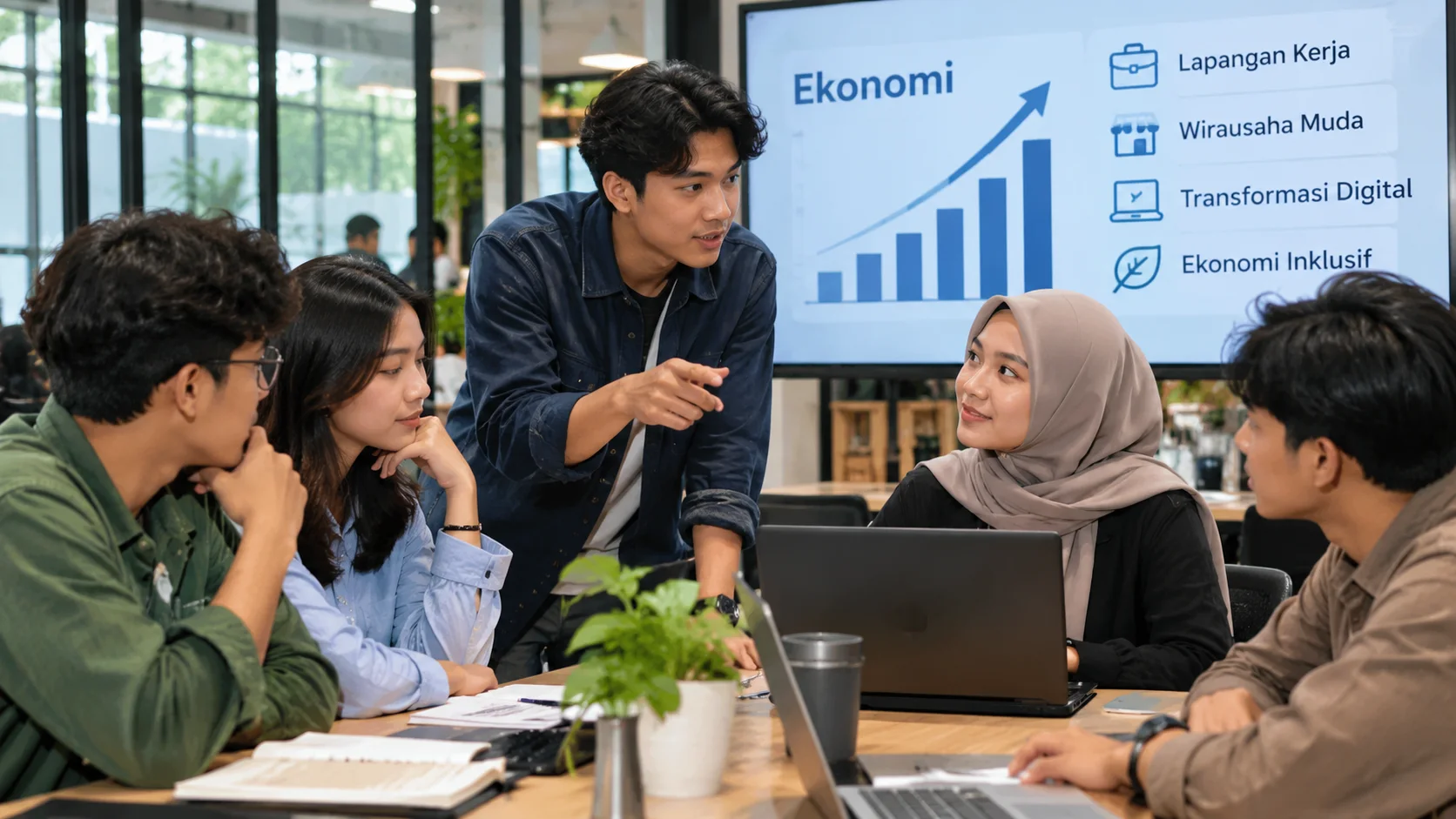
JurnalPost.com - Generation Z has grown up amidst rapidly shifting technological changes. The internet, artificial intelligence, and the digital economy have unlocked numerous new opportunities. However, these advancements have not automatically made the economic future feel more secure for young people.
Job competition, skill demands, the cost of living, and limited access to capital remain tangible challenges. Therefore, the Gen Z political manifesto regarding the economy must stem from one core idea: economic growth must provide fair opportunities and a decent standard of living.
Gen Z does not just need promises about the abundance of jobs. They need policies that help young people acquire skills, enter the workforce, build businesses, and receive protection while working.
These challenges are evident in data from Statistics Indonesia (BPS). In 2025, the Open Unemployment Rate (TPT) for the 20–24 age group was recorded at 14.35 percent. This figure is higher than the national TPT of 4.85 percent in the same year.
The 20–24 age group does not represent all of Gen Z, but the data provides a snapshot of the difficult transition process many young people face from education to the workforce (BPS, 2025).
Education Connected to Future Needs
First, Gen Z is pushing for education and training that is more closely aligned with the needs of the workforce. Diplomas remain important, but they are not always enough.
The workforce also requires critical thinking, communication, problem-solving, digital literacy, and the ability to adapt to technological developments.
The government needs to strengthen vocational education, digital skills training, and quality internship programs. Collaboration between schools, universities, industry, and local governments must be directed toward ensuring training materials match real-world needs.
Internship programs must also provide meaningful experience and learning, rather than simply placing young people as additional labor without mentorship.
Access to such training must be open to young people outside of major cities. Online training can be a solution, but it must be supported by adequate internet access and learning facilities.
Paving the Way for Young Entrepreneurs
Second, the future economy must provide space for young people to create jobs, not just seek them.
The growth of digital commerce, the creative industry, and technology-based businesses presents opportunities for the younger generation to build small-scale enterprises.
However, the spirit of entrepreneurship must be accompanied by tangible support. The government can expand access to financing for startups, provide mentorship in financial management and marketing, and simplify business legalization processes.
These programs need to be implemented transparently, be easily accessible, and not be centered solely in urban areas.
Small businesses and the local economy should also be part of this agenda. Young people in the regions must be given the opportunity to develop their area's potential, ranging from food products and handicrafts to tourism and digital services.
In this way, economic growth will not be concentrated only in big cities but can also be felt by communities in various regions.
Advanced Technology, Protected Workers
Third, digital transformation must go hand-in-hand with worker protection.
Platform-based work, freelance jobs, and the creative economy do offer flexibility. However, these workers still require payment security, transparent information, workplace safety, and access to social protection.
The government must ensure that labor regulations are capable of keeping pace with changing forms of employment. Companies and digital platforms must also be held accountable for providing clear grievance mechanisms and working conditions that do not disadvantage workers.
Amidst the development of artificial intelligence, which is shifting skill requirements, upskilling and retraining programs need to be expanded so that young workers are not left behind.
Technological progress should be a means to increase productivity and prosperity, rather than a factor that increases uncertainty for the workforce.
An Inclusive and Sustainable Economy
Fourth, the Gen Z economic manifesto must prioritize equity.
The opportunity to learn, work, and build a business should not be determined by where someone is born or their family's economic condition.
Equitable access to the internet, transportation, educational facilities, and financing is a crucial part of economic policy that provides broader opportunities for the public.
Gen Z also needs to push for development that prioritizes environmental sustainability.
Investment in renewable energy, waste management, sustainable agriculture, and public transportation can open economic opportunities while preserving the quality of life for future generations.
Development should not merely chase short-term growth at the expense of the environment that will be inherited by young people.
Quality economic growth must consider the balance between industrial progress, public welfare, and environmental sustainability.
Time for Young People to Help Determine the Direction
The Gen Z political manifesto is not just a list of demands for the government. More than that, it is an invitation for the younger generation to be involved in the planning, implementation, and oversight of economic policy.
The aspirations of young people need to be heard through public dialogue spaces, consultation forums, community organizations, and the democratic process.
Ultimately, a successful economy is not just one that records high growth, but one whose benefits can be felt widely.
Gen Z wants a future where education paves the way to decent work, small businesses have the opportunity to grow, workers receive protection, and technological progress brings benefits to society.
The future of Indonesia's economy cannot be built simply by asking young people to keep adapting. The state, the business world, educational institutions, and society must also change to create fair opportunities.
Gen Z are not just heirs to the future. They are citizens of today who have the right to help determine its direction.
Reference Sources
Statistics Indonesia. (2025). Open Unemployment Rate by Age Group, 2025.
https://www.bps.go.id/id/statistics-table/2/MTE4MCMy/tingkat-pengangguran-terbuka-berdasarkan-kelompok-umur.html





Comments 0
Write a Comment Share your response