

SIDOARJO, JurnalPost.com – Have you ever felt insecure simply because your hair is different from your friends'? Or felt ashamed of your body shape after receiving comments from others?
For some, comments about physical appearance might be considered harmless jokes. However, for teenagers in the process of finding their identity, such remarks can leave a lasting impression and affect how they view themselves.
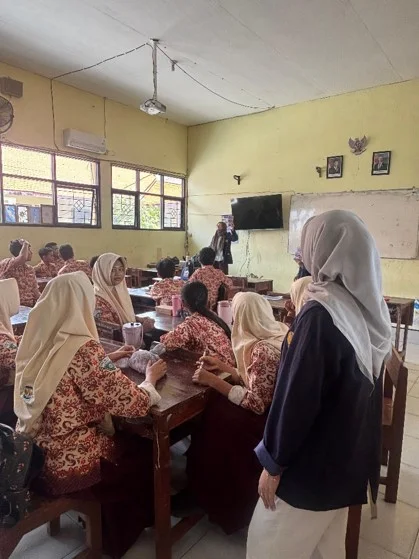
This issue was the focus of a psychoeducation session on positive body image held for class X-10 at SMAN 1 Gedangan on Wednesday (11/11/2026).
The activity, led by Intan Anggraheni Zahrin Prasetyo from the Guidance and Counseling Study Program at the State University of Surabaya (UNESA), aims to help students recognize, accept, and appreciate their own physical conditions.
Through material presentations and interactive discussions, students were encouraged to understand that every individual has unique physical characteristics and that these differences should not be a reason to feel inferior.
Behind Physical Jokes, There Are Feelings That Are Not Always Visible
One of the highlights of the psychoeducation session was when several students voluntarily shared their personal experiences regarding their physical appearance.
One student shared that she had felt insecure because of her frizzy hair. A condition that might be considered normal by others had significantly affected how she evaluated her appearance.
Another experience was shared by a student who admitted to frequently receiving comments from peers about eating too much.
While recounting this experience, the student even broke down in tears. This moment demonstrated that comments perceived as jokes by some can cause deep sadness for those receiving them.
Both experiences illustrate that body image issues are not always about the desire to have an ideal body shape. Discomfort with one's appearance can also arise from daily experiences, including comments about hair, body shape, and eating habits.
Remarks made without considering others' feelings have the potential to affect a person's self-confidence, especially if such comments are repeated.
Therefore, building a friendship environment that values mutual respect is a crucial part of supporting adolescent psychological development.
Understanding Positive Body Image and the Importance of Self-Acceptance
Body image is body image is an individual's mental representation, perception, and evaluation of their own body shape, size, and appearance.
Cash, as cited in research by Ramanda, Akbar, and Wirasti (2019), explains that body image relates to an individual's experience in perceiving their body shape and weight, as well as behaviors directed toward evaluating their physical appearance.
In general, body image can be understood through two tendencies: positive body image and negative body image.
A positive body image is demonstrated by one's ability to accept, appreciate, and care for their physical condition. Conversely, a negative body image tends to be characterized by dissatisfaction with appearance, the habit of comparing oneself to others, and excessive focus on physical flaws.
Having a positive body image does not mean one must always be satisfied with every part of their body. Self-acceptance is actually about the ability to appreciate the body without constantly blaming or belittling oneself.
Teenagers can still pay attention to their appearance, change their hairstyle, choose clothes they like, or maintain physical fitness. However, this should be done as a form of self-care, not because they feel worthless for having a different appearance.
The Influence of Peer Environments and Social Media
Adolescence is a developmental period marked by various physical, psychological, and social changes.
Changes in height, weight, body shape, and the emergence of secondary sexual characteristics can influence how teenagers evaluate their appearance.
Every individual experiences development at different times and with different characteristics. These differences sometimes make some teenagers feel they do not fit the standards of appearance they see in their surroundings.
Beyond physical changes, peer environments also influence the formation of body image.
Comments regarding skin color, height, weight, hair condition, or eating habits can become experiences that shape a teenager's self-assessment.
The influence of social media is also a concern. Various posts displaying specific standards of beauty or handsomeness can drive teenagers to compare their appearance with others.
In reality, everyone has unique physical characteristics and does not have to follow a single standard of appearance to feel accepted.
Therefore, it is important for teenagers to understand that physical appearance is not the only measure of a person's quality and self-worth.
Learning to Love Yourself and Respect Others
Through this psychoeducation activity, students of class X-10 at SMAN 1 Gedangan were also invited to understand several simple steps to build a more positive body image.
The first step is learning to accept one's own physical condition. Every individual has uniqueness, whether in body shape, skin color, height, or hair characteristics.
Second, reduce the habit of comparing oneself to others. Everyone has their own strengths and weaknesses, so others' appearances should not be used as a benchmark to determine one's own value.
Third, use social media wisely. Teenagers can choose content that provides a positive influence and limit exposure to posts that make them feel constantly dissatisfied with their appearance.
Fourth, care for the body as a form of self-appreciation. Maintaining hygiene, consuming nutritious food, getting enough rest, and engaging in physical activity are parts of caring for one's health.
Fifth, watch your words and respect others' feelings. Before commenting on someone's physical condition, it is important to consider whether the remark is necessary and how it might impact the recipient.
When a friend expresses discomfort with their appearance, listening without judgment can be a meaningful form of support.
Psychoeducation Provides a Safe Space for Students to Share
The psychoeducation activity at SMAN 1 Gedangan was active and received an enthusiastic response from the students.
Participants followed the presentation, engaged in discussions, and showed the courage to share experiences related to body image and self-confidence.
The students' willingness to share personal experiences highlights the importance of providing a comfortable space for teenagers to express their feelings.
Stories about frizzy hair and comments about eating habits serve as a reminder that body image issues are very close to daily life.
Through this activity, students are expected not only to understand the concept of positive body image theoretically but also to be able to apply it through attitudes of mutual respect and appreciation for physical differences.
Building a positive body image is not just about convincing someone that they are beautiful, handsome, or attractive. Equally important is creating a social environment that does not make someone feel they must change themselves just to be accepted.
Ultimately, everyone has uniqueness that does not need to be equated with others. Different hair, diverse body shapes, or other physical characteristics are not reasons to feel inferior.
Learning to love yourself does not mean you have to feel perfect, but rather being able to accept yourself with all your strengths and weaknesses.
Before using someone's appearance as a subject for jokes, it is better to understand their feelings first. Because something considered a joke by one person may not necessarily feel pleasant to another.
Not all wounds are visible, and not all jokes feel funny. Through self-acceptance and mutual respect, teenagers can build a more positive friendship environment that supports the growth of self-confidence.
References
Ramanda, R., Akbar, Z., & Wirasti, R. A. M. K. (2019). Literature study on the theoretical foundation of body image for adolescent development. Jurnal Edukasi: Jurnal Bimbingan Konseling, 5(2), 121–135. DOI: 10.22373/je.v5i2.5019.
Comments 0
Write a Comment Share your response