

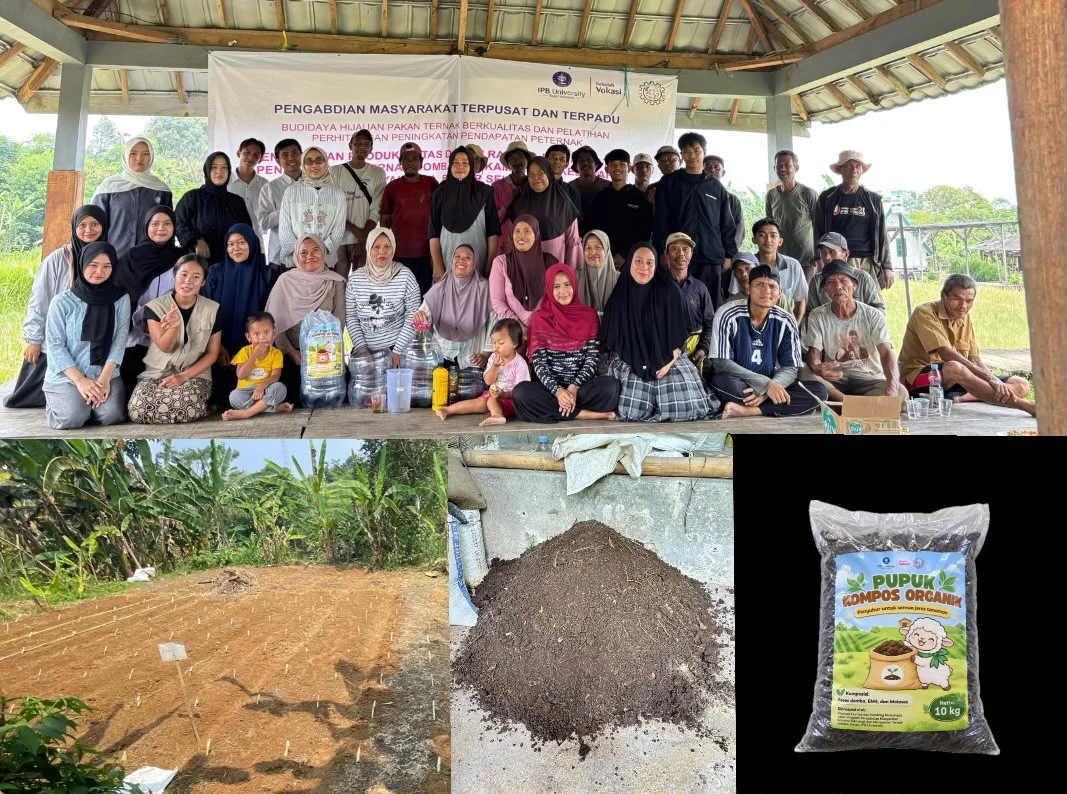
BOGOR, JurnalPost.com – The Livestock Technology and Management (TNK) Study Program at the IPB Vocational School held a Centralized and Integrated Community Service Program (PPM) for the year 2026 in Mulyaharja Village, South Bogor District, Bogor City, on Sunday (15/11/2026).
This activity serves as an effort by the university to support increased livestock productivity while creating additional income opportunities for farmers through livestock waste processing and land utilization for forage provision.
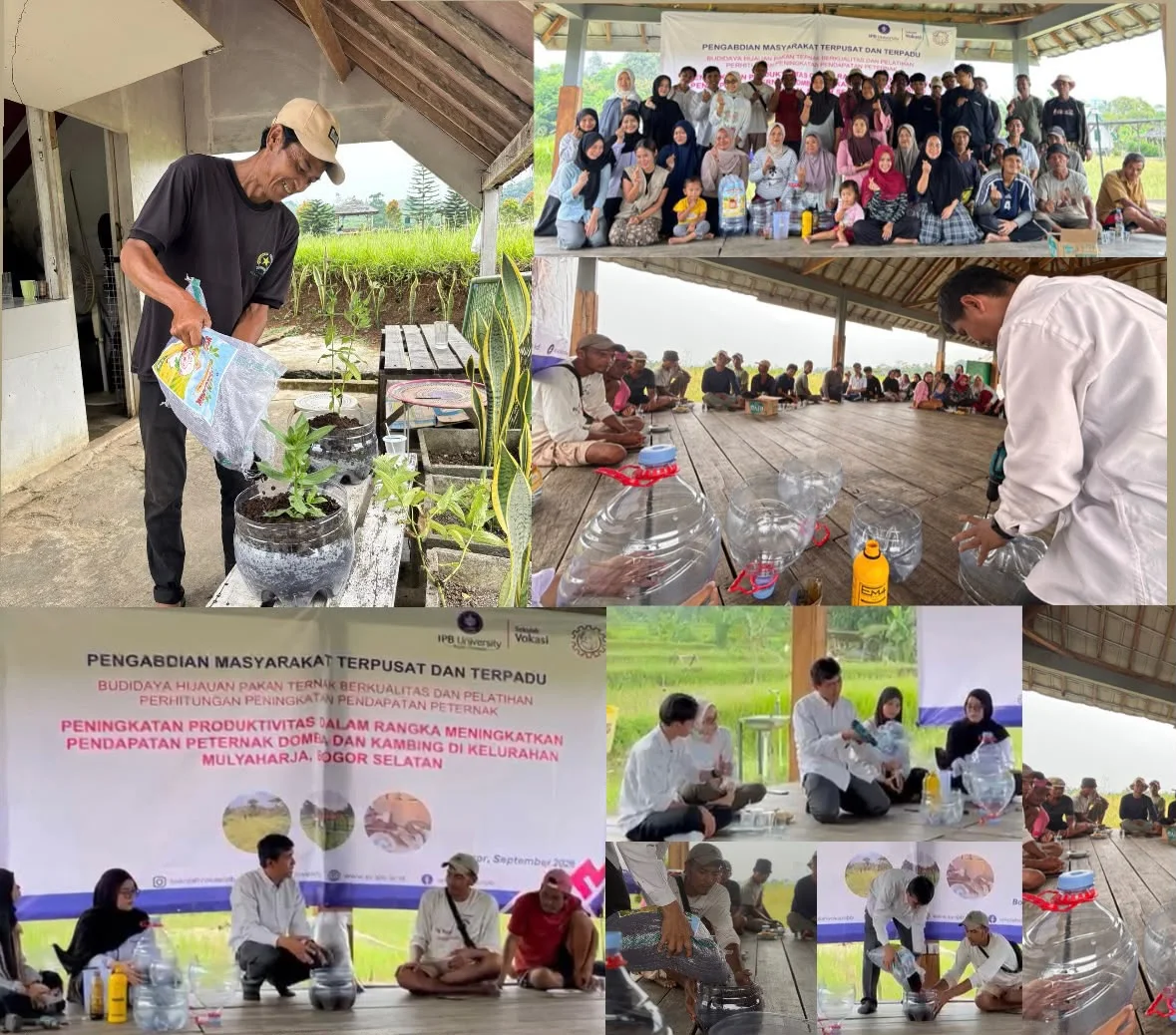
The program included practical training on making compost from sheep and goat manure, as well as planting various types of high-quality forage. Through this activity, farmers are expected to manage available resources more effectively and sustainably.
The Head of the TNK Study Program PPM at IPB Vocational School, Fariz Am Kurniawan, S.Pt., M.Si., explained that this composting training implemented an updated method by activating microorganisms before the composting process begins.
Unlike previous methods that did not include a microbial activation stage, this approach is designed to optimize the activity of microorganisms in decomposing organic matter derived from sheep and goat manure.
“Through this updated method, it is hoped that the composting process will be more optimal and produce more mature compost that can be used as organic fertilizer to support the growth of forage,” explained Fariz.
Farmers Equipped with Skills to Process Waste into Organic Fertilizer
The composting training is a continuation of a series of previous PPM activities that addressed efforts to increase farmers' income, as stated by Nurul Fikri.
During the activity, farmers were introduced to the concept of integrated farming system This concept emphasizes the optimal use of livestock resources, including processing livestock waste into organic fertilizer that can be reused to support forage production.
Levanda Gevansa, a student of the Livestock Technology and Management Study Program at IPB Vocational School, provided an explanation regarding the composition of materials and the technical stages of processing livestock manure into compost.
Levanda explained that the composting process begins by preparing a bioactivator solution consisting of 150 milliliters of EM4, 150 milliliters of molasses, and 15 liters of water. These three ingredients are mixed in a ratio of 1:1:100.
The bioactivator solution is then activated for three to four days to optimize microorganism activity. After the activation process is complete, the solution is mixed evenly with 150 kilograms of sheep and goat feces as the main ingredient for the compost.
The mixture then undergoes a composting process for approximately 21 days until it produces organic fertilizer that can be used to support the growth of forage crops.
Through this training, farmers not only gained an understanding of waste processing techniques but were also equipped with practical skills to produce organic fertilizer independently.
Utilizing livestock manure as compost material is expected to reduce livestock waste while providing economic added value. The resulting fertilizer can be used for their own land needs and has the potential to be developed as an additional business product.
Planting Forage on 450 Square Meters of Land
In addition to the composting practice, the PPM activity also included the planting of various types of high-quality forage on a plot of 450 square meters.
The types of forage planted include biovitas, biogras, bionutris, and pakchong. The planting was carried out collectively by local farmers and students of the Livestock Technology and Management Study Program at IPB Vocational School, including Farhan Herdiansyah and Kaka Fauzi.
This activity aims to introduce the use of available land as a source of livestock feed that can be managed independently by farmers.
The availability of forage is a crucial factor in supporting livestock productivity, especially for sheep and goat farmers. By developing their own feed crops, farmers are expected to reduce their dependence on external forage supplies.
Planting high-quality forage is also part of implementing an integrated farming system, which connects livestock activities with agricultural land management.
In this system, livestock manure can be processed into compost to fertilize the land, while the resulting forage crops are utilized back as livestock feed.
This cycle of resource utilization is expected to help farmers increase business efficiency, maintain feed availability, and open opportunities for sustainable business development.
Collaboration Between University and Community
The PPM implementation was also attended by the Secretary and Head of the TNK Study Program Research Team for the year 2026, Dr. Sari Putri Dewi, S.Pt., M.Si., as well as teaching assistants and students from the Livestock Technology and Management Study Program at IPB Vocational School.
Also present were the Mulyaharja Field Agricultural Extension Worker (PPL), Agus Faisal, and the Village Coordinator, Mansyur, who supported the implementation of activities with the local community.
The presence of these various parties demonstrates the importance of collaboration between universities, extension workers, and the community in promoting the application of appropriate technology in the livestock sector.
This activity received a positive response from the Mulyaharja Village community. The participants' enthusiasm was evident from their involvement during the practice sessions and interactive discussions with the service team.
The farmers had the opportunity to learn firsthand about composting techniques and understand the potential of utilizing land to produce high-quality forage.
Through this Community Service Program, the IPB Vocational School hopes that the knowledge and skills provided will not stop at the training activity but can be applied sustainably in daily livestock business management.
The synergy between the university, agricultural extension workers, and the community is expected to strengthen farmers' independence, increase business productivity, and create new economic opportunities through the optimal use of local resources.


Comments 0
Write a Comment Share your response