

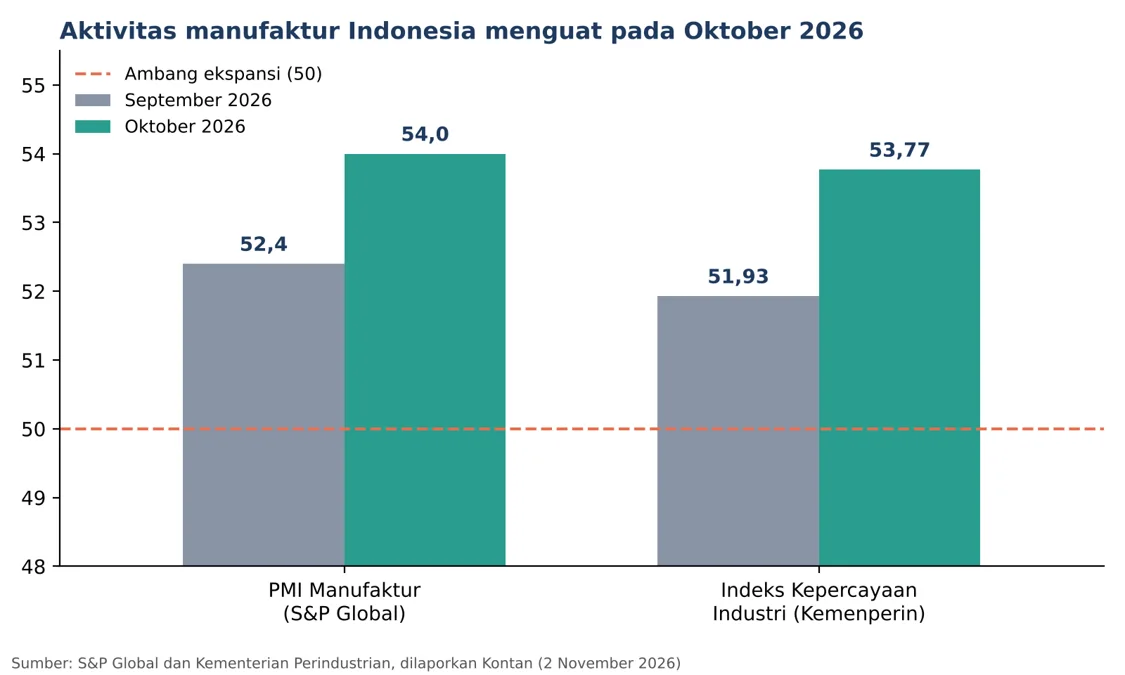
JurnalPost.com - In early November 2026, encouraging news emerged from Indonesia's manufacturing sector. Purchasing Managers' Index (PMI) for Indonesian manufacturing rose to 54.0 in October 2026, up from 52.4 in September. This figure represents the highest level since March 2024 and indicates that industrial activity is in an expansion phase.
This increase is certainly worth welcoming with optimism. However, behind these positive figures, an equally important question arises: does a higher PMI mean that factories in Indonesia are already working at full capacity?
This question is worth examining from the perspective of Operations and Production Management, as increased manufacturing activity does not necessarily mean that all production resources are being utilized optimally.
Understanding PMI and the Meaning of Industrial Expansion
The PMI is an economic indicator compiled based on monthly surveys of purchasing managers in manufacturing companies. This survey assesses changes in several operational aspects, such as new orders, production, employment, supplier delivery times, and raw material inventories.
Simply put, a PMI value above 50 indicates expansion, while a value below 50 indicates contraction. A value of 50 signifies conditions that are relatively unchanged compared to the previous month.
With the PMI reaching 54.0, Indonesia's manufacturing activity shows strengthening compared to the previous month. However, that figure does not mean that industrial production capacity has been utilized at 54 percent or that most factories are operating at full capacity.
This is an important distinction to understand. The PMI describes the direction of change in industrial activity, not the level of production capacity utilization.
Rising Index Does Not Necessarily Mean Full Factory Capacity
Imagine a factory has a production capacity of 1,000 units per day, but has only been producing 600 units. When demand increases and production rises to 650 units, the factory is experiencing expansion.
However, that increase in production does not mean its entire capacity has been utilized. There is still room to increase output without immediately adding production facilities.
A similar condition can occur in a factory that is already using 90 percent of its capacity. When production increases even slightly, its activity also shows growth, although the room for expansion is much more limited.
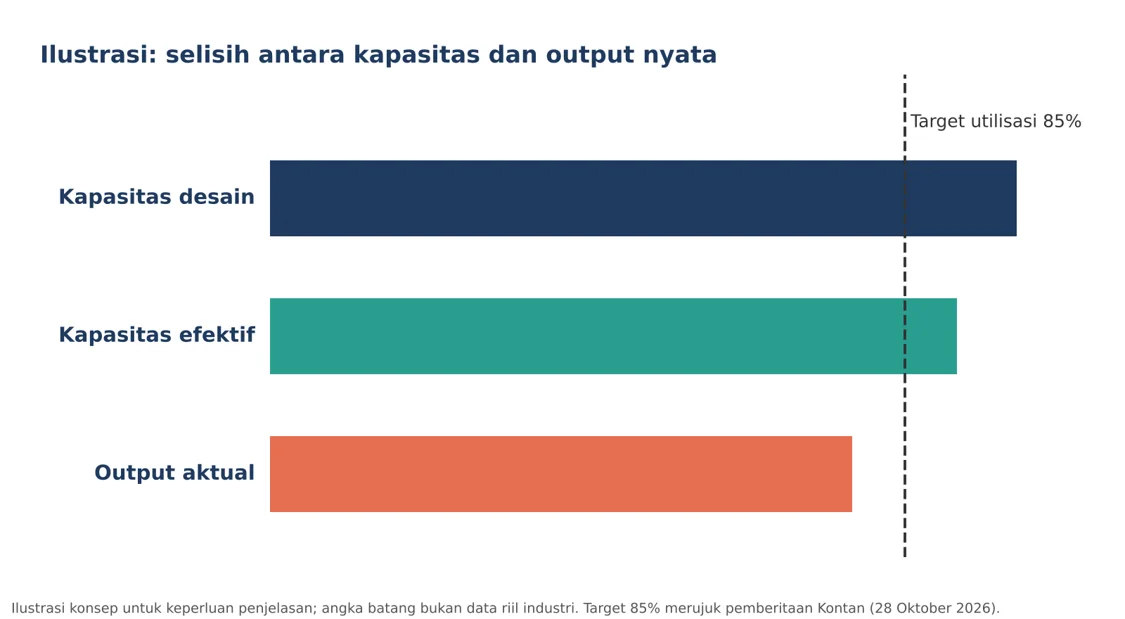
Both factories are experiencing increased production, but they face different operational conditions.
Therefore, the rise in PMI needs to be read alongside other indicators so that we do not misjudge the overall state of the industry.
Capacity Utilization as a Measure of Operational Performance
In Operations and Production Management, one of the key indicators for assessing the utilization of production facilities is the capacity utilization rate.
Utilization shows the ratio between actual output and available design capacity. Meanwhile, capacity efficiency can be seen by comparing actual output to effective capacity.
Design capacity is the theoretical maximum production capability. Effective capacity takes into account various operational constraints, such as machine maintenance schedules, equipment setup times, and normal working conditions.
Actual output is the production result truly achieved by the company.
As an illustration, a factory has a design capacity of 1,000 units per day and an effective capacity of 850 units. If its actual output is only 650 units, the utilization of design capacity has only reached 65 percent, while efficiency against effective capacity is around 76.5 percent.
This difference shows that an increase in production cannot be judged solely by growth in orders or business activity.
In a Kontan report on 28 October 2026, the government was reported to be targeting manufacturing industry utilization to reach 85 percent, from a level still in the range of 70 percent.
This target shows that there is room to increase the utilization of already available industrial capacity.
Investment Stalled, Production Challenges Increase
Another issue that needs attention is industrial investment.
In a Kontan report on 2 November 2026, the strengthening of manufacturing PMI was said to not yet be fully followed by an increase in investment and labor absorption.
This condition poses a distinct challenge for company operations management.
When demand increases, but investment in machinery or the construction of new facilities remains stalled, companies need to find ways to maximize the capacity they already have.
If capacity is not yet being used optimally, improving work processes can be a solution. However, if effective capacity is already nearing its limit, companies risk facing order backlogs, delivery delays, increased overtime costs, and pressure on product quality.
This is where the capability of operations management is truly tested.
Based on the third-quarter 2026 economic growth data, the manufacturing industry contributed 1.20 percentage points to the national economic growth, which reached 5.47 percent.
This contribution shows the importance of the manufacturing industry as a driver of the national economy. However, to maintain sustainable growth, increased output must be accompanied by productivity and good resource management.
What Should the Industry Do?
In my opinion, there are several steps that manufacturing companies can take so that the expansion of industrial activity is also followed by an increase in operational performance.
Identify production bottlenecks (bottleneck). Companies need to identify the production stages that act as the main constraints. Based on the Theory of Constraints, the overall output capability of a system is heavily influenced by the process that most limits the flow of production.
Implement realistic aggregate planning. Companies must be able to balance market demand with production capacity, labor force, operational schedules, and inventory levels.
Carry out preventive machine maintenance. Scheduled maintenance can reduce the risk of sudden breakdowns that cause production processes to stop.
Control raw material inventory. Too little inventory can hinder production, while excessive stock increases storage costs and ties up working capital.
Apply the principles of lean manufacturing. Companies need to reduce waste, such as waiting times, defective products, processes that do not provide added value, and unnecessary material movement.
These steps show that increasing capacity does not always have to start with purchasing new machines. In some conditions, improving the production system can provide faster and more efficient benefits.
Industrial Growth Must Be Followed by Productivity
Indonesia's manufacturing PMI reaching 54.0 is a positive development. This figure indicates a strengthening of industrial activity and provides hope for national economic growth.
However, we must not stop at the conclusion that a rise in PMI means all factories are working optimally.
For me, indicators of industrial growth need to be viewed more comprehensively. In addition to paying attention to the PMI, companies and policymakers also need to evaluate capacity utilization, labor productivity, process efficiency, and investment readiness.
This is because an industry that continues to receive orders is not necessarily capable of producing products in the most efficient way.
Ultimately, manufacturing success is not only determined by how fast the production wheels turn, but also by how well a company manages its capacity and resources.
The PMI may be up, but the question of how full and how efficiently our factories are operating must still be answered.
Data Sources and References
Kontan. (2 November 2026). Indonesia Manufacturing PMI Breaks 54.0, Industrial Investment Still Stalled.
Kontan. (28 October 2026). Pursuing the Manufacturing Industry Utilization Target of 85%.
BCA Sekuritas, Daily News. (5 November 2026). Manufacturing Industry Contributes 1.20 Percent of 5.47 Percent Growth.
Ministry of Finance of the Republic of Indonesia. (3 November 2026). Manufacturing Strengthens, External Sector Performance Remains Positive.










Comments 0
Write a Comment Share your response