

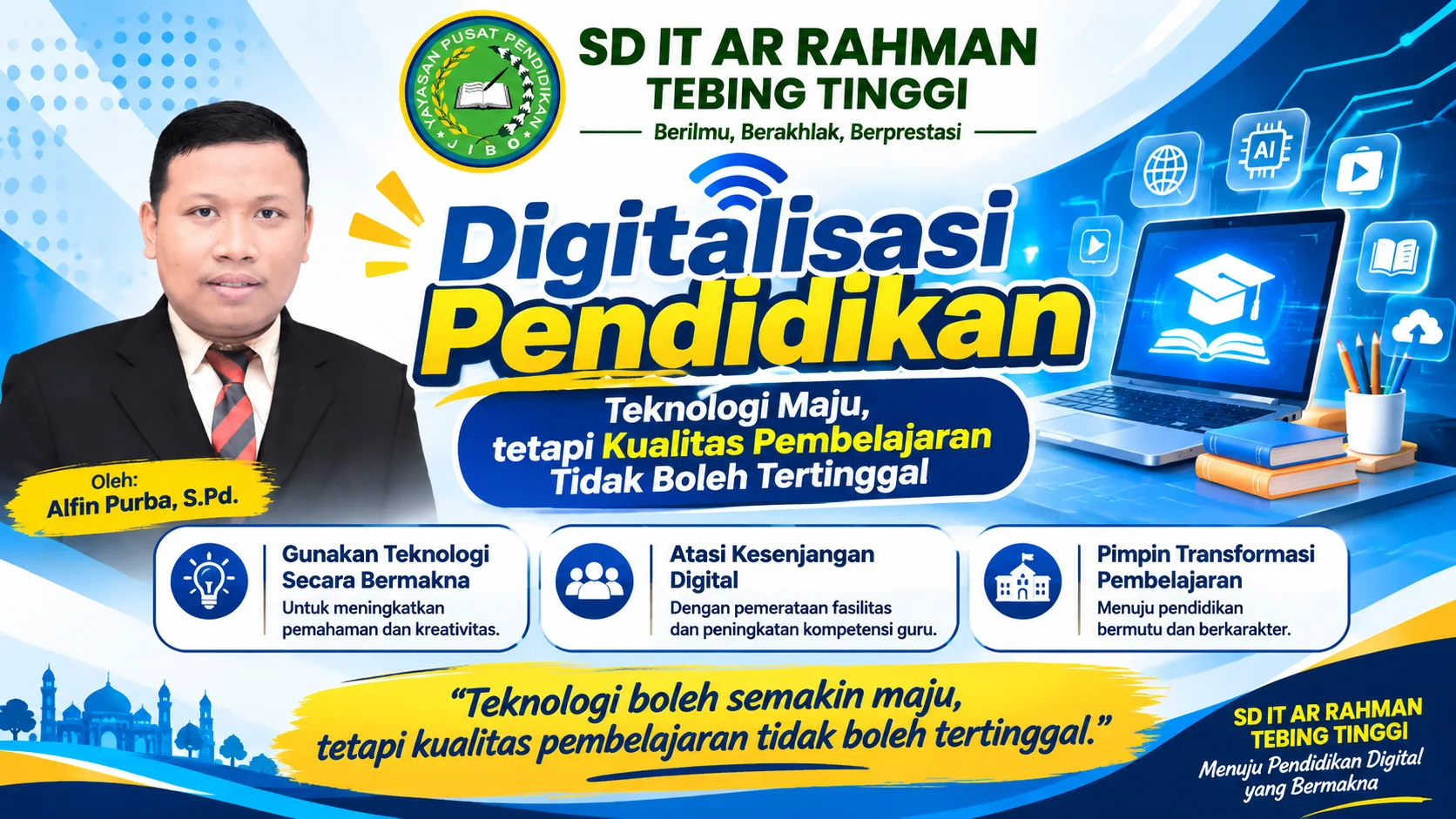
JurnalPost.com - The development of digital technology has brought major changes to various areas of life, including education. Today, the use of computers, laptops, the internet, interactive projectors, digital learning platforms, and even artificial intelligence (Artificial Intelligence/AI) is becoming increasingly common in schools. Educational digitalization has even become a key direction in efforts to improve the quality and equity of education in Indonesia.
However, behind this progress lies a fundamental question that needs reflection: has the use of technology in schools truly improved the quality of learning, or are schools simply becoming busier using digital devices without any meaningful change in the teaching and learning process?
This question is important because the success of education should not be measured by the number of technological devices available, but by the extent to which that technology helps students understand material, develop critical thinking skills, enhance creativity, and build character.
Digitalization Is More Than Replacing Chalkboards with Screens
One misconception in the implementation of educational digitalization is the belief that learning has become modern simply because teachers use laptops, projectors, or digital applications. In reality, the use of technology does not automatically make learning higher quality.
In practice, there is still learning that merely transfers material from books to presentation screens. Teachers deliver material via PowerPoint, students watch the presentation, and then complete assignments digitally. The media used has changed, but the pedagogical approach has not necessarily evolved.
The main issue lies not in the technology, but in how technology is utilized to improve the pedagogical process. Quality learning requires interaction, dialogue, exploration, problem-solving, collaboration, and meaningful learning experiences.
UNESCO, through its Global Education Monitoring Report 2023: Technology in Education – A Tool on Whose Terms? emphasizes that technology should be used based on student needs, contextual relevance, equitable access, and evidence of its benefits. Technology must complement human interaction in learning, not replace the role of the teacher.
This means that the success of educational digitalization is not sufficiently measured by the availability of devices, but must be viewed through changes in the quality of the students' learning experience.
The Digital Divide and the Challenge of Teacher Quality
The next challenge is the gap in facilities and the ability to utilize technology. Not all schools have the same infrastructure conditions. Some schools are supported by stable internet networks, adequate learning devices, and prepared human resources. Conversely, there are still schools facing limitations in electricity, internet access, hardware, and technical support.
The Indonesia Education Report 2025 published by the Center for Education Standards and Policy shows that information and communication technology facilities in educational units are not yet evenly distributed. Several regions, particularly in eastern Indonesia, still face greater limitations in ICT facilities compared to other areas.
This condition shows that educational digitalization cannot be implemented with a uniform approach. Policies that succeed in urban schools cannot necessarily be applied directly to schools with limited infrastructure.
Beyond facilities, teacher competence is also a determining factor. It is not enough for teachers to simply be able to operate applications or use digital devices. Teachers need to understand how to select technology that aligns with learning objectives, student characteristics, and the material being taught.
This is where the importance of continuous professional development for teachers lies. Digitalization training should not stop at introducing applications but must touch upon learning design, pedagogical strategies, learning outcome evaluation, digital literacy, and the ethical and responsible use of technology.
Principals Must Lead the Transformation of Learning
Educational digitalization is also a matter of school management. Principals have a responsibility to ensure that technology investments truly provide benefits toward improving the quality of learning.
From the perspective of educational management, it is not enough for a principal to act merely as an administrator and provider of facilities. Principals need to exercise instructional leadership by guiding teachers to utilize technology appropriately.
There are three important steps that can be taken:
Develop a digitalization program based on learning needs. Schools need to develop digitalization programs oriented toward learning needs. The procurement of devices must be based on a needs analysis, not just following technological developments or policy trends.
Strengthen teacher competence continuously. Schools need to strengthen teacher competence through learning communities, practice-based training, peer mentoring, and academic supervision. Teachers need to be given the opportunity to try, evaluate, and improve digital-based learning.
Build a monitoring and evaluation system. Principals must build a monitoring and evaluation system. The use of technology needs to be measured based on its impact on student engagement, material comprehension, assessment quality, and the development of their competencies.
In this way, digitalization becomes part of a school's quality improvement strategy, rather than just a facility procurement program.
Returning the Purpose of Technology to Student Interests
In my view, the biggest problem with educational digitalization is not a lack of technology, but the fact that the orientation of technology use toward student learning needs is not yet optimal.
Schools must be brave enough to evaluate whether every device and application used truly provides benefits. If the use of technology actually makes students more passive, increases dependency, or reduces social interaction, then the learning approach needs to be improved.
The government needs to ensure the equitable distribution of digital infrastructure, especially for schools that are still lagging behind. Local governments need to provide technical support and teacher competency improvement programs tailored to the conditions of each region.
Meanwhile, educational units need to have clear indicators of digitalization success. These indicators should not only be the number of devices, the number of applications, or the amount of training activities, but also the improvement in learning quality and student outcomes.
Teachers must also be encouraged to develop learning that combines technology with conventional methods proportionally. Not all learning activities must use screens. Direct discussion, reading books, practice, experiments, and social interaction remain important parts of education.
Technology Must Strengthen, Not Replace Education
Educational digitalization is an unavoidable necessity. However, technological progress must not cause the world of education to lose its primary orientation: building human beings who are knowledgeable, have character, are creative, and are capable of facing the changes of the times.
An advanced school is not the one with the most digital devices, but the one capable of using technology appropriately to create meaningful learning.
It is time that the success of educational digitalization is no longer measured only by how sophisticated the technology a school possesses is, but by how much positive change is felt by the students.
Because while technology can accelerate access to information, the quality of education remains determined by the quality of the people managing it. Do not let educational technology advance while the quality of learning lags behind.
References
UNESCO. (2023). Global Education Monitoring Report 2023: Technology in Education – A Tool on Whose Terms? Paris: UNESCO.
Center for Education Standards and Policy. (2025). Indonesia Education Report 2025: Achievements and Improvement Agenda. Ministry of Basic and Secondary Education.
Republic of Indonesia. (2003). Law Number 20 of 2003 concerning the National Education System.







Comments 0
Write a Comment Share your response