

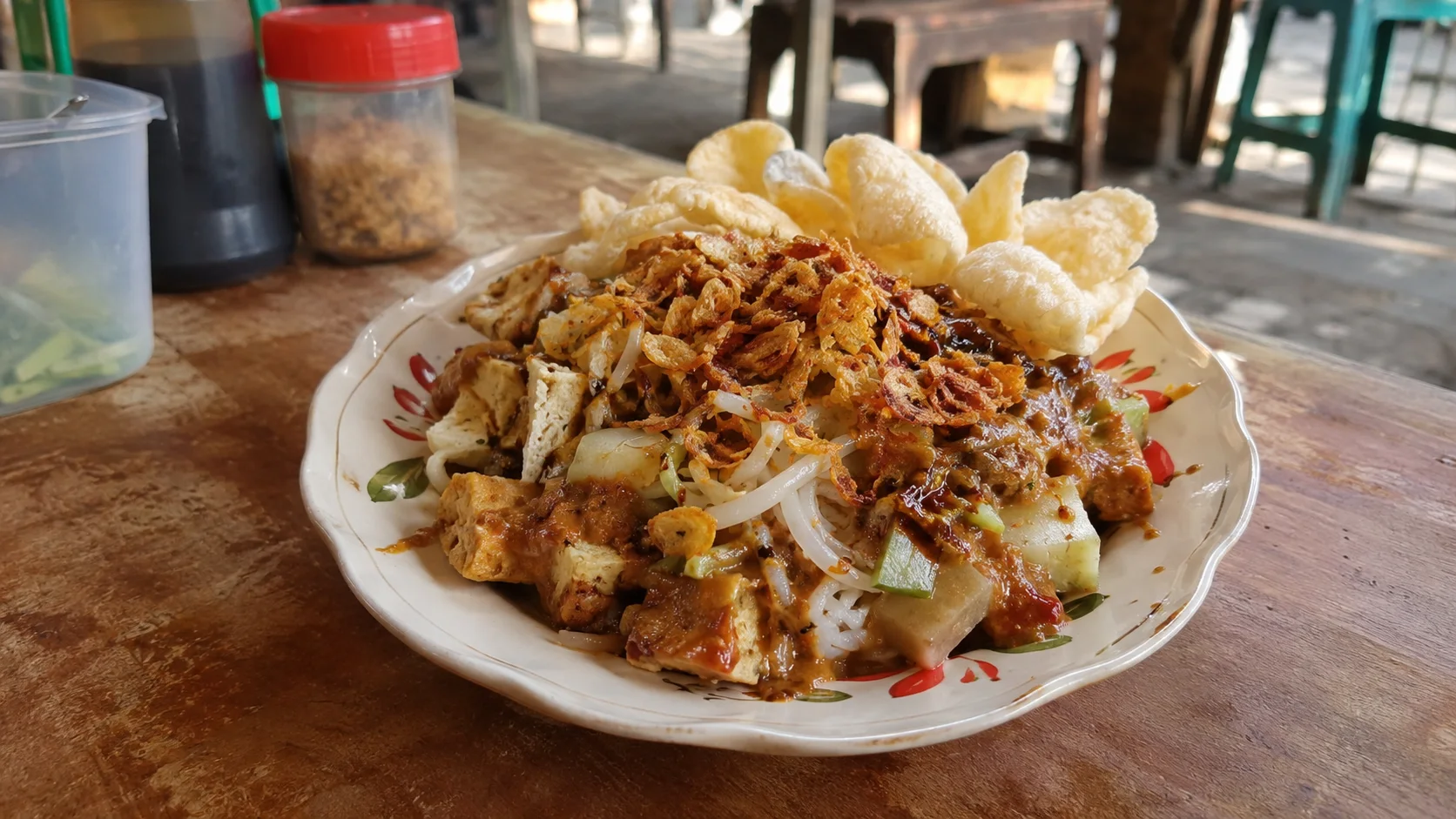
CIREBON, JurnalPost.com – In an alleyway in the Sunyaragi area of Kesambi District, Cirebon City, a husband and wife operate a modest culinary business called Ketoprak Sedap Malam. Without any employees, the couple manages all business activities, from preparing raw ingredients and cooking to serving customers.
Although run on a small scale, the business located on Gang Jalak II, Sunyaragi, manages to sell an average of 35 portions of ketoprak daily.
This performance caught the attention of students from the Management Study Program at the Faculty of Economics and Business, Universitas Swadaya Gunung Jati (UGJ) Cirebon, who conducted a business feasibility study on the establishment.
The study results indicate that Ketoprak Sedap Malam maintains a healthy sales volume relative to its break-even point. With a minimum requirement of approximately five portions per day to cover costs, average sales are seven times that threshold.
However, these results do not fully guarantee long-term sustainability. The study team assigned a rating of "Conditional GO", meaning the business has potential for continuation but still requires verification of several financial and operational aspects.
High Evening Demand
Ketoprak Sedap Malam experiences different sales patterns between the day and night.
During the day, the average number of customers is around 10. Meanwhile, at night, specifically from 19.00 to 22.00, the number of customers increases to approximately 20 or more.
The business attracts a diverse clientele, ranging from students and workers to the general public.
One of the competitive advantages identified in the study is the use of banana leaf-wrapped rice cakes (lontong). This presentation style distinguishes it from other ketoprak vendors in the Sunyaragi area.
Within a relatively short radius, there are several similar businesses, including Ketoprak Primadona, located about 200 meters away with a similar price point, and Ketoprak Al Jumhur Siti, located about 400 meters away with a price of Rp14,000.
The presence of these competitors makes food quality, pricing, and service critical factors in retaining customers.
Menu Options and Pricing at Ketoprak Sedap Malam
Ketoprak Sedap Malam offers several menu options at relatively affordable prices.
The following is the price list recorded in the study:
Original Ketoprak: Rp12,000
Egg Ketoprak: Rp15,000
Indomie Ketoprak: Rp17,000
Indomie + Egg Ketoprak: Rp20,000
Extra Crackers: Rp2,000
This menu variety provides options for customers based on their preferences and purchasing power.
However, the study team noted that production cost calculations for each menu item still need to be performed in greater detail to determine the specific profit margin for each product.
Profit of Rp3,000 per Portion and a Low Break-Even Point
A key component of this study is the analysis of production costs and business profitability.
For the Original Ketoprak sold at Rp12,000, the cost of goods sold (COGS) is estimated at Rp9,000 per portion.
These costs include rice cakes Rp1,500, fried tofu Rp2,000, vermicelli, bean sprouts, and cucumber Rp1,500, peanut sauce and shallots Rp2,500, crackers and soy sauce Rp1,000, as well as gas, oil, and tissues Rp500.
Based on these calculations, each portion of Original Ketoprak provides a contribution margin of Rp3,000 to cover fixed costs and generate profit.
The business's fixed costs are estimated at Rp450,000 per month, consisting of stall rent Rp400,000 and electricity Rp50,000.
Based on a sales simulation of 35 portions per day at a price of Rp12,000, the business turnover is estimated to reach Rp420,000 per day or approximately Rp12.6 million over 30 days.
After accounting for variable and fixed costs included in the simulation, the monthly profit is estimated to reach Rp2.7 million.
However, this figure does not yet include owner wages, equipment depreciation, and several other operational costs that have not been accounted for.
The break-even point (BEP) for the business is estimated at 150 portions per month. With an average sales volume of 1,050 portions per month, the business has a margin of safety of approximately 85.7 percent.
This means that, based on the simulation assumptions, sales remain well above the minimum threshold required to cover costs.
Rising Raw Material Costs as a Primary Threat
Although sales performance is considered good, Ketoprak Sedap Malam faces challenges from fluctuating raw material prices.
The contribution margin of only Rp3,000 per portion makes business profits quite sensitive to increases in production costs.
In the simulation conducted by the team, a 5 percent increase in raw material prices could reduce monthly profit to approximately Rp2,227,500.
If raw material costs increase by 10 percent, profit is estimated to drop to Rp1,755,000. Meanwhile, a 15 percent increase would shrink profits to around Rp1,282,500 per month.
Conversely, if the number of customers decreases by 20 percent with the same cost structure, the simulated profit would still be in the range of Rp2,070,000 per month.
These calculations demonstrate that controlling raw material costs is a key factor in maintaining profitability.
The team also examined the possibility of adjusting the selling price.
If raw material costs increase by 10 percent and the price of Original Ketoprak is raised from Rp12,000 to Rp13,000, the simulated profit could reach Rp2,805,000 per month, assuming the number of customers remains unchanged.
However, any price increase must consider customer purchasing power and competition from other ketoprak vendors.
Three-Year Business Projection
The study also developed a three-year business growth projection using three scenarios: optimistic, moderate, and pessimistic.
In the optimistic scenario with a sales growth of 10 percent per year, monthly profit is estimated to increase from Rp2.7 million in the first year to Rp3,015,000 in the second year and Rp3,361,500 in the third year.
In the moderate scenario with a growth of 5 percent per year, the simulated profit is estimated to reach Rp2,857,500 in the second year and Rp3,022,875 in the third year.
Meanwhile, in the pessimistic scenario with a sales decline of 5 percent each year, profit is still projected to be around Rp2,542,500 in the second year and Rp2,392,875 in the third year.
All these figures are projections based on assumptions of selling price and fixed cost structures, not actual financial results for future periods.
Therefore, changes in raw material prices, competitive conditions, and consumer behavior must continue to be monitored.
Business Legality and Financial Recording
Regarding legality, Ketoprak Sedap Malam is registered with a Business Identification Number (NIB) issued on 12 July 2023 under the micro-enterprise category.
The owner also stated that they possess a halal certificate and meet relevant licensing and food safety requirements.
However, supporting documents other than the NIB still need to be further examined to ensure compliance.
In financial management, the owner uses manual ledger recording and a mobile phone application.
Meanwhile, promotional activities are conducted through social media to introduce the product and reach customers.
Study Results: Business Worth Continuing with Several Notes
Based on the various aspects analyzed, the student team assigned a status of "Conditional GO" to Ketoprak Sedap Malam.
This rating indicates potential for business sustainability but is not a final decision regarding overall business feasibility.
There are at least four matters that need to be resolved before a final conclusion can be reached: verification of actual turnover through transaction records over 14–30 days, calculation of COGS for all menu items, calculation of owner wages, and examination of legal documents.
If weaknesses are found that can still be corrected, such as excessively high production costs or inappropriate selling prices, the business may be categorized for improvement or REVISE.
Meanwhile, the option of changing the business model or REPLACE is only considered if the business proves unsustainable despite reasonable improvements.
This study also provides lessons for micro, small, and medium enterprises (MSMEs) regarding the importance of transaction recording, production cost calculation, raw material price monitoring, and understanding competitive conditions.
Small businesses with seemingly high sales do not necessarily generate large profits if production costs are not precisely controlled.
Conversely, a simple business with organized financial records and an understanding of its break-even point can have a stronger foundation to maintain and grow its business.
About the Author
Huda Fadhlunnisa is a student of the Management Study Program, Faculty of Economics and Business, Universitas Swadaya Gunung Jati, Cirebon.
This article was developed from a Business Feasibility Study course assignment under the guidance of Sandi Nasrudin Wibowo, S.E., M.M., MCE, based on the Project Charter of the PT Achiki group, compiled with Fahlevy Apik Kurnia and Khairunnisa Salsabila Gunawan.







Comments 0
Write a Comment Share your response