


SURABAYA, JurnalPost.com — Foreign language proficiency and the use of artificial intelligence (AI) are becoming essential skills for tourism sector professionals. These skills are considered necessary not only for tour guides but also for travel drivers who interact directly with tourists throughout their journeys.
This initiative was carried out by a Community Service (PkM) team from the State University of Surabaya (Unesa) through a program titled “Strategic Adaptation of the Lintas Karya Muda Tourism Bureau MSME in Business Model Transformation Through Strengthening Multi-role Drivers (Driver-Translator-Tour Guide) Based on Mandarin Language Training and the Use of Free-AI from China.”
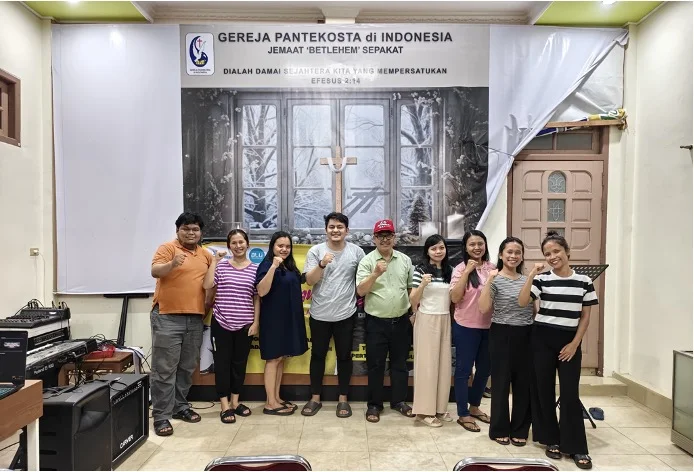
The program, which involved Unesa lecturers and students, collaborated with the Lintas Karya Muda Tourism Bureau MSME. The activity took place at Kedai Sedjiwa 32, Jalan Praban 32, Surabaya, on September 23, 2026.
The training was designed to expand the role of travel drivers. Beyond their duty of transporting tourists, drivers are encouraged to possess basic skills as translators and travel companions or tour guides.
To support these skills, participants received basic Mandarin language training related to tourism activities. They were also introduced to several free AI technologies from China that can be used as learning tools or to assist in finding information when interacting with tourists.
The head of the Lintas Karya Muda MSME, Gindo Dusqi Pakulabang, stated that strengthening driver competence is a crucial step because drivers are among the individuals who interact most frequently with tourists during trips.
“Because drivers are essentially the people closest to and most often with the tourists, if they also possess sufficient Mandarin skills and understand the latest technology, service for Chinese tourists will be more optimal,” said Gindo.
According to him, the training is expected to provide drivers with basic communication skills in Mandarin while also understanding how to use AI technology to assist in their work.
“Ultimately, after this training, the hope is that the drivers will become more proficient in Mandarin, even if only at a basic level, and become more aware that there is AI technology that can quickly answer whatever is needed,” he continued.
Mandarin Training and AI Utilization
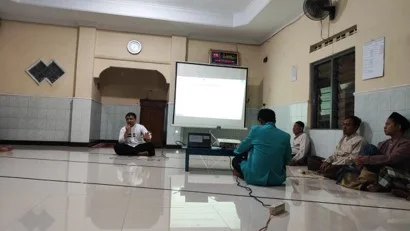
The training was conducted interactively. Yogi Bagus Adhimas, along with Unesa student Ananda Novia Safitri, took turns presenting material on the use of simple Mandarin for tourism needs and the utilization of AI technology.
The participants' enthusiasm was evident when several drivers photographed the material displayed on the slides using their mobile phones. The atmosphere became more relaxed when participants learned that all training materials would be shared for free after the session.
One of the Lintas Karya Muda travel drivers, Anang Setiawan, admitted that several Mandarin language materials and the use of AI were quite relevant to his work needs.
“There were some Mandarin sentences earlier that I really needed, so I took a photo. I also took a photo of how to use the AI so I wouldn't forget. But it turns out the files will be provided. Thank you to the team from Unesa,” said Anang.

Free AI for Sustainable Use
The selection of free AI platforms was a key focus of the program. The consideration was that the technology introduced to the drivers should remain usable after the activity concludes without adding any financial burden.
This approach is considered important so that the technology does not just become training material, but can truly be used in daily activities.
Mandarin can help drivers build basic communication with tourists from China, while AI can be utilized to look up vocabulary meanings, learn specific expressions, obtain conversation examples, and help find information needed during trips.
This learning model demonstrates that increasing human resource capacity does not always have to take place in a formal classroom. Materials can be adapted to work needs, making them easier to apply directly in the field.
For travel drivers, communication skills are important because they do not just act as drivers. In many tourist trips, drivers are often the first people asked about destinations, travel routes, food, shopping places, and basic information about the area being visited.
Therefore, foreign language proficiency and technological literacy have the potential to improve service quality while providing a better travel experience for tourists.
Encouraging Competence Improvement for Tourism Workers
The program was also linked to the Sustainable Development Goals (SDGs), specifically SDG 4 on Quality Education and SDG 8 on Decent Work and Economic Growth.
Improving language skills and technological literacy is expected to strengthen the competence of tourism workers while opening opportunities for service development that is more adaptive to the needs of international tourists.
The PkM activity also served as a space for collaboration between academics and business owners. Academics brought learning approaches and research-based knowledge, while business owners provided direct experience regarding needs and challenges in the field.
Through this approach, the Mandarin material does not stop at theory but is directed toward conversations that are likely to be encountered when accompanying tourists. AI technology is also introduced as a tool that can be used sustainably.
After the training is completed, drivers are expected to continue the learning process independently. For example, when they encounter Mandarin vocabulary or expressions they do not understand, they can utilize AI to search for meanings, usage examples, or alternative ways to communicate.
Thus, the learning process does not stop when the PkM activity ends. Drivers can continue to develop their skills while working, both when interacting with tourists and when preparing for their next trip.



Comments 0
Write a Comment Share your response