

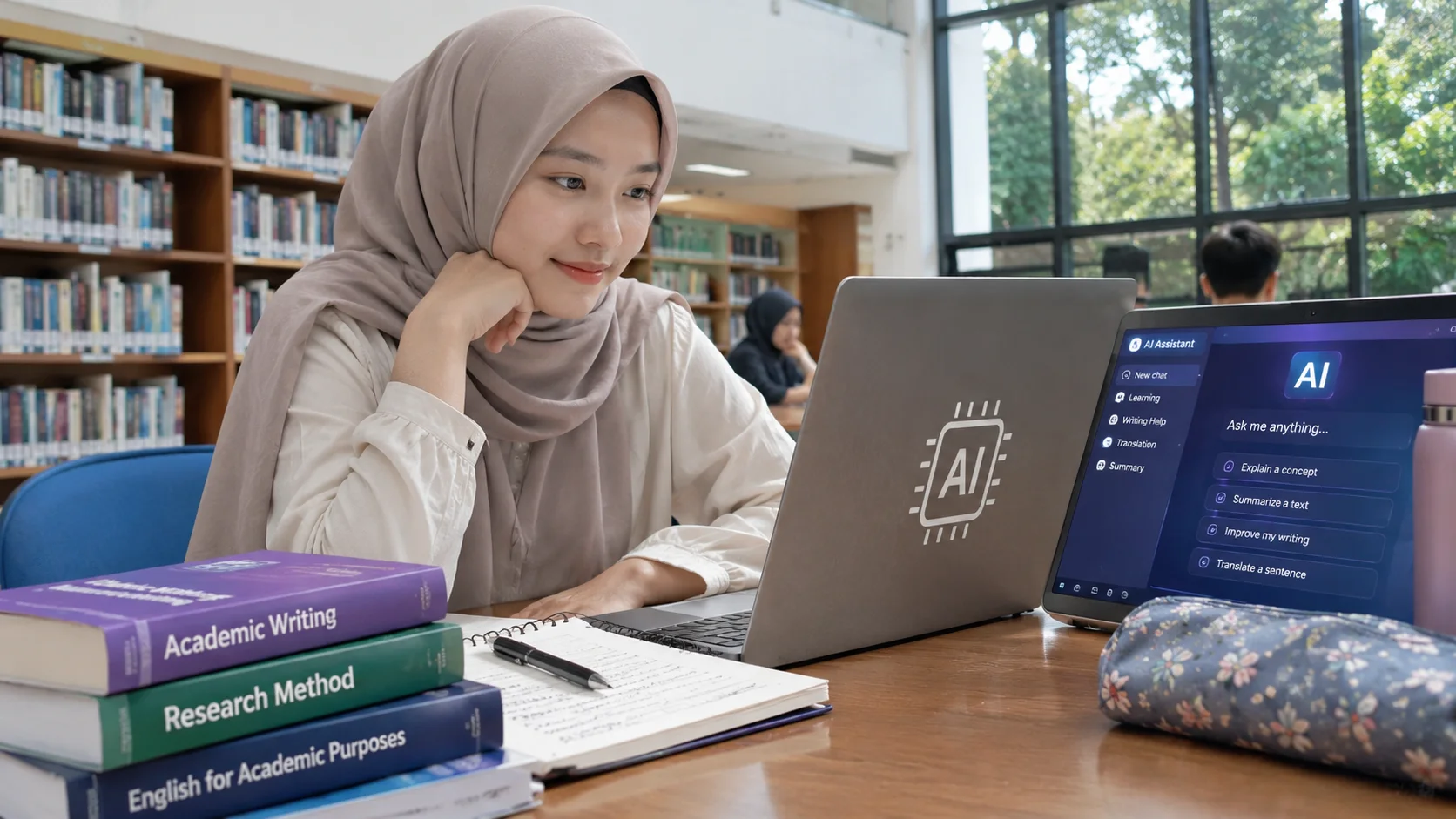
JurnalPost.com - The evolution of digital technology has brought significant changes to the world of education. One technology increasingly being utilized is Artificial Intelligence (AI). Its presence provides students with convenience in searching for information, understanding course materials, and assisting in the completion of various academic assignments.
Today, students no longer rely solely on books, lectures, or conventional learning sources. With the help of AI, various information can be obtained in a short amount of time. Students can even request explanations for difficult material using simpler, more understandable language.
For English Education students, for example, AI can be utilized to translate texts, understand vocabulary, improve sentence structure, and practice using foreign languages.
However, behind these conveniences, the use of AI also presents a number of challenges. Excessive reliance can diminish the habit of independent thinking, while the information generated by AI is not always accurate.
Therefore, students need to understand that AI should be used as a supporting medium for learning, not as a substitute for personal effort and critical thinking skills.
The Role of AI in Assisting Student Learning Processes
The presence of AI provides new opportunities for students to develop more flexible learning methods. This technology allows students to obtain additional explanations when they encounter difficulties in understanding course materials.
Through AI, students can ask questions, request practice problems, search for writing ideas, and obtain explanations for concepts they do not yet understand.
Research by Lin and colleagues (2026), which reviewed 394 empirical studies on the use of generative AI in higher education, shows that this technology is widely utilized to support academic activities, particularly in providing feedback, tutoring, and writing.
These findings demonstrate that AI has the potential to serve as a supporting tool for learning in higher education.
In addition to helping with material comprehension, AI can also assist students when working on assignments that require creativity and idea development.
For example, students who have difficulty determining an essay topic can use AI to obtain an initial overview. After that, students still need to develop ideas based on their own understanding and reasoning.
In foreign language learning, AI can also help explain the meaning of readings, provide examples of vocabulary usage, and correct grammatical errors.
This convenience makes the learning process more practical. Nevertheless, students should not accept all AI-generated answers without performing a verification process first.
AI Dependency and the Risk of Declining Critical Thinking Skills
Although it offers various benefits, excessive use of AI can lead to dependency.
This condition can occur when students become accustomed to delegating the entire assignment process to AI, from searching for information and structuring answers to drawing conclusions.
If this habit continues, students risk losing the opportunity to practice their critical thinking skills.
In fact, critical thinking is one of the essential skills in higher education. Students must be able to analyze information, compare opinions, ask questions, and draw conclusions based on logical reasoning.
An, Lu, and Yang (2026), through a systematic review of student dependency on generative AI, explain that excessive AI use can be associated with various negative consequences for independent learning processes.
Dependency can also affect a student's self-confidence.
For example, students who too frequently use AI to generate answers may experience difficulty when they have to explain the material using their own understanding.
They may become hesitant in expressing opinions because they are accustomed to obtaining answers instantly.
Furthermore, AI sometimes generates information that sounds convincing but is not necessarily correct or appropriate for the context of the question.
Therefore, students must continue to verify information through books, scientific journals, and other trusted sources.
Proper use of AI should help students understand an issue, not eliminate the thinking process they are supposed to perform.
AI Can Support Independent Learning
On the other hand, the appropriate use of AI has the potential to increase student independence.
This technology allows students to study material according to their individual needs and abilities, without always having to wait for direct explanations from lecturers.
Students can utilize AI to search for additional study materials, create practice questions, evaluate answers, and obtain explanations for mistakes made.
Wang and colleagues (2024), in their research on AI-assisted self-directed learning, found that the technology can be utilized to seek inspiration, develop ideas, and support writing activities.
This indicates that AI can help students develop initiative in learning if used in the right way.
Additionally, research by Vázquez-Parra and colleagues (2024) discusses the relationship between the use of AI technology and students' complex thinking skills.
The research highlights the importance of thinking skills in facing technological developments that are increasingly integrated with education.
In my opinion, the benefits of AI will be more apparent if students use it as a means to broaden their horizons.
For example, when assigned to write an essay, students should first determine the topic and formulate their own opinions. AI can then be used to help evaluate the structure of the writing or provide additional perspectives.
By doing so, students remain active participants in the learning process rather than just passive consumers of information.
Challenges of Academic Ethics and Information Accuracy
Beyond the issue of dependency, the use of AI also presents challenges in maintaining academic honesty and responsibility.
One risk that needs attention is plagiarism or the use of work without proper attribution.
Students who use AI to generate the entire content of an assignment without understanding or contributing their own thoughts risk losing the opportunity to develop their academic capabilities.
Moreover, not all assignments permit the use of AI in the same way. Therefore, students need to pay attention to the rules set by lecturers or the university.
Research by Zhai, Wibowo, and Li (2024) discusses the impact of excessive reliance on AI dialogue systems on students' cognitive abilities, including challenges related to the responsible use of technology.
Another risk is the accuracy of information.
AI can generate explanations that appear complete and well-structured, but they still carry the possibility of error. If students copy these answers directly without verification, misinformation can affect the quality of their academic work.
Privacy issues also require attention. Students should not carelessly input personal data, important documents, or confidential information into AI systems.
Therefore, AI literacy needs to be part of a student's digital skills. Users not only need to know how to operate the technology but also understand its limitations, risks, and responsibilities in its use.
Using AI Wisely in the Higher Education Environment
The utilization of AI in education should not be viewed as a threat. Conversely, this technology can be an opportunity to improve the quality of learning if used wisely.
Students can start by getting into the habit of understanding material independently before asking for AI assistance.
When facing difficult problems, AI can be used to obtain additional explanations. However, the answers provided must be analyzed, compared, and re-checked through relevant sources.
Students should also use AI to support creativity, not to replace the process of generating ideas.
In writing activities, for example, AI can help check grammar and provide input on the structure of the writing. However, the substance of the arguments and conclusions should still reflect the author's understanding.
The role of lecturers is also important in providing guidance on the responsible use of AI. Students need to understand the boundary between using technology as a learning aid and delegating all academic work to automated systems.
With this balance, AI can become a learning medium that helps students improve their knowledge, skills, and independent thinking abilities.
AI as a Tool, Not a Substitute for Student Ability
The development of artificial intelligence is part of a technological shift that is difficult to separate from the lives of students today.
AI offers various conveniences, ranging from information retrieval, foreign language translation, and material comprehension to idea development in the preparation of academic assignments.
However, these conveniences must be balanced with critical thinking, creativity, and responsibility in using the technology.
Students should not make AI a shortcut to complete all work without understanding the process.
Instead, AI needs to be utilized to deepen understanding, broaden horizons, and improve independent learning skills.
In my view, the success of AI use in education is not measured by how fast students complete assignments, but by how much the technology helps them understand the material and develop their own capabilities.
Ultimately, AI can be a beneficial learning medium in the digital era. However, artificial intelligence must remain a support for human intelligence, not a replacement for the effort, creativity, and thinking ability of students.
Bibliography
An, C., Lu, K., & Yang, J. (2026). The dependency trap: A systematic review of the contributing factors and consequences of student over-reliance on generative AI in higher education. Humanities and Social Sciences Communications, 13, 1604.
Lin, M. P.-C., Chang, D. H., Winne, P. H., Bowen, G. M., & Ryoo, J. (2026). Mapping generative AI in higher education teaching and learning: A scoping review. International Journal of Educational Technology in Higher Education, 23, 55.
Vázquez-Parra, J. C., et al. (2024). Complex thinking and adopting artificial intelligence tools: A study of university students. Frontiers in Education, 9, 1377553.
Wang, C., Li, Z., & Bonk, C. (2024). Understanding self-directed learning in AI-assisted writing: A mixed methods study of postsecondary learners. Computers and Education: Artificial Intelligence, 6, 100247.
Zhai, C., Wibowo, S., & Li, L. D. (2024). The effects of over-reliance on AI dialogue systems on students' cognitive abilities: A systematic review. Smart Learning Environments, 11, 28.









Comments 0
Write a Comment Share your response