

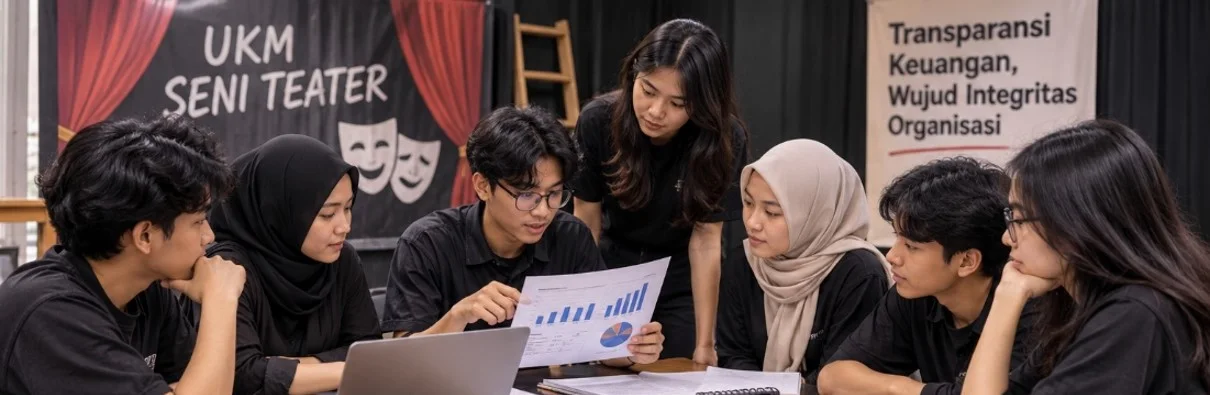
JurnalPost.com - Student organizations are more than just platforms for developing interests, talents, and creativity. Within them, students also learn to collaborate, make decisions, and manage responsibilities. One such responsibility that requires attention is the management of organizational finances. Although often viewed as a mere administrative task, financial transparency has a significant impact on an organization's sustainability.
Every organizational activity requires funding, ranging from routine rehearsals, performances, and equipment procurement to refreshments and other operational needs. These various requirements necessitate that organizations manage their funds in a planned manner.
Therefore, financial management is not merely about recording income and expenses. Information regarding the use of funds must also be communicated clearly so that it can be understood and accounted for to the members.
Financial Transparency in Student Organizations
This issue has become a focus in the financial management of the Theater Arts Student Activity Unit (UKM). Based on interviews with seven informants from the board and general membership, it is known that the organization has been using spreadsheets to record income and expenses.
Organizational funds are derived from student activity budgets, member dues, inventory rentals, and additional fundraising activities. Meanwhile, expenditures are used to support performance needs and various organizational activities.
The board has also prepared a Budget Plan (RAB) before activities and an accountability report (LPJ) after activities are completed. Information regarding cash balances and members who have not yet paid is usually communicated periodically.
For some activities, the status of balances and budgets is also shared during initial meetings or kick-offsessions. This mechanism shows that efforts to record and communicate financial information have indeed been implemented within the organization.
Although this mechanism is in place, interview results indicate that information openness is not yet felt equally by all members.
Some informants consider the communication of financial information to be quite good because there is routine recording and notification of cash status. However, other informants noted that information updates are sometimes delayed. Furthermore, access to financial reports is not yet easily obtained by all members.
Other obstacles relate to members' understanding of the use of organizational funds. Some members do not yet understand in detail the nominal budget used for activities.
Informants also mentioned expenditures that sometimes exceed the RAB and delays in member dues payments. Additionally, the process for fund reimbursement or reimbursement is not fully understood by all members.
This condition cannot immediately be considered evidence of corruption. However, these various obstacles indicate risks in financial governance that need to be addressed.
Available records do not necessarily guarantee transparency if information is difficult for members to access. Risks can also arise when transaction evidence is incomplete or the use of funds is not adequately explained.
Transparency and accountability play a crucial role in building organizational integrity. Transparency allows members to know how funds are managed and used. Meanwhile, accountability ensures that those responsible are able to explain every decision and the use of funds.
The OECD (2020) identifies transparency and accountability as essential elements in building integrity and preventing the risk of irregularities.
Building an Integrated Financial Management System
Therefore, one effort that can be implemented is to build an integrated financial management system based on spreadsheets digital.
This system does not have to use complicated or expensive applications. The use of spreadsheets can be a viable choice because it is relatively easy to implement and adapt to the organization's needs. With organized management, this medium can function as a tool for both recording and communicating financial information.

In this system, every transaction needs to be recorded by including the date, source of income, amount, purpose of expenditure, person in charge, and balance.
Complete records will help the board track every change in the organization's financial condition. Transaction evidence such as receipts, invoices, or transfer proofs also needs to be archived.
If transaction evidence is unavailable, expenditures must be accompanied by a written explanation so they can still be accounted for.
Figure 2. Illustration of a spreadsheet-based financial recording system as an effort to improve organizational transparency and accountability.
Information on balances and cash should be updated at least once a month, as well as before and after activities.
The board also needs to compare the RAB with the realization of expenditures to determine the alignment between planning and the use of funds. If there are discrepancies, the board needs to provide an explanation regarding the causes.
If additional needs arise outside the budget, their use must be accompanied by justification and approval from the authorized party.
In addition to recording transactions, procedures for cash payments and reimbursement also need to be made clearer. Members must know payment deadlines and how to request fund reimbursements.
Information regarding required documents, the parties providing approval, and payment status also needs to be communicated openly. With clear procedures, members can understand their rights and obligations without having to rely on verbal explanations.
The division of access rights is also important in a financial management system. The treasurer and relevant board members can be given authority to change data according to their responsibilities.
Meanwhile, members can be given access to view summaries of the organization's financial information. This division allows openness to be maintained without having to expose all internal documents that are sensitive.
Thus, the need for transparency can be balanced with the security of organizational data.
The implementation of this system also needs to be accompanied by periodic evaluations. The board can check the accuracy of balance updates and the completeness of transaction evidence.
Furthermore, the alignment between the RAB and expenditure realization needs to be checked so that every use of funds can be explained. Clarity in cash reports and the reimbursement process should also be part of the evaluation.
Before being implemented comprehensively, the system can be tested on one activity to identify shortcomings that still need to be improved.
Financial Transparency as an Implementation of Pancasila Values
More than just administrative improvement, financial transparency is also a form of implementing Pancasila values.
Honesty and responsibility in managing funds reflect the value of Belief in the One and Only God. Providing fair access to information reflects the value of Just and Civilized Humanity, while openness can strengthen unity and trust among members.
Budget decisions made through deliberation reflect the value of Democracy, while the use of funds according to needs and mutual agreement is a manifestation of Social Justice.
These efforts are also in line with the goals of sustainable development or Sustainable Development Goals (SDGs).
SDG 16 emphasizes the importance of transparent and accountable institutions. SDG 4 supports character education and the strengthening of integrity, including through educational environments. Meanwhile, SDG 17 encourages cooperation among various parties in achieving common goals.
The implementation of financial transparency in student organizations can be a simple step to support these values.
Building an Anti-Corruption Culture from the Student Environment
Ultimately, an anti-corruption culture is not built solely through formal rules or supervision. Such a culture can begin with simple habits within student organizations.
These habits include recording every transaction, keeping proof of expenditures, and submitting reports openly. Additionally, every member needs to have a commitment not to use organizational funds for personal interests and to have the courage to speak up if discrepancies are found.
The experience of managing the finances of the Theater Arts UKM shows that a recording system alone is not enough without information openness and shared responsibility.
Transparent financial management allows every member to understand the use of organizational funds. The involvement of members in knowing and overseeing the use of funds can also strengthen trust in the board.
This simple step can be a space for learning integrity as well as a foundation for building an anti-corruption culture from the student environment.
References
Faisal, Y., & Widarta, E. (2024). Workshop on simple accounting information system design using spreadsheets for student organization boards. Jurnal Pengabdian Masyarakat Tri Pamas, 6(1). https://ejurnal.stietribhakti.ac.id/index.php/TRIPAMAS/article/view/780
Corruption Eradication Commission. (2024, 18 March). Are we already acting with integrity? ACLC KPK. https://aclc.kpk.go.id/aksi-informasi/Eksplorasi/20240318-sudahkah-kita-berintegritas
Organisation for Economic Co-operation and Development. (2020). OECD public integrity handbook. OECD Publishing. https://doi.org/10.1787/ac8ed8e8-en
Oksyah, I. G., & Lestari, B. A. H. (2026). The influence of internal control systems and organizational board competence on the accountability of student organization fund management at the Faculty of Economics and Business, University of Mataram. Jurnal Maneksi, 15(1), 427–440. https://doi.org/10.31959/jm.v15i1.3731
United Nations. (2026). Goal 4: Quality education. https://sdgs.un.org/goals/goal4
United Nations. (2026). Goal 16: Peace, justice and strong institutions. https://sdgs.un.org/goals/goal16
United Nations. (2026). Goal 17: Partnerships for the goals. https://sdgs.un.org/goals/goal17



Comments 0
Write a Comment Share your response