

JurnalPost.com - Not every child who leaves school loses the desire to learn. Many are forced to bury their dreams because circumstances compel them to shoulder responsibilities that no child should have to bear.
In society, children who drop out of school are often unfairly stigmatized. They are labeled as lazy, unintelligent, or lacking the drive to succeed. Yet, behind the decision to leave the classroom often lies a set of problems far more complex than a simple lack of motivation.
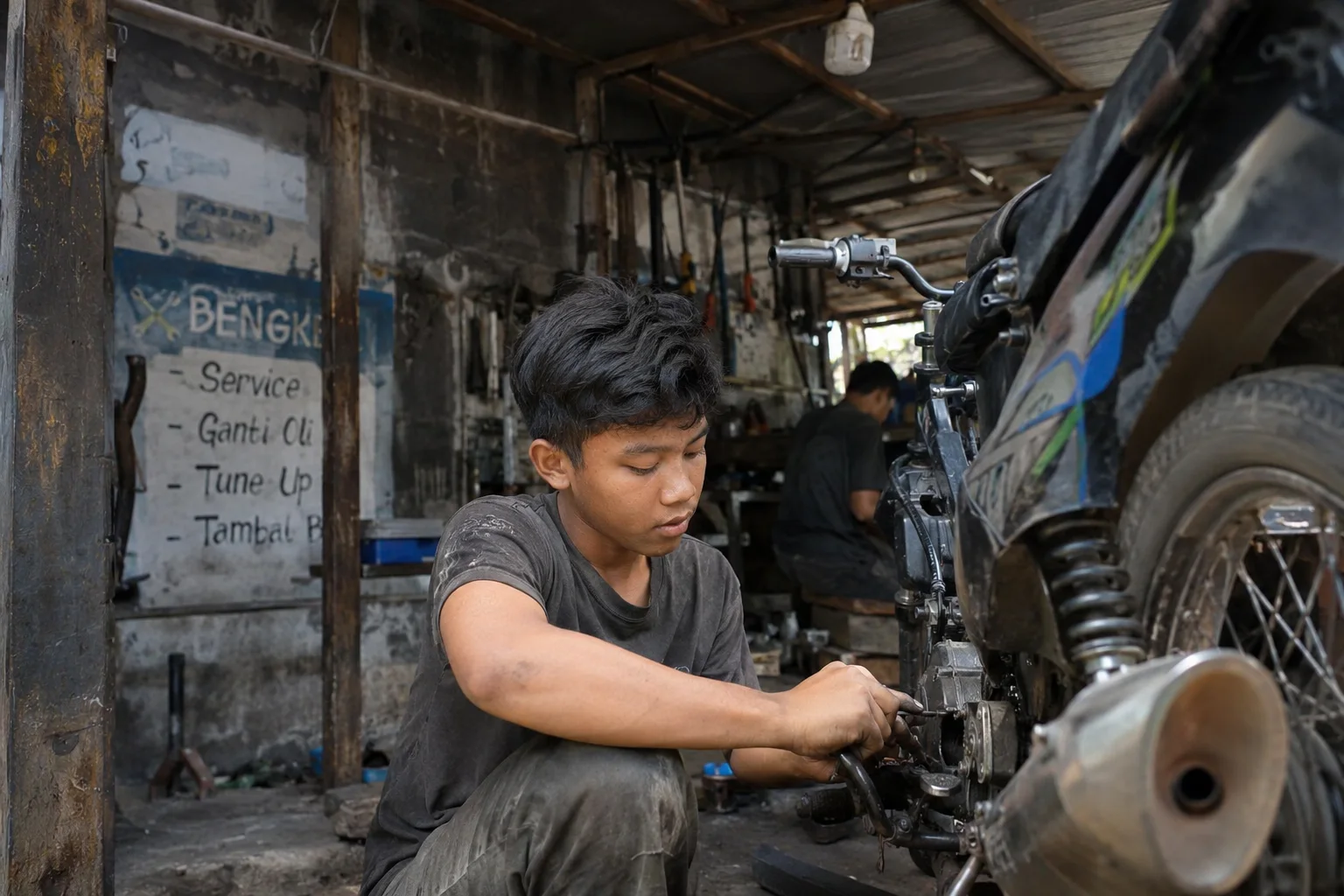
Some children are forced to work in markets to support their parents. Others spend their days in repair shops, caring for younger siblings at home, or seeking odd jobs to help meet their family's basic needs. They do not quit because they fail to grasp their lessons, but because life demands they become adults before their time.
Nearly One Million Indonesian Children Have Dropped Out of School
The issue of school dropouts in Indonesia is not merely a story of individual limitations. It has become a social challenge that demands serious attention.
According to data from the Ministry of Primary and Secondary Education as of 1 April 2026, the number of Out-of-School Children (ATS) in Indonesia has reached 3,966,858. This figure includes 1,913,633 children who have never attended school, 986,755 children who dropped out, and 1,066,470 children who completed one level of education but did not continue to the next.
This data shows that nearly one million children are categorized as having dropped out of school. This number is not just a statistic; it is a reflection of the many children facing barriers to continuous education.
Every number represents a human life. There are deferred dreams, missed opportunities, and futures that must be fought for along a difficult path.
When Economic Circumstances Outweigh the Desire to Learn
One of the primary causes of school dropouts is family economic pressure. When parental income is insufficient to cover daily needs, a child's education is often the first thing to suffer.
Educational costs go beyond tuition fees. There are still expenses for transportation, uniforms, school supplies, and daily meals that must be met.
For families in limited economic conditions, these expenses can become an overwhelming burden. Consequently, some children choose or are forced to work to help support the household.
Hakim's study (2020) on the factors causing school dropouts shows that this issue is linked to various interconnected conditions, including family circumstances and the social environment.
Data from the Central Statistics Agency in Education Statistics 2025 also shows that the dropout issue persists across various levels of education. In 2025, the dropout rate for senior high school/equivalent was recorded at 0.86 percent, junior high school/equivalent at 0.54 percent, and elementary school/equivalent at 0.09 percent.
These differences indicate that the risk of dropping out is relatively higher at the senior secondary level.
During adolescence, a child begins to be seen as capable of helping with family work. In difficult economic conditions, this perception can turn into a demand to start earning money immediately.
This is where the issue of education meets a reality that does not always offer fair choices.
How can a child concentrate on school assignments when they have to worry about their family's food costs? How can a teenager maintain their enthusiasm for learning when their parents are ill and there is no reliable income?
These questions remind us that the opportunity to learn is determined not only by academic ability but also by the social and economic conditions in which a child grows up.
They Have Not Lost Their Spirit, Only Their Opportunity
The assumption that children who drop out of school lack the motivation to learn needs to be reconsidered.
Research by Abror and his colleagues (2026) on the experiences of adolescents who dropped out in marginalized communities highlights how they adapt to limitations and strive to find ways to sustain their lives.
The desire for education does not always vanish when someone leaves formal schooling. Some children shift their focus to practical skills that they believe will allow them to earn an income more quickly.
They learn to repair vehicles, sew clothes, trade, or work in various informal sectors. These activities demonstrate an ability to adapt to circumstances, not proof that they are incapable of pursuing an education.
However, the ability to survive should not be used as an excuse to allow children to lose their right to education.
Formal education remains essential because it provides foundational knowledge, develops critical thinking skills, and offers broader opportunities to improve future well-being.
The struggles of children who work to support their families deserve understanding. Nevertheless, the circumstances that force them to sacrifice their education must remain a collective concern.
Returning Children to School Requires More Than Advice
Addressing the dropout problem cannot be done simply by asking children to return to school or advising them to be more diligent.
Such an approach will not solve the problem if the root cause is a family's inability to meet their basic needs.
Schools need to implement early detection for students at risk of dropping out, for example, through attendance monitoring, behavioral changes, and communication with parents or guardians.
When a student begins to miss school frequently, the first step should not be immediate punishment, but rather identifying the problems they are facing.
A humane approach allows schools to understand whether a child is experiencing economic pressure, family issues, learning difficulties, or other obstacles.
On the other hand, the government must ensure that educational assistance truly reaches the families who need it most.
Programs for educational cost assistance, scholarships, social protection, and the equitable distribution of school facilities must be targeted and sustainable.
Special attention is also required for children in disadvantaged, frontier, and outermost (3T) regions, who still face limited access to education.
Additionally, equivalency education through Paket A, Paket B, and Paket C can serve as an alternative for children who have left formal schooling. Skills training can also be developed as a complement to education so they have the opportunity to build a better future.
These efforts require cooperation between the government, schools, families, and the community. It is not enough to just provide programs; we must ensure that every child in need can actually access them.
Children Have the Right to a Childhood and a Future
Ultimately, the issue of school dropouts is not just about the number of students leaving the classroom. It also concerns the inequality of opportunity and society's ability to protect children's rights.
We need to stop viewing children who drop out as failures. Many of them are actually struggling to face circumstances that are difficult even for adults to bear.
A child who works from a young age is not necessarily choosing to abandon education. They may simply be trying to ensure their family can eat the next day.
Therefore, the success of handling school dropouts should not be measured solely by how many children are re-enrolled, but by their ability to survive, learn, and complete their education without being burdened by the same problems again.
Children should have the opportunity to learn, play, discover their potential, and build dreams without having to shoulder the entire economic burden of their families.
Because, they are not children who failed as students. They are children who were forced to grow up too quickly, when they should have still had time to enjoy their childhood and fight for their future.
Bibliography
Abror, A. F., Alqo, C. H., Sahin, A., Al Arif, M. R., Rohmah, N. S., & Kunaepi, A. (2026). School Dropout and Adaptive Resilience: Understanding Adolescents’ Educational Choices in Muslim Marginalized Communities, 1(2), 31–37.
Ariyani, S. N. Q. (n.d.). Trends in Junior High School Dropout Rates in the Special Region of Yogyakarta.
Central Statistics Agency. (2025). Education Statistics 2025. BPS.
Hakim, A. (2020). Factors Causing School Dropouts. Journal of Education, 21(2), 122–132. https://doi.org/10.33830/jp.v21i2.907.2020
Ministry of Primary and Secondary Education. (2026). Data on Out-of-School Children (ATS) as of 1 April 2026. Out-of-School Children Dashboard.
Lestari, Y. B., Kurniawan, F., & Ardi, R. B. (n.d.). Causes of High Dropout Rates in Elementary School (SD).








Comments 0
Write a Comment Share your response