

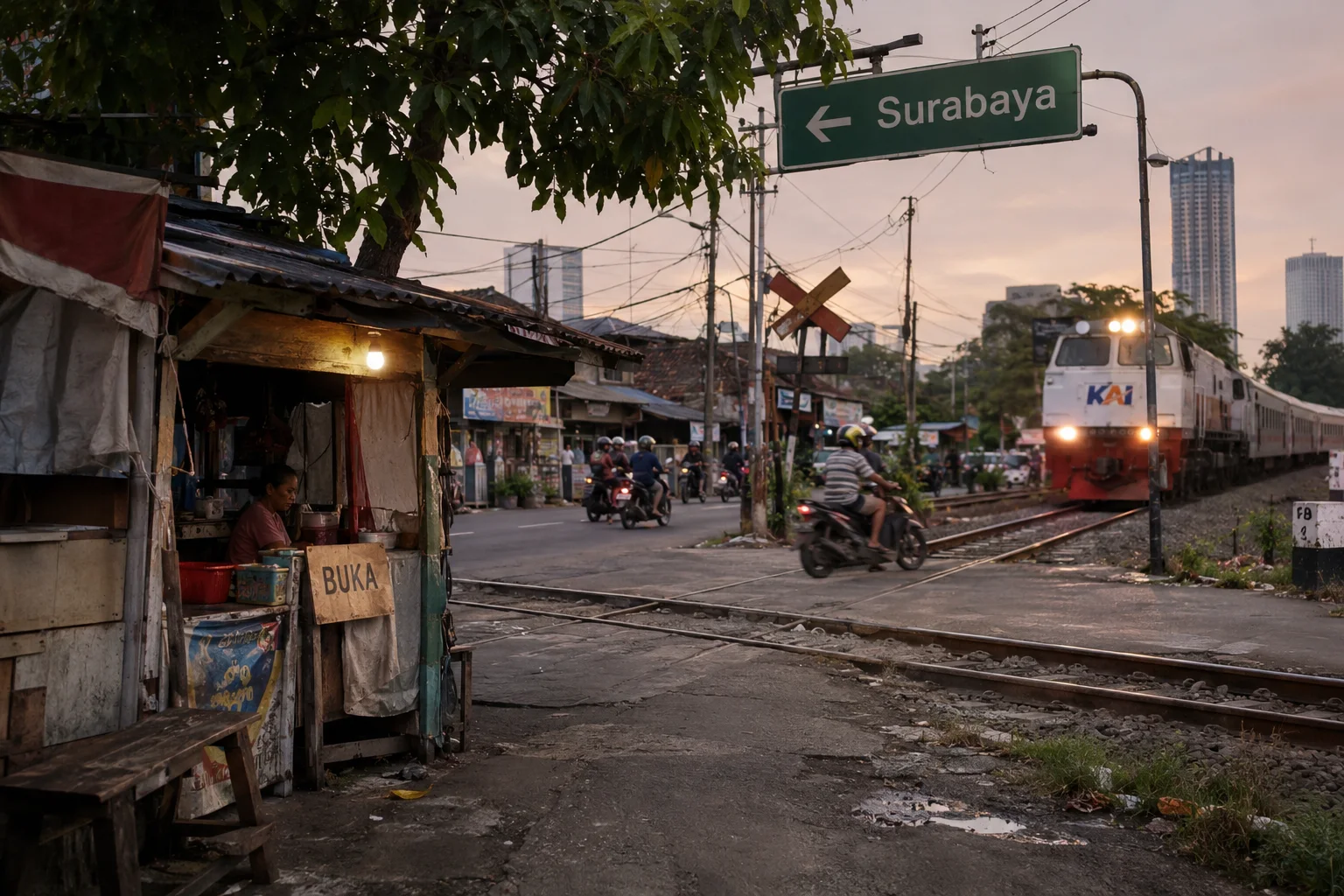
JurnalPost.com Metropolitan life is not always synonymous with progress, luxury, and the glitz of the city. Behind high-rise buildings and the ceaseless activity of urban centers lie social realities characterized by limited living space, economic pressure, and human alienation. These depictions are also found in literature, particularly in poetry that presents human experience through specific language and symbols.
One Indonesian poet who frequently explores urban life is F. Aziz Manna. Hailing from Sidoarjo, East Java, the poet possesses a deep connection to the social and cultural life of Surabaya and its surrounding areas. This experience serves as a vital component in many of his poems, including those compiled in the collection Golek.
Two poems from the collection, “Surabaya 2 x 4 Meter” and “Perlintasan Sebidang Tanpa Palang Pintu” (Unmanned Level Crossing), are compelling to study as they present a portrait of human life amidst the complexity of urban space.
These poems offer more than just linguistic beauty; they contain signs that can be interpreted as representations of social issues, economic limitations, and the psychological pressures faced by metropolitan society.
To understand these meanings, Charles Sanders Peirce’s semiotic approach can be utilized as a foundation for analysis.
Reading Poetry through the Perspective of Peircean Semiotics
Reading poetry is not merely about understanding the literal meaning of words. Readers must also observe the relationship between language, the objects depicted, and the meaning that emerges through the process of interpretation.
Sobur (2017) explains semiotics as the study of signs and the process of meaning-making. In its development, Charles Sanders Peirce became a key figure in advancing the understanding of how signs function.
According to Peirce, a sign or representamen is something that represents a specific object and produces a meaning or interpretant.
The relationship between these three elements is known as a triadic relation: representamen, object, and interpretant.
In the poem “Surabaya 2 x 4 Meter,” this relationship is found through the depiction of a simple structure that forms part of the protagonist’s living space.
The phrase “a plywood structure two meters wide and four meters long” acts as a representamen referring to the object of a small building with limited dimensions.
Through this sign, the reader can construct an interpretation regarding spatial limitations, the simplicity of the living or working environment, and the potential socio-economic conditions of the people living within it.
Meanwhile, the poem “Perlintasan Sebidang Tanpa Palang Pintu” presents signs through diction such as “stone, wood, iron,” “roaring speed,” and “train.”
These words build an image of an environment that is harsh, noisy, and filled with movement.
This depiction is then juxtaposed with phrases such as “the burden of life strikes the body,” “fever and flu,” and “a sprain or red-blue bruises,” which direct the reader toward physical and psychological suffering.
The interconnectedness of these signs forms a picture of human life confronting environmental pressures and limited choices.
Qualisign, Sinsign, and Legisign: Reading Signs in Urban Life
In Peircean semiotics, signs can be classified based on the nature of the representamen into three categories: qualisign, sinsign, and legisign.
A qualisign is a quality that has the potential to function as a sign, such as a color, atmosphere, or specific character that leaves an impression on the reader.
In the poem “Surabaya 2 x 4 Meter,” the phrase “gray eyes staring sharply” presents a visual quality as well as a psychological atmosphere that can be interpreted as exhaustion, fatigue, or alienation.
Meanwhile, the poem “Perlintasan Sebidang Tanpa Palang Pintu” features the phrase “tremor, fear, trembling.”
This sequence of words reinforces the impression of fear moving from a physical response to inner pressure.
Both images demonstrate how the quality of language can create an emotional atmosphere related to human experience in an urban environment.
The next category is the sinsign, a sign that exists through a concrete event or existence.
In the poem “Surabaya 2 x 4 Meter,” the phrase “a small wooden board attached to a bamboo curtain” presents a physical object that is part of the protagonist’s environment.
In “Perlintasan Sebidang Tanpa Palang Pintu,” the arrival of a train can be understood as a concrete event that presents a potential danger to those nearby.
The existence of these objects and events strengthens the impression of the reality of life constructed through the poetry.
Meanwhile, a legisign is a sign that works based on rules, habits, or specific social conventions.
In “Surabaya 2 x 4 Meter,” the word “Open” on the small wooden board is an example of a conventional sign understood as an indicator of business activity or service.
In the poem “Perlintasan Sebidang Tanpa Palang Pintu,” the phrase “the signature of the examiner” can be linked to social conventions regarding validation, authority, or legitimacy.
Through these three categories, the language of poetry brings together emotional quality, material existence, and social consensus that shape human life experience.
Icon, Index, and Symbol as Representations of Social Reality
The next classification in Peircean semiotics is based on the relationship between the sign and its object: icon, index, and symbol.
An icon is a sign that has a relationship of resemblance to the object it represents.
In the poem “Surabaya 2 x 4 Meter,” the description of “her gray eyes” builds a visual image of someone who can be imagined as having a dim and weary gaze.
Meanwhile, the phrase “igniting gray feathers” in “Perlintasan Sebidang Tanpa Palang Pintu” presents imagery that can be associated with the form of ash that is light and flying like feathers.
Both images show how poetic imagery helps the reader visualize the objects and atmosphere the poet intends to build.
Furthermore, an index is a sign that has a factual, proximity, or cause-and-effect relationship with its object.
In “Surabaya 2 x 4 Meter,” the existence of the plywood building can be read as a clue regarding the material condition of a space. In the context of the entire poem, this simple building can direct the interpretation toward economic limitations.
In the poem “Perlintasan Sebidang Tanpa Palang Pintu,” the phrase “the fire it carries will burn” presents a relationship between a source of danger and the possible consequences it causes.
This image can be understood not only physically but also opens up possibilities for interpreting the threats humans face in navigating life.
A symbol is a sign whose meaning is formed based on social agreement or convention.
In the poem “Surabaya 2 x 4 Meter,” the words “shorts and t-shirt” refer to a form of clothing familiar in daily life.
In the context of the poem, this choice of clothing can be read as a symbol of simplicity. However, simple clothing does not automatically indicate a specific economic status without considering the context of the entire text.
Meanwhile, in “Perlintasan Sebidang Tanpa Palang Pintu,” a symbolic reading can be developed through interpreting the train and the crossing as a metaphor for the journey of life, the intersection of choices, and the possibility of danger.
This symbolic interpretation is contextual and must be distinguished from sign relationships that are purely conventional.
Rheme, Dicisign, and Argument: Understanding Layers of Poetic Meaning
The final trichotomy in Peircean semiotics relates to the relationship between the sign and the interpretant, which includes rheme, dicisign, and argument.
A rheme is a sign that opens up possibilities for meaning without necessarily stating a fact with certainty.
In the poem “Surabaya 2 x 4 Meter,” the phrases “her face is bronze honed by time” and “her hair is faded gold coiled haphazardly” form an image of someone who has gone through a long life journey.
The use of this metaphor gives the reader space to interpret the protagonist’s experience, age, exhaustion, or resilience.
Meanwhile, the phrase “stone, wood, iron, roaring speed” in the poem “Perlintasan Sebidang Tanpa Palang Pintu” presents associations regarding material strength, the harshness of the environment, and movement that can cause fear.
Unlike a rheme, a dicisign is a sign that conveys information about a state or event.
In “Surabaya 2 x 4 Meter,” the phrase “She sits right in the middle of the gaping door, cross-legged” describes the protagonist’s actions more concretely.
The reader gains information about the position and activity of the character within the space described by the poet.
Meanwhile, in “Perlintasan Sebidang Tanpa Palang Pintu,” the expression “perhaps a little sprain or red-blue bruises” presents the possibility of a physical condition involving injury.
The word “perhaps” indicates that the condition is not stated as a certainty. However, the expression still provides a clue regarding the experience of physical suffering that is part of the world of the poem.
The final category is the argument, a sign that builds meaning through a relationship of reasoning.
In both poems, the poet does not explicitly state that the characters are part of a poor social group or are experiencing social marginalization.
However, through the relationship between signs—such as narrow spaces, simple buildings, environmental pressure, and depictions of physical and psychological suffering—the reader can construct an argument regarding the possibility of social issues in the characters’ lives.
This meaning emerges through a process of reasoning about the entirety of the signs presented by the poet, not just based on one specific word or phrase.
Portraits of Alienation and the Pressures of Metropolitan Life
Reading the two poems by F. Aziz Manna shows that metropolitan life can be represented through human experiences far removed from the image of city grandeur.
“Surabaya 2 x 4 Meter” presents the issue of limited living space through objects, activities, and the depiction of characters in a simple environment.
Meanwhile, “Perlintasan Sebidang Tanpa Palang Pintu” displays a life filled with pressure, anxiety, and threats that appear through the depiction of the environment and the human body.
Both poems have different modes of expression but reveal a common thread regarding the relationship between humans and the social space where they live their lives.
Urban space in both works is not merely a geographical background but also helps shape the experiences and inner struggles of the characters.
Limited space, fear, exhaustion, and the effort to survive become part of the meaning that can be traced through the relation of signs.
Through the perspective of Peircean semiotics, poetry can be understood as a system of signs that opens up various possibilities for interpreting the reality of life.
Analysis of “Surabaya 2 x 4 Meter” and “Perlintasan Sebidang Tanpa Palang Pintu” shows that the relationship between representamen, object, and interpretant, as well as the classification of signs—qualisign, sinsign, legisign, icon, index, symbol, rheme, dicisign, and argument—can be used to uncover layers of meaning in literature.
Ultimately, both poems invite readers to see the side of metropolitan life that often escapes attention: people living in limitations, facing social pressure, and continuing to try to maintain their existence amidst the changes of the city.
Through poetic language and the relationship between signs, F. Aziz Manna provides a space for reflection on the lives of urban society while demonstrating that poetry can be a medium to read and understand social reality more deeply.



Comments 0
Write a Comment Share your response