

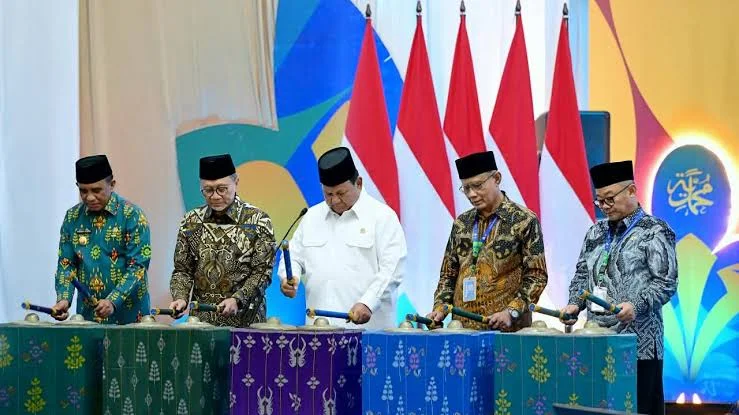
JurnalPost.com - President Prabowo Subianto's speech at the opening of the Tanwir Muhammadiyah and the 114 anniversary of Muhammadiyah in Palu, Central Sulawesi, on Saturday, 14 November 2026, presented a political statement worthy of reflection. Before Muhammadiyah leaders, the President stated that he possesses the capacity to carry out a revolution in Indonesia.
This statement is more than mere political rhetoric. Amidst issues of economic inequality, poverty, the control of natural resources, and the strong influence of vested interest groups on state policy, a call for revolution from a head of state carries both significant meaning and a major challenge.
Historically, revolutions generally arise from public resistance against power perceived as unjust. The French Revolution in 1789, for instance, grew out of dissatisfaction with social inequality and monarchical power. Meanwhile, the Iranian Revolution in 1979 demonstrated how public mobilization could topple a long-standing government.
However, what President Prabowo conveyed reveals a different situation. The call for fundamental change is coming from the center of government, from a leader who holds the constitutional authority to reform state policy.
The question then arises: to what extent can a revolution from the Palace change the power structure that has long been seen as providing space for the dominance of specific economic interests?
A Wealthy Nation, Yet Prosperity Remains Uneven
Indonesia is a country with vast natural resource wealth. Minerals, coal, petroleum, natural gas, forests, and marine resources are vital capital for national development.
Unfortunately, the magnitude of this potential wealth is not yet fully proportional to the welfare of the people.
Based on data from the Central Statistics Agency (BPS), the number of poor people in March 2026 still reached 22.93 million people, or approximately 8.07 percent of Indonesia's total population.
Although poverty figures show a decline, the reality that millions of citizens still live in limitation serves as a reminder that economic development has not resolved all welfare issues.
In several regions producing natural resources, mining, plantation, and extractive industry activities can indeed contribute to economic growth. However, these activities also bring risks of land conflicts, environmental damage, and the loss of community livelihoods if not managed responsibly.
Therefore, the success of development should not be measured solely by investment value, state revenue, or economic growth.
A more fundamental metric is the extent to which national wealth truly improves the quality of life for the people, especially those living around natural resource exploitation areas.
The state must not function merely as a business permit issuer and revenue collector. The state must ensure that the management of natural wealth generates prosperity that can be felt equitably.
Oligarchy and the Threat of State Capture
One of the fundamental issues in state governance is the strong link between economic power and political power.
In the perspective of political economy, oligarchy describes the concentration of wealth and political influence within a limited group that has the ability to sway the direction of public policy.
The problem arises when capital power no longer merely conducts economic activities but begins to dictate political decisions, licensing processes, regulatory formation, and even law enforcement.
This phenomenon is known as state capture, a condition where state policies and institutions are disproportionately influenced by private interests.
In his speech in Palu, President Prabowo alluded to the practice of purchasing influence over state officials. This statement reveals concerns regarding the possibility of public power being traded for the benefit of specific groups.
However, it is important to emphasize that the existence of large business players is not inherently identical to illegal oligarchic practices. Legitimate investment remains necessary for national development.
The issue that must be addressed is the abuse of economic influence to obtain special treatment, avoid legal obligations, or control state policy for narrow interests.
If such practices are allowed to persist, the law risks losing its function as an instrument of justice and instead becomes a tool for protecting the interests of groups with access to power.
Revolution Must Begin with Reforming the Power System
A call for revolution from a President certainly carries a different political weight compared to calls for change from outside the government.
The President not only has the opportunity to criticize a system deemed problematic but also holds the authority to initiate improvements through policy, bureaucratic reform, and the strengthening of state institutions.
Therefore, the revolution in question should not stop at replacing elites or changing the configuration of power.
A true revolution must address the root of the problem: abuse of authority, corruption, conflicts of interest, inequality in resource control, and the weak accountability of state administrators.
In a constitutional democracy, a revolution cannot be interpreted as granting unlimited power to a single leader.
Conversely, fundamental change must strengthen the supremacy of the constitution, the independence of law enforcement agencies, government transparency, and public oversight.
This commitment must apply without exception, including to officials, entrepreneurs, or groups with proximity to the center of power.
Without the courage to clean up his own circle of power, the revolutionary agenda risks merely resulting in a change of the group enjoying privileged access to the state.
Restoring the Mandate of Article 33 of the 1945 Constitution
The Indonesian Constitution has actually provided a clear direction regarding the management of national wealth.
Article 33 paragraph (3) of the 1945 Constitution asserts that the earth, water, and natural resources contained therein are controlled by the state and utilized for the greatest prosperity of the people.
This provision must be understood as a constitutional mandate to ensure that natural resources do not only generate profits for capital holders but also provide broad benefits to the community.
State control cannot be reduced to the authority to issue mining permits, plantation concessions, or natural resource exploitation rights.
Such control must be realized through policies, regulations, management, and oversight that truly prioritize the public interest.
Local and indigenous communities need protection for their rights. Regions producing natural resources must also receive commensurate benefits through improved education, health, infrastructure, and economic opportunities.
At the same time, environmental protection must be placed as an inseparable part of development.
The integrity of the state will lose its meaning if the government is more responsive to the interests of concession holders than to the people who have lost their land, living space, and livelihoods.
Five Agendas to Test the Seriousness of the Revolution
For the call for change not to end as a mere political statement, there are five fundamental agendas that need to serve as a measure of the government's seriousness.
First, a comprehensive audit of natural resource permits. The government needs to ensure legality, environmental compliance, reclamation obligations, state revenue, and the transparency of the ultimate beneficial owner or beneficial owner in the mining, forestry, plantation, and strategic industry sectors.
Second, indiscriminate law enforcement. Practices of corruption, abuse of authority, and corporate crime must be handled professionally based on evidence and fair legal processes, without considering the perpetrator's proximity to power.
Third, equitable distribution of economic benefits. Natural resource wealth must make a tangible contribution to the welfare of the people in producing regions, not just increase corporate profits or central government revenue.
Fourth, transparency and public participation. Information regarding concessions, permits, and environmental impacts needs to be adequately disclosed so that the public can oversee decisions that affect their lives.
Fifth, improving the integrity of state administrators. Prevention of conflicts of interest, strengthening of ethical standards, and independent oversight must be part of institutional reform.
These five agendas require measurable indicators so that the public can assess whether change is truly taking place or if it is merely a political promise.
Revolution Must Not Turn into a Cult of Personality
President Prabowo's speech before Muhammadiyah also has important moral and national dimensions.
As a community organization with a long history in education, health, and social empowerment, Muhammadiyah can play a strategic role in pushing for change that favors the public interest.
However, civil society support for the reform agenda should not be interpreted as support without criticism.
Community organizations, academics, activists, and affected community groups must instead maintain their independence to oversee government policy.
Long-lasting change does not depend solely on the firmness of a leader. Change must produce strong institutions, a trustworthy legal system, and oversight mechanisms capable of functioning even when leadership changes.
Therefore, a revolution from the Palace must not develop into a cult of personality or a new concentration of power.
The revolution must be a path to strengthen the rule of law, expand economic justice, and ensure every policy is carried out based on the constitutional mandate.
Ultimately, the success of a revolution is not determined by how loudly political statements are delivered, but by the tangible changes felt by the people.
When corruption can be suppressed, the law is enforced fairly, the environment is protected, and national wealth generates more equitable prosperity, only then will the reform agenda gain substantive meaning.
Restoring the integrity of the state means restoring the alignment of power with the people. Because the strength of a nation does not lie in the magnitude of its leaders' authority, but in the courage to use that authority to uphold justice and ensure shared prosperity.









Comments 0
Write a Comment Share your response