

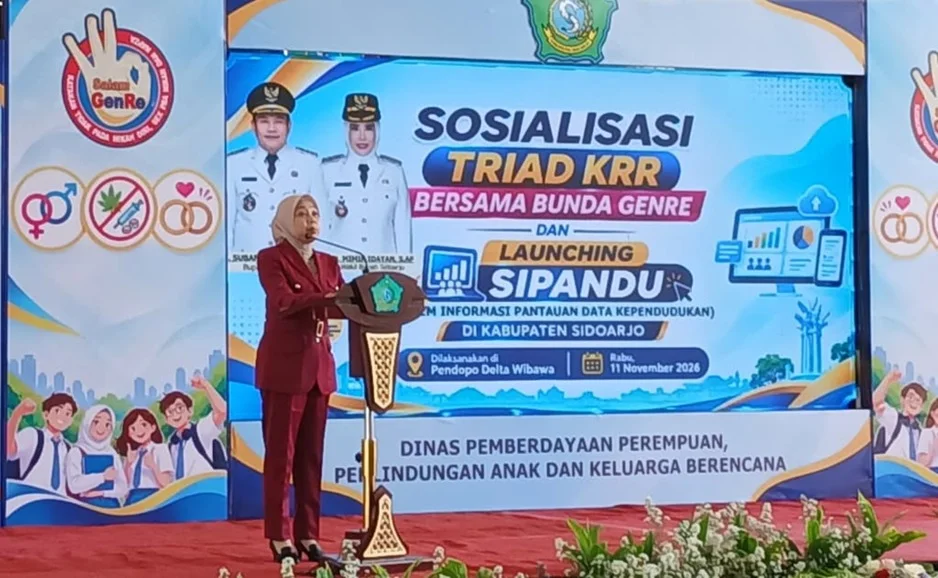
Sidoarjo, JurnalPost.com – Interns from the 'Magang Berdampak' program currently practicing at the Sidoarjo Regency Office of Women's Empowerment, Child Protection, and Family Planning (DP3AKB) supported the Socialization of the Three Basic Threats to Adolescent Reproductive Health (TRIAD KRR) alongside the Bunda GenRe (Generasi Berencana), which was held in conjunction with the launch of the Population Development Data Monitoring Information System (SIPANDU). The event took place on Wednesday (11/11/2026) at the Delta Wibawa Pavilion, Sidoarjo Regency.
This event serves as part of the Sidoarjo Regency Government's efforts to improve the quality of the younger generation through reproductive health education while strengthening population development monitoring via information technology. The event involved various regional government agencies, family planning counselors, GenRe members, and Adolescent Information and Counseling Centers (PIK-R) from across Sidoarjo Regency, with approximately 400 participants in attendance.
The TRIAD KRR socialization was conducted to increase adolescent knowledge and understanding regarding the three basic threats to reproductive health: adolescent sexuality, the abuse of narcotics, psychotropics, and other addictive substances (NAPZA), and early marriage. This education is essential to equip adolescents with the ability to understand risks that could impact their health and future, enabling them to make responsible decisions.
The event was opened by the Chair of the Sidoarjo Regency PKK Mobilization Team and Bunda GenRe, Dr. Sriatun, alongside Assistant I Ainun Amalia, S.Sos., and the Head of the Sidoarjo Regency DP3AKB, Heni Kristiani, S.Pd., MM., through a ceremonial bell-ringing. During the event, Bunda GenRe provided guidance on the importance of mentoring adolescents, particularly in navigating peer influence and the rapid flow of information. Family communication and a safe environment are critical factors in ensuring adolescents receive accurate information and avoid risky behaviors.
In addition to adolescent reproductive health education, the event served as the launch momentum for SIPANDU, or the Population Development Data Monitoring Information System. SIPANDU is a web-based application owned by the Sidoarjo Regency Government used to monitor the progress of population development implementation in a centralized and real-timemanner.
Through this system, every regional apparatus organization (OPD) can report the progress of their action plans according to their respective work programs and responsibilities. The collected data then becomes part of the monitoring process for population development achievements based on the pillars of the Population Development Roadmap (PJPK).
The existence of SIPANDU is expected to support a more targeted monitoring and evaluation process for population development. By presenting information on action plan progress within a single system, the local government can view program implementation achievements across various agencies and identify aspects that still require follow-up.
During the event, interns placed in the Family Planning and Family Resilience Division assisted in ensuring the smooth operation of the proceedings through registration duties. These tasks included welcoming invited guests, directing participants to sign the attendance list, receiving official travel order documents (SPPD), and distributing refreshments and souvenirs to participants.
This involvement provided direct experience regarding administrative support and service in the implementation of government activities. Through these tasks, the students gained an understanding of the importance of precision, coordination, and administrative management in supporting the success of an event.
Interestingly, the launch of SIPANDU is also linked to the students' previous experience during their placement in the Population Control Division. Previously, the interns were involved in the initial data collection process for the development of the SIPANDU prototype. This activity involved gathering work program information from various OPDs, reviewing the alignment of programs with population development pillars, and collecting achievement data used as material for system development.
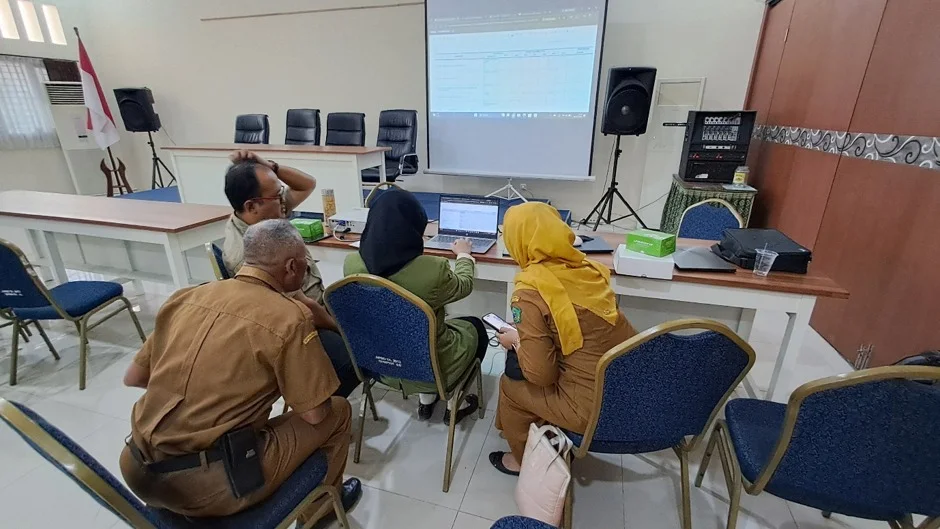
This experience provided an understanding of the population development monitoring process, particularly the relationship between regional agency work programs and the pillars of population development. Thus, the launch of SIPANDU represents an experience that has continuity with the work the students performed during their placement in the Population Control Division.
Through their involvement in this activity, the students gained practical work experience that encompasses administrative support for event organization as well as an understanding of population development programs. This experience is part of the learning process to recognize the implementation of local government programs and the connection between the field of public administration and the practice of government operations.





Comments 0
Write a Comment Share your response