

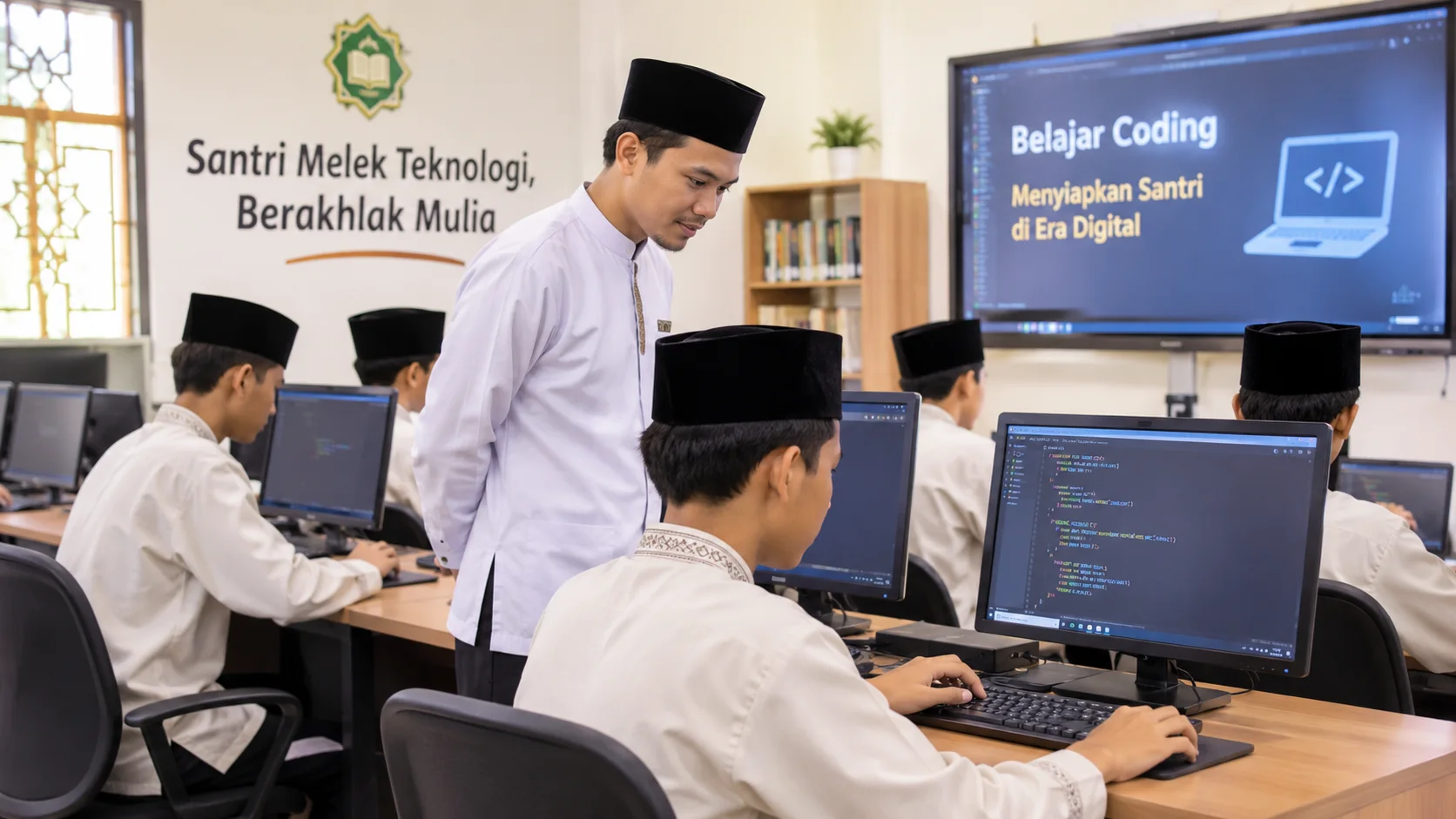
JurnalPost.com - Pesantren have long been recognized as Islamic educational institutions that play a vital role in shaping the character, discipline, morality, and religious understanding of their students (santri). Through an educational system that emphasizes spiritual values and community life, pesantren have produced many graduates who contribute across various fields.
However, the rapid advancement of technology presents new challenges for the world of pesantren education. The emergence of artificial intelligence (artificial intelligence), automation, and the growth of the digital economy have transformed how people work. This condition raises an important question: do santri possess sufficient skills to compete in the workforce after completing their education?
To address these challenges, pesantren need to begin broadening their educational orientation. Religious education remains the primary foundation, but it must be supported by the development of skills relevant to the needs of the era. In this way, santri will not only possess a strong foundation in religious knowledge but also the ability to adapt to technological changes and the demands of the workforce.
[Insert main article photo here]
Digital Skills as a Necessity for Pesantren Graduates
The development of digital technology has influenced almost every aspect of public life, including education, commerce, communication, and the workforce.
Based on the publication Telecommunication Statistics of Indonesia 2024 published by the Central Statistics Agency (BPS), 72.78 percent of the Indonesian population has accessed the internet. This figure illustrates the increasingly widespread use of digital technology in daily life.
Meanwhile, the report The Future of Jobs Report 2023 from the World Economic Forum (WEF) highlights the growing need for technological skills, including technology literacy, artificial intelligence, and data processing.
This shift is a significant concern for educational institutions, including pesantren. The ability to use technology is no longer just an additional skill; it is increasingly essential for supporting professional activities and unlocking economic opportunities.
If learning in pesantren focuses solely on religious education without providing space for digital skill development, graduates risk facing a competency gap when entering the workforce.
Therefore, digital skills should be viewed as part of the essential life skills for santri. Mastering technology can help them develop their potential, create business opportunities, and participate in community development without abandoning the Islamic values they have learned.
Challenges for Pesantren in Developing Digital Skills
Efforts to strengthen digital education in pesantren are certainly not without various challenges.
One of the obstacles still faced, especially by pesantren in remote areas, is limited technological infrastructure. Not all pesantren have adequate computer equipment, learning laboratories, or stable internet connections.
This condition can affect the opportunities for santri to learn and practice digital skills directly.
In addition to facility issues, the availability of teaching staff is also a distinct challenge. Learning subjects such as programming (coding), digital marketing (digital marketing), graphic design, and artificial intelligence requires mentors who are proficient in these fields.
Meanwhile, not all pesantren have teachers or specialized staff with digital technology competencies.
As a result, the introduction of technology is sometimes still limited to the use of computers and the internet, failing to evolve into productive activities that allow santri to produce digital works or innovations.
Another challenge relates to the dense learning schedule in the pesantren environment. Quranic studies, classical book studies (kitab), formal education, and other religious activities have become essential parts of the daily life of santri.
If digital skills are added without careful planning, these activities have the potential to increase the learning burden.
Therefore, pesantren need to design a balanced learning pattern so that the development of technological competence can proceed without reducing the quality of religious education.
On the other hand, the use of technology must also be accompanied by an understanding of digital ethics. Santri need to be guided so they can utilize the internet wisely, maintain privacy, avoid the spread of false information, and use digital media for beneficial activities.
Pesantren Strategies for Developing Santri Digital Skills
To face these various challenges, planned and sustainable steps are required. There are a number of strategies that pesantren can implement to strengthen the digital skills of their santri.
1. Integrating Digital Skills into the Curriculum
The initial step that can be taken is to adjust the educational curriculum to the needs of technological development.
Pesantren can introduce programming, graphic design, database management, digital marketing, and other technology skills through additional subjects or extracurricular activities.
These programs can also be developed in the form of certified training so that santri have proof of competency that can be utilized when continuing their education or entering the workforce.
The implementation needs to be adjusted to the capabilities and needs of each pesantren, so that digital education can complement religious learning.
2. Developing Infrastructure and Digital Entrepreneurship Activities
The provision of learning facilities is an important part of supporting the improvement of santri skills.
Pesantren can develop computer laboratories, provide adequate internet access, and form creative spaces to support learning activities and business development.
Through these facilities, santri not only learn to use technology but also gain the opportunity to apply it in real-world activities.
One approach that can be developed is the One Pesantren One Product (OPOP) program, by utilizing electronic commerce platforms or e-commerce.
Through these activities, santri can be involved in various stages of business, ranging from product development, packaging design, and promotional material creation to online marketing.
A study by Amalia and colleagues (2024) regarding the economic empowerment of pesantren through the OPOP program in the Pantura Lamongan region shows the relevance of developing productive economic activities within the pesantren environment.
This approach can be an alternative for entrepreneurship learning that connects digital capabilities with the economic activities of santri.
3. Expanding Cooperation with Various Parties
Digital transformation in pesantren does not have to be carried out independently. Limitations in facilities or teaching staff can be overcome gradually through cooperation with various institutions.
Pesantren can establish partnerships with the government, universities, Vocational Training Centers (BLK), vocational schools, technology communities, and companies operating in the digital sector.
Such cooperation allows pesantren to bring in instructors and practitioners who have experience in their respective fields of expertise.
The Ministry of Communication and Digital (Komdigi) has also shown attention to increasing the digital capacity of santri.
In its official publication on 2026, the Deputy Minister of Communication and Digital, Nezar, expressed the ministry's readiness to support various initiatives involving pesantren in strengthening the digital capabilities of the community.
Support through training, mentoring, and competency certification can be an opportunity for pesantren to develop technology-based education in a more directed manner.
4. Improving the Competency of Teachers and Pesantren Caretakers
The development of santri digital skills also requires the readiness of educators.
Ustaz, ustazah, teachers, and pesantren caretakers need to have the opportunity to participate in technology training through competency improvement programs, including a training of trainersapproach.
Through such programs, teaching staff can acquire knowledge and skills that are then applied in learning activities.
Teachers who understand technology are not only able to introduce the use of digital devices but can also mentor santri in developing more productive capabilities.
Furthermore, the role of teachers is crucial in instilling digital ethics, such as maintaining politeness in communication, respecting the privacy of others, being critical of information, and using technology responsibly.
With this approach, digital education is not only oriented toward technical capabilities but also toward character formation that is in harmony with the values of the pesantren.
Building a Generation of Digital Santri Who Are Moral and Competitive
Preparing santri to face the development of the world of work is part of the effort to strengthen the quality of pesantren education in the modern era.
Mastery of digital technology does not have to be viewed as something that contradicts the traditions of pesantren education. On the contrary, technology can be a means to expand the benefits of knowledge and develop the potential of santri.
Santri who possess religious understanding, good character, and digital skills have the opportunity to take on broader roles in community life.
They can not only work in various sectors that require technological capabilities but also have the potential to become entrepreneurs, digital creators, and drivers of innovation in their surrounding environments.
To realize this, pesantren require sustainable support, whether through curriculum strengthening, facility improvement, teacher training, or collaboration with various parties.
By combining religious education and the mastery of technological skills, pesantren can contribute to preparing human resources who are characterized, adaptive, and competitive toward Golden Indonesia 2045.
Bibliography
Amalia, D., Shofiyah, S., Rif'ah, S., & Sa'idaturrohmah, N. (2024). Economic empowerment of pesantren through One Pesantren One Product (OPOP) at Pondok Pesantren in the Pantura Lamongan region. Amalee: Indonesian Journal of Community Research and Engagement, 5(2), 677–693. https://doi.org/10.37680/amalee.v5i2.2426
Central Statistics Agency. (2025, 29 August). Telecommunication Statistics of Indonesia 2024. https://www.bps.go.id/id/publication/2025/08/29/beaa2be400eda6ce6c636ef8/telecommunication-statistics-in-indonesia-2024.html
Ministry of Communication and Digital of the Republic of Indonesia. (2026). Kemkomdigi prepares digital training and certification for santri to face the world of work. https://portal.komdigi.go.id/kanal-publik/berita-kini/10343
World Economic Forum. (2023). The Future of Jobs Report 2023. https://www.weforum.org/publications/the-future-of-jobs-report-2023/







Comments 0
Write a Comment Share your response