

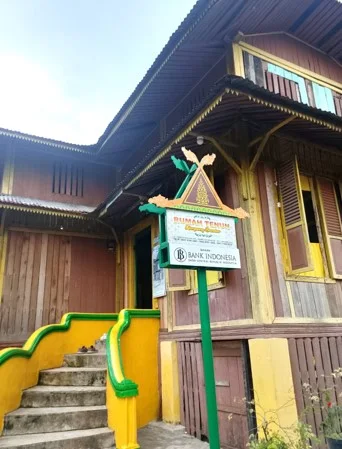
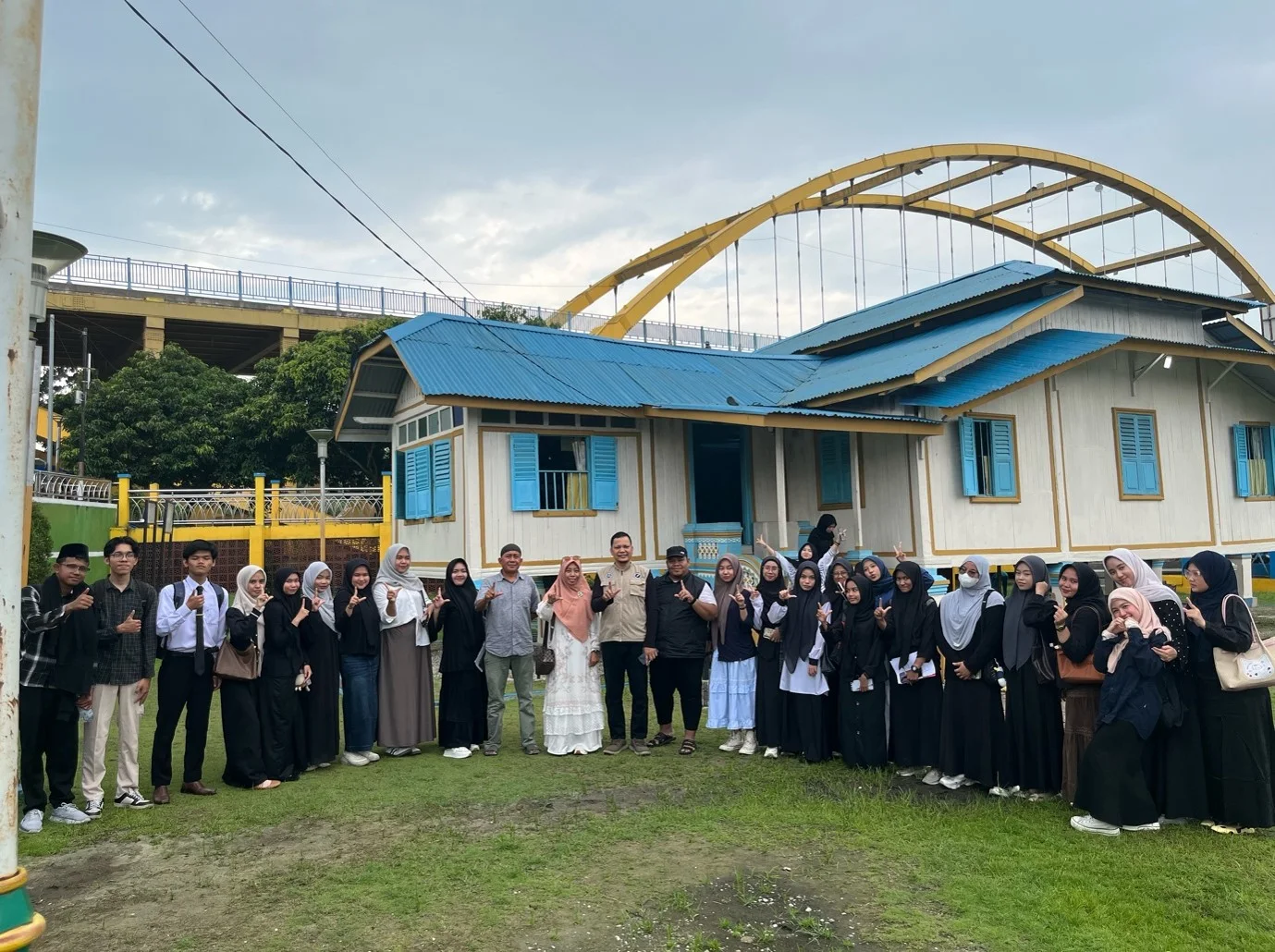
PEKANBARU, JurnalPost.com — A total of 29 students from the English Education Study Program, Faculty of Teacher Training and Education (FKIP), Islamic University of Riau (UIR), visited the Kampung Bandar Weaving House in Pekanbaru on Friday (20/11/2026). This visit was part of a learning activity to gain a deeper understanding of the history and cultural heritage of the Riau Malay people.
This activity was conducted as part of the News Writing and Reporting course taught by Fitri Wulandari, S.Pd., M.Pd.
Through this experience, students had the opportunity to practice journalistic skills firsthand, ranging from observation and interviewing to information gathering and writing news reports based on their field findings.
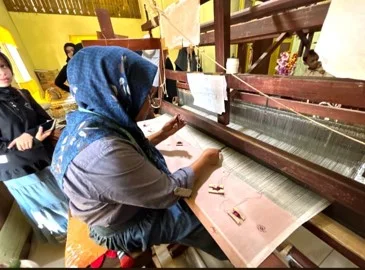
During the visit, students learned about the history of the building and observed artisans at work creating traditional woven fabrics.
The students also interviewed an artisan named Rina to gather information regarding the production process, the materials used, and the various efforts made to preserve traditional weaving crafts.
Learning the History of the Kampung Bandar Weaving House
The Kampung Bandar Weaving House occupies a historic building estimated to have been built around 1887. The structure was formerly the residence of H. Yahya, a prominent rubber entrepreneur of his time.
Today, this historic building serves as a center for the preservation and development of traditional Riau Malay weaving crafts.
Currently, there are about four artisans working directly at the Kampung Bandar Weaving House due to space and equipment limitations.
Meanwhile, other members, particularly mothers with family responsibilities, continue their weaving activities from their respective homes.
This work system allows artisans to earn an income without neglecting their household duties.
Observing the Weaving Process Firsthand
In an interview with the students, Rina explained that it takes about one week to produce a single piece of woven fabric.
The production stages begin with dyeing the yarn, which takes about one day. Afterward, the yarn is air-dried at room temperature to maintain quality and prevent color damage.
Once dry, the yarn is wound onto bobbins before entering the weaving stage.
Every stage requires patience, precision, and specialized skills to produce high-quality woven fabric.
Regarding raw materials, artisans generally use premium cotton yarn. Additionally, silk and spun silk options are available, depending on customer requests.
This process provided students with insight into the lengthy production stages and the expertise required to create a piece of traditional woven fabric.
Utilizing Natural Dyes from the Surrounding Environment
In addition to maintaining traditional weaving techniques, the artisans at the Kampung Bandar Weaving House are developing the use of natural dyes derived from materials found in the local environment.
Some of the natural materials used include ketapang leaves, jengkol peels, and turmeric.
These materials are processed into dyes for the yarn before the weaving process begins.
The use of natural dyes serves as an alternative to synthetic dyes and represents a way to utilize local resources to support traditional craft production.
This innovation demonstrates that cultural preservation can go hand-in-hand with creative development and the utilization of local environmental potential.
Product Innovation to Attract the Younger Generation
The Kampung Bandar Weaving House does not only produce traditional songket fabric but also develops various creative products by utilizing production scraps.
Leftover weaving materials are repurposed into items such as tanjak (traditional Malay headgear), scarves, and various types of souvenirs.
Another innovation is the creation of woven fabric without gold thread, making it more suitable for daily use.
These product developments also aim to attract interest from younger consumers toward traditional weaving crafts.
Through product diversification, artisans strive to maintain cultural values while adapting their crafts to evolving market needs and tastes.
Receiving Support from Various Institutions
To improve artisan skills and product quality, the Pucuk Rebung Community Self-Reliance Group (KSM) has received guidance and training from various institutions, including Bank Indonesia and several government agencies.
This mentorship program helps artisans develop production skills while enhancing the quality of their crafts.
Products from the Kampung Bandar Weaving House have also been showcased through various exhibitions, including the Karya Kreatif Indonesia (KKI).
Participation in such events provides local artisans with opportunities to promote their products and introduce the richness of traditional Riau Malay weaving to a wider audience.
Beyond attracting the attention of the Indonesian public, the Kampung Bandar Weaving House has also received visitors from various countries.
International students from Malaysia, Singapore, and Cambodia have visited to study traditional weaving techniques and learn about Riau Malay culture.
Journalistic Learning and Cultural Preservation
The visit by UIR English Education students to the Kampung Bandar Weaving House provided a learning experience that focused not only on journalistic skills but also on the introduction and preservation of local culture.
Through direct observation and interviews with the artisans, students gained an understanding of how traditional weaving techniques are maintained and adapted to meet changing market demands.
The activity also introduced students to the role of the Pucuk Rebung KSM as the manager of the Kampung Bandar Weaving House, which supports artisans through traditional production and product development.
These various activities contribute to the sustainability of Riau Malay weaving crafts while creating economic opportunities for the local community.
Through this experiential learning, students not only developed their observation, interviewing, and news-writing skills but also broadened their perspective on the importance of safeguarding cultural heritage for future generations.
Author: Gadis Ayu Safitri
Affiliation: English Education Study Program, Faculty of Teacher Training and Education (FKIP), Islamic University of Riau (UIR), Pekanbaru, Indonesia.




Comments 0
Write a Comment Share your response