

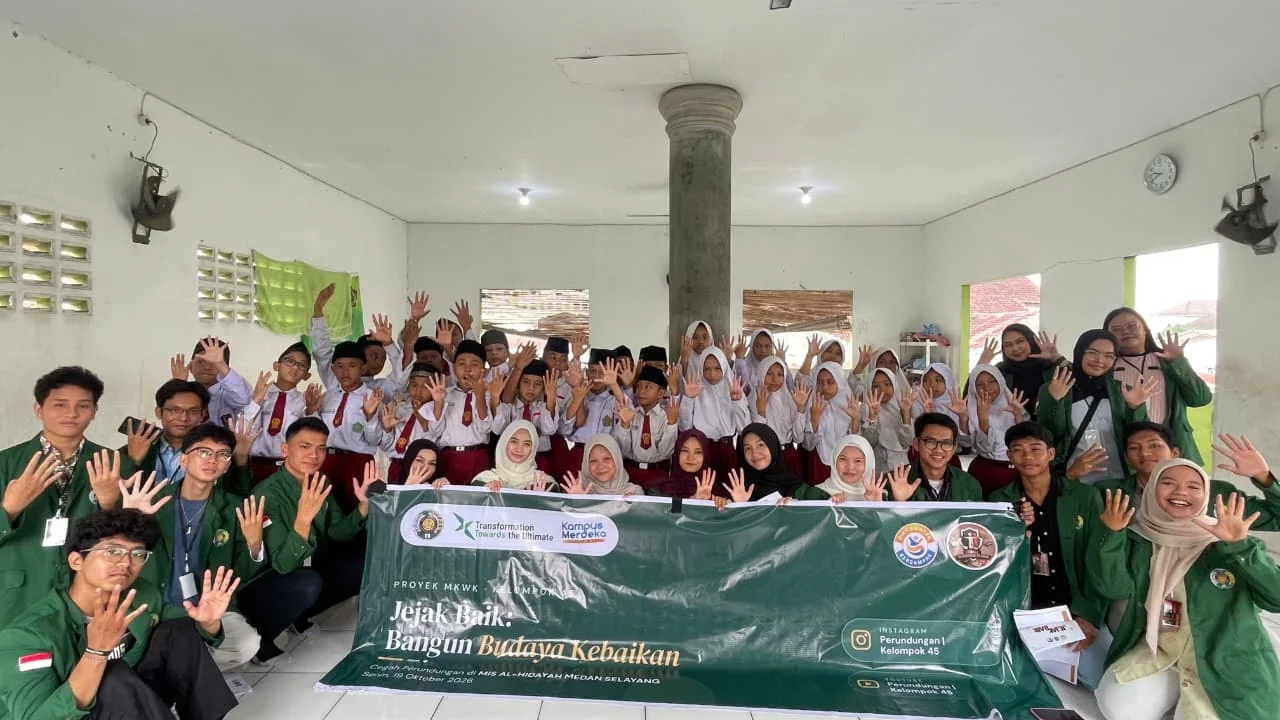
MEDAN, JurnalPost.com – A total of 20 students from the Universitas Sumatera Utara (USU), part of the Bullying Group 45 in the Compulsory Curriculum Course (MKWK), held an anti-bullying education program titled “Jejak Baik” (Good Tracks) at MIS Al-Hidayah, Jalan Padang Bulan, Medan Selayang, on 26 October and 2 November 2026.
Through the use of secret cards, animated videos, interactive games, and collaborative drawing activities, 30 students were encouraged to recognize various forms of bullying, cultivate empathy, and habituate selfless acts of kindness.
The program also serves as a contribution by USU students toward supporting the Sustainable Development Goals (SDGs), specifically Goal 4 regarding Quality Education and Goal 16 regarding Peace, Justice, and Strong Institutions.
Instilling an Anti-Bullying Culture from an Early Age
Preventing bullying from an early age was the primary motivation for this program. Bullying in educational settings remains an issue requiring attention from various stakeholders.
The 2022/2023 Education Report notes that 24.4 percent of students in Indonesia have experienced bullying. Meanwhile, the results of the 2022 National Assessment indicate that 36.31 percent of students are at risk of experiencing bullying.
In North Sumatra, 1,975 cases of violence against women and children were recorded throughout 2025, with 68.8 percent of the victims being children. Medan is reported to have the second-highest number of such cases.
At the elementary school level, bullying can manifest in verbal or social forms, such as teasing, name-calling, or excluding peers from social circles.
Addressing these issues, the USU MKWK students chose an approach based on positive behavioral habituation as a strategy for bullying prevention. Children are not only introduced to the negative impacts of bullying but are also encouraged to build habits of mutual respect and helping others.
Learning Anti-Bullying through Interactive Activities
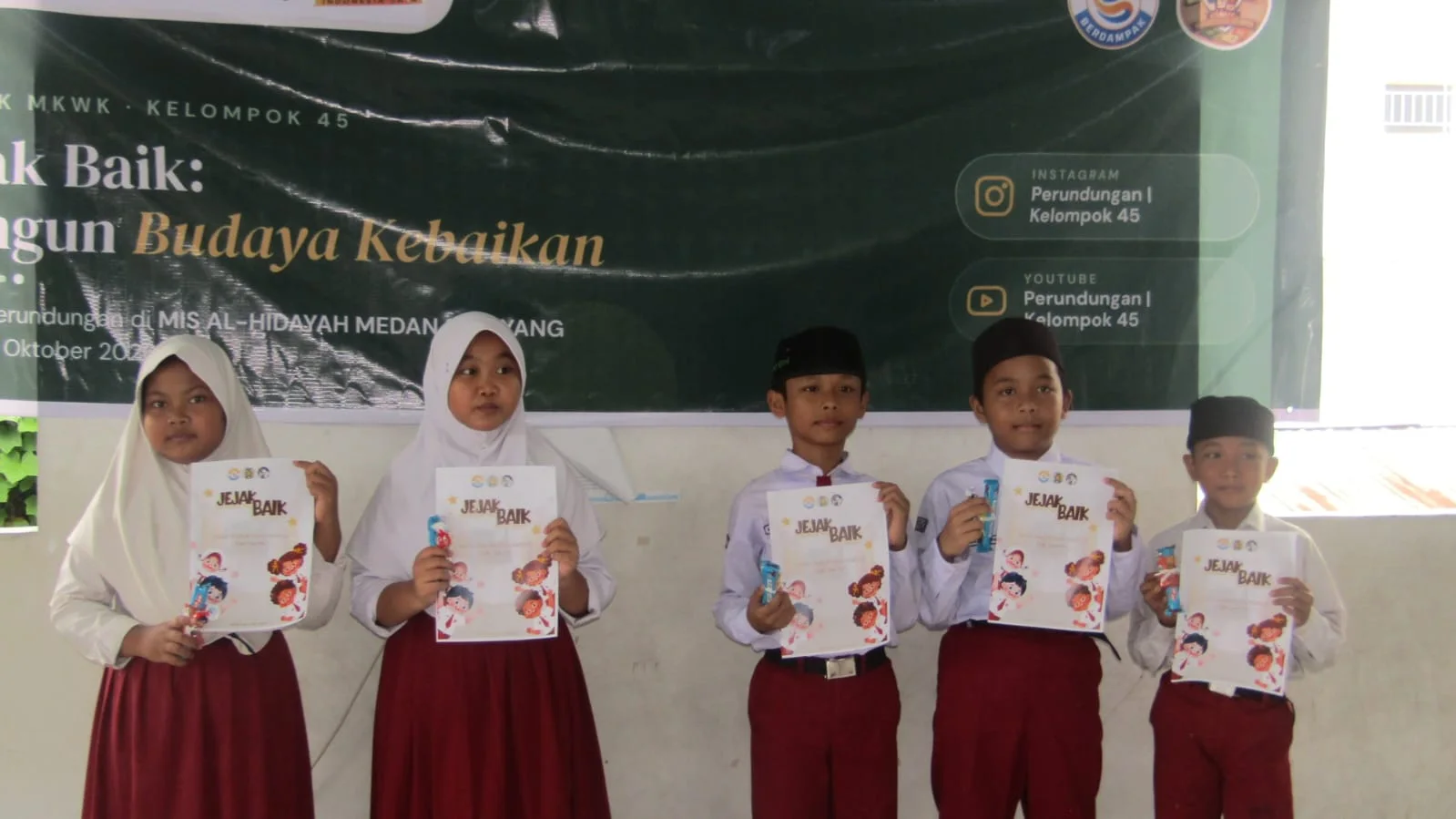
On the first day of the program, Monday (26/10/2026), the session began with opening remarks, an introduction to bullying, and the distribution of “Jejak Baik” cards to 30 MIS Al-Hidayah students.
The students provided insights into the various forms of bullying, its impact on victims, and the importance of building healthy friendships.
The activities continued on Monday (2/11/2026) with a presentation on the negative impacts of bullying via animated videos. The student team also incorporated interactive games and ice-breaking sessions to create a fun learning environment.
The students were enthusiastic throughout the activities, watching the videos closely, actively answering questions, and participating in games with great energy.
The session proceeded with a collaborative drawing activity using sheets of paper joined together to form a large canvas.
Through this medium, each student had the opportunity to express their feelings, creativity, and ideas about kindness. This activity also served as a means to practice teamwork, appreciate differences, and build camaraderie among students.
“Jejak Baik” Cards: Learning to Do Good Without Expectation
The primary innovation of this program is the use of “Jejak Baik” cards, a simple educational tool designed to encourage students to perform positive actions over a period of seven days.
Each card consists of two parts. In the first part, students are asked to record at least three different names of friends they interacted with each day. In the second part, they write down the various acts of kindness they performed.
The contents of the cards are kept secret so that students learn to perform acts of kindness without expecting recognition from their peers.
Various simple actions were recorded on the cards, ranging from helping friends with classroom chores, lending books, sharing snacks, to assisting friends who were struggling with their studies.
The head of the Bullying Group 45, Aulya Ningrum, explained that the program was designed so that children could understand the value of kindness through direct experience.
“We want children to get used to feeling the benefits of doing good, rather than just being told that bullying is wrong,” said Aulya Ningrum, head of the Bullying Group 45 of the USU MKWK.
After the recording period ended, the cards were collected and evaluated with the school. Students who met the requirements received prizes as a form of appreciation for their participation.
Evaluation Results Show Improved Student Understanding
Based on the evaluation of 30 students, all participants, or 100 percent, stated that they enjoyed working on the “Jejak Baik” cards.
A total of 80 percent of students understood the assigned tasks, while 86.67 percent expressed willingness to introduce the activity to other friends.
Improvement was also evident from the pre-test and post-test results. The average pre-test score of 87.33 increased to 94.67 in the post-test.
The number of students who achieved a perfect score also doubled, from 10 students to 20 students.
These evaluation results indicate an increase in student understanding regarding bullying after participating in the educational activities. However, continuous habituation is still necessary to determine the long-term impact on student behavior.
The Principal of MIS Al-Hidayah, Sri Ningsih Pardosi, S.Si., appreciated the approach used by the students to instill empathy in the children.
“Bullying cannot be eradicated just by punishment; this habituation through cards helps teachers instill empathy from an early age,” said Sri Ningsih Pardosi, S.Si., Principal of MIS Al-Hidayah.
A positive impression was also shared by one of the student participants, Nailah Hadilah, after completing the activities.
“After hearing the explanation from the older students, I know that teasing friends is hurtful. I wrote down that I helped a friend with their homework and shared my snacks; it was fun because my friends didn't know,” said Nailah Hadilah.
Promoting a Sustainable Culture of Kindness in Schools
The final evaluation recorded that 29 students, or 96.67 percent, committed to continuing to perform acts of kindness after the “Jejak Baik” card program ended.
Additionally, 28 students, or 93.33 percent, expressed a commitment to stop teasing their friends.
The student team recommends that the habituation through “Jejak Baik” cards be implemented periodically with the involvement and guidance of homeroom teachers.
The school is also expected to continue providing a safe space for students to voice the problems they face. Based on the evaluation, 40 percent of students chose to talk to their teachers when experiencing harassment from peers.
The activity concluded with the distribution of prizes to students, the presentation of tokens of appreciation to the school, and a photo session with the Principal of MIS Al-Hidayah.
Through the “Jejak Baik” program, the USU MKWK students hope that bullying prevention efforts can grow from simple habits practiced every day.
By instilling empathy, care, and mutual respect from an early age, the school environment is expected to become a safer, more comfortable, inclusive, and bullying-free learning space.





Comments 0
Write a Comment Share your response