

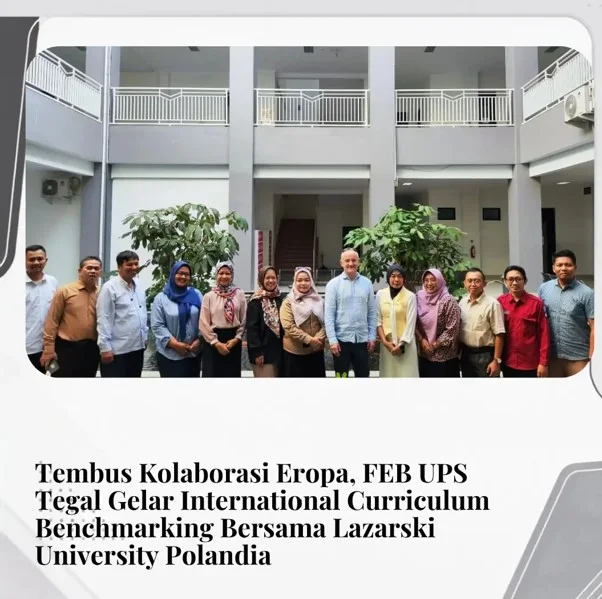
TEGAL, JurnalPost.com – The Faculty of Economics and Business (FEB) at Universitas Pancasakti (UPS) Tegal continues to expand its international academic network through an International Curriculum Benchmarking session with the Faculty of Economics and Management at Lazarski University, Warsaw, Poland, on Tuesday (3/11/2026).
Carrying the theme “Strengthening Global Partnership and Academic Collaboration,” this activity serves as a strategic step for FEB UPS Tegal to improve the quality of higher education while expanding opportunities for academic collaboration with institutions in Europe.
This initiative is also part of an effort to develop a curriculum that is more adaptive, innovative, and relevant to the advancement of science and the needs of the global labor market.
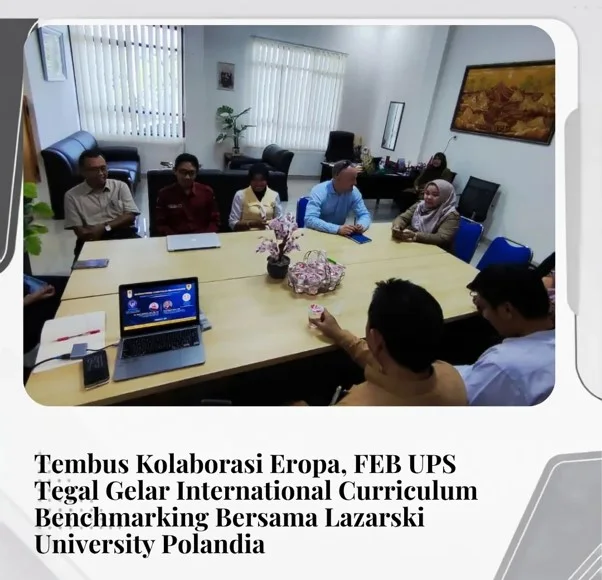
The Dean of the Faculty of Economics and Business at Universitas Pancasakti Tegal, Dr. Dewi Indriasih, MM., Ak., CA., along with the structural officials of FEB UPS Tegal, participated in discussions and academic insight exchanges with Prof. Martin Dahl, PhD, from the Faculty of Economics and Management at Lazarski University, Poland.
The meeting provided a space for academic communication to discuss experiences, ideas, and best practices in higher education, particularly in the fields of economics and business.
Both institutions had the opportunity to learn about each other's education systems, learning approaches, and curriculum development strategies.
Strengthening Education Quality through Curriculum Benchmarking
Curriculum benchmarking is the process of comparing and studying the curriculum of an educational institution against others that possess relevant academic experience and practices to serve as a reference.
This process is not merely about imitating another university's education system, but also aims to identify strengths, evaluate weaknesses, and discover development opportunities to improve learning quality.
In the context of the collaboration between FEB UPS Tegal and Lazarski University, the benchmarking activity provided an opportunity to learn how economics and business education is developed within an international academic environment.
Global economic developments, digitalization, changing public consumption patterns, and advancements in information technology have brought significant changes to workforce requirements.
Universities are expected not only to provide theoretical knowledge but also to equip students with practical skills, critical thinking abilities, communication, leadership, and the capacity to adapt to change.
Therefore, continuous curriculum evaluation is essential to ensure that learning materials and methods remain relevant to industry needs.
Through this international benchmarking, FEB UPS Tegal seeks to gain new perspectives in aligning curriculum development with the dynamics of global education.
Getting to Know Lazarski University in Poland
Lazarski University is a private higher education institution located in Warsaw, Poland. Founded in 1993, the university has over three decades of experience in providing higher education.
Lazarski University has three main faculties: the Faculty of Law and Administration, the Faculty of Economics and Management, and the Faculty of Medicine.
In the fields of economics and management, the university offers programs related to economics, international business, management, finance, and international relations. Several programs are conducted in both Polish and English.
An orientation toward international education is one of the hallmarks of Lazarski University in developing its academic network.
Through the Erasmus+ program, the university maintains partnerships with various universities, business schools, and law schools across numerous countries.
This international cooperation network opens opportunities for students and academic staff to participate in exchange programs, academic mobility, and international internships.
Lazarski University's experience in building cross-border education networks serves as a relevant reference for FEB UPS Tegal in strengthening education quality and developing academic collaboration opportunities.
Preparing Economics and Business Graduates for Global Competition
One of the primary focuses of the International Curriculum Benchmarking activity is to gain international perspectives on the development of economics and business curricula.
The changing business environment demands that university graduates possess increasingly diverse competencies. It is not enough for students to simply understand economics, accounting, management, and marketing theory; they must also be able to apply that knowledge to solve real-world business problems.
Digital technology, for instance, has transformed how companies conduct operations, market products, manage finances, and interact with consumers.
In facing these changes, several aspects can be considered in the development of economics and business curricula, including:
1. Strengthening digital competence
Students need to have an understanding of information technology, digital marketing, data analysis, and the utilization of technology in business activities.
2. Improving foreign language skills
Mastery of English is a vital skill to support professional communication and collaboration with individuals and companies from various countries.
3. Developing critical thinking skills
Students need to be equipped with the ability to analyze economic problems, evaluate information, and make decisions logically and responsibly.
4. Increasing practical learning experience
The learning process should connect theory with real-world conditions through case studies, business projects, research, entrepreneurial activities, and internship programs.
5. Understanding the global economy
Students need to understand international trade, global economic dynamics, market competition, and the development of economic relations between nations.
These five aspects can serve as considerations in curriculum development so that FEB UPS Tegal graduates possess competencies relevant to the needs of the business and industrial world.
Opening Opportunities for Academic Collaboration with European Universities
The International Curriculum Benchmarking with Lazarski University also serves as a momentum for FEB UPS Tegal to expand its academic network at the international level.
Interaction between higher education institutions has the potential to open opportunities for various academic activities, ranging from student and lecturer exchanges and international guest lectures to collaborative research, scientific seminars, and joint academic publications.
Cross-border collaboration can also provide students with broader learning experiences while enriching the perspectives of educators in developing teaching methods.
Through this activity, FEB UPS Tegal is expected to continue strengthening institutional capacity, improving curriculum relevance, and building an education ecosystem that is responsive to global developments.
This step is also part of Universitas Pancasakti Tegal's efforts to promote the internationalization of higher education and prepare a generation of professionals in the fields of economics and business who are competent, adaptive, and capable of competing at the international level.





Comments 0
Write a Comment Share your response