

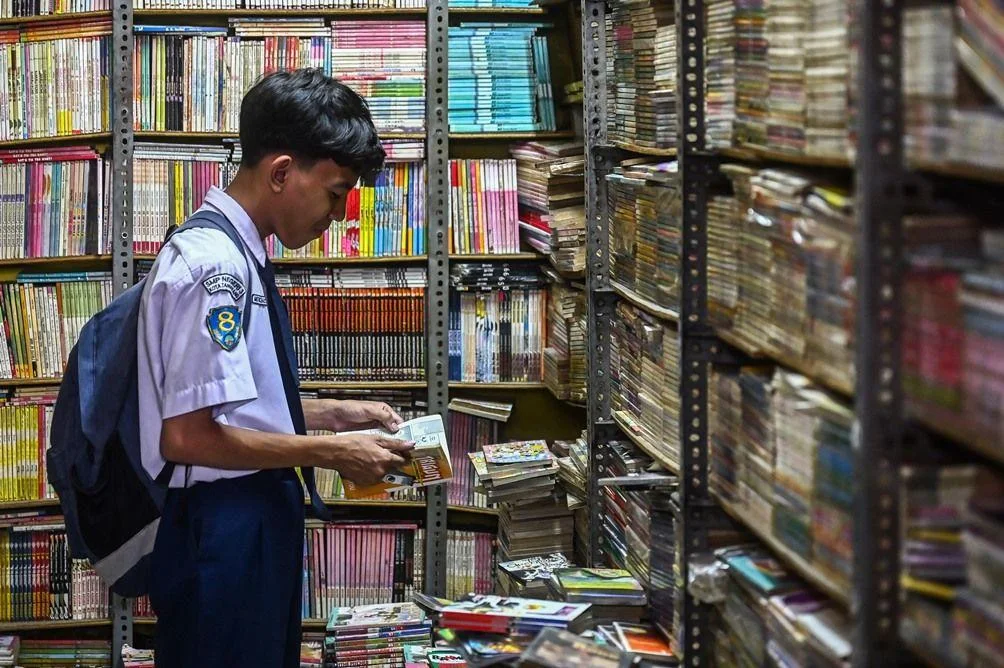
JurnalPost.com – Reading is often cited as a vital habit. During school ceremonies, principals frequently emphasize the importance of reading to expand knowledge. Parents often urge their children to read books rather than just playing with gadgets in their rooms.
However, amidst various government efforts to improve the quality of education, a major issue persists: does every Indonesian citizen have an equal opportunity to acquire knowledge?
In reality, one problem that often escapes public attention is the affordability of books as a tool for educating the public. Books are beneficial for gaining knowledge, developing mindsets, and building critical thinking skills to solve everyday life problems.
Unfortunately, some people still face obstacles in obtaining decent reading materials. For some, buying a book might be a minor expense. For other families, however, such an expenditure must be carefully reconsidered because there are still basic needs that must be met.
When books become difficult to afford, children from economically disadvantaged families potentially have fewer learning resources. Meanwhile, children who can afford books have broader opportunities to explore knowledge beyond school materials.
If this condition persists, economic disparities may affect learning opportunities. Yet, a person's desire to learn should not be hindered simply by economic limitations.
This situation causes concern because the public is constantly encouraged to improve their reading culture, while access to sources of knowledge remains uneven.
Constitutional Mandates and the Reality of Indonesian Literacy
Indonesia's independence does not only mean that the nation is free from the colonization of other countries, but it also marks the beginning of the struggle to build a just, prosperous, and knowledgeable society.
This is stated in the Preamble to the 1945 Constitution of the Republic of Indonesia (1945), which asserts that one of the goals of the Indonesian state is to educate the nation's life.
This goal emphasizes the importance of efforts to educate the Indonesian public, one of which can be realized through the improvement of literacy.
Meanwhile, Article 28C paragraph (1) of the 1945 Constitution states that every person has the right to develop themselves through the fulfillment of basic needs, to receive education, and to benefit from science and technology.
Furthermore, Article 31 paragraph (1) also states that every citizen has the right to receive education.
Both provisions show that education and knowledge development are part of the rights of the Indonesian people. Therefore, the state has a responsibility to encourage the availability of access to learning resources that can be utilized by various segments of society.
An overview of literacy challenges in Indonesia can be seen through the results of the Programme for International Student Assessment (PISA) 2025 published by the Organisation for Economic Co-operation and Development (OECD) in September 2026.
In that assessment, Indonesia obtained a score of 365 for reading ability, compared to a score of 359 in PISA 2022. Although there was a numerical increase, the OECD assessed that Indonesia's reading ability results in both periods were relatively the same.
Only about 27 percent of Indonesian students aged 15 reached the minimum competency of Level 2 or higher in reading, while the OECD country average reached 69 percent.
These results are related to various factors, such as the quality of learning, family environment, reading habits, and the availability of reading materials.
This data serves as a reminder that improving literacy skills still requires serious attention from the government and the Indonesian public.
The issue of equitable access to reading materials also needs attention. Based on data from the National Library of the Republic of Indonesia presented on 21 September 2026, there are 235,258 libraries recorded in Indonesia.
However, of that number, only 16,965 libraries or about 7.2 percent have been accredited.
Accreditation is one indicator to see the fulfillment of library quality standards, although accreditation status does not directly determine the suitability of the entire collection owned by a library.
The low number of accredited libraries remains a concern in efforts to promote the standardization of library services in Indonesia.
The existence of a large number of libraries does not necessarily guarantee that the public will obtain decent reading sources. Libraries also need to provide collections that are relevant to the needs of readers as well as services that support community learning activities.
Limited availability of reading materials can reduce students' opportunities to build reading habits outside the school environment.
In fact, the ability to understand reading does not only develop through classroom learning, but also through the process of reading and exploring various information independently.
Thus, equitable access to books needs to be viewed as a supporting effort in improving students' literacy skills.
Finding a Way Amidst Barriers to Book Access
The high price of books is not a problem that can be viewed from only one side. The selling price of books is influenced by various components, such as raw materials, the printing process, distribution costs, author royalties, and publisher operational costs.
Indonesia's geographical condition, which consists of many islands, makes this problem even more complex because it can cause book shipping costs to be higher in areas far from distribution centers.
As a result, readers in those areas must spend more to obtain the same book compared to readers living near sales centers.
This cost difference can further burden people with limited economic means. In fact, to obtain a book they truly want, someone might need to set aside money for quite a long time.
To buy a book on their wishlist, many people have to save up and reconsider their expenses. Ultimately, a simple thing like buying a book becomes something that cannot be done at any time.
In my opinion, this situation is quite concerning because the desire to acquire knowledge should not be an additional burden for people with limited economic means.
Although the high price of books is not solely the fault of publishers or the government, this condition shows the importance of the government's role in creating a more inclusive and sustainable literacy ecosystem.
On the other hand, technological developments actually open up opportunities to expand public access to knowledge.
Digital books, online libraries, and various other platforms can be alternatives for people who have difficulty obtaining printed books.
However, digitalization does not automatically solve all literacy problems. Not everyone has equal access to electronic devices and internet connections.
In my opinion, the government needs to pay greater attention to building literacy infrastructure that can improve the quality of public education sustainably, in addition to programs for meeting the nutritional needs of students.
Both need attention so that educational development is not only oriented toward meeting current needs but also toward improving the quality of human resources in the long term.
Building an Inclusive Literacy Ecosystem
The government needs to strengthen the existence of public libraries, school libraries, and community reading centers, especially in areas that still have limited facilities.
The provision of books does not only need to consider quantity, but also the quality and relevance of the collection to the needs of the community.
The government can also develop targeted book subsidy programs for students and people with limited economic means.
However, such policies will not fully solve the problem if book distribution still struggles to reach people in certain areas.
Therefore, literacy policies need to pay attention to price affordability, equitable distribution, and the quality of reading facilities simultaneously.
If this is done consistently, I believe that interest in reading across various levels of society can continue to grow.
However, the responsibility of building a literacy culture certainly does not lie solely in the hands of the government. Society, families, schools, and communities also have important roles.
Families can cultivate reading habits from an early age. Schools can create a learning environment that encourages student curiosity, while communities can provide spaces for sharing books and literacy activities for the general public.
In addition, the public needs to respect intellectual property by avoiding the purchase and distribution of pirated books.
Literacy as a Right, Not a Luxury
Ultimately, the issue of high book prices brings us back to the question of the meaning of educating the nation's life.
Education is not a process that stops when someone leaves school. Knowledge must be obtainable throughout life, and books are one of the means that make this possible.
Therefore, access to affordable and quality books needs to be part of the focus in national development.
A reading culture is not built solely through appeals and slogans. The public also needs opportunities, facilities, and access to adequate reading materials.
Do not let literacy become a luxury for those who can afford to buy books, while people with limited economic means must sacrifice the opportunity to acquire knowledge.
Because educating the nation's life means opening up learning opportunities for all people, regardless of their economic status.





Comments 0
Write a Comment Share your response