

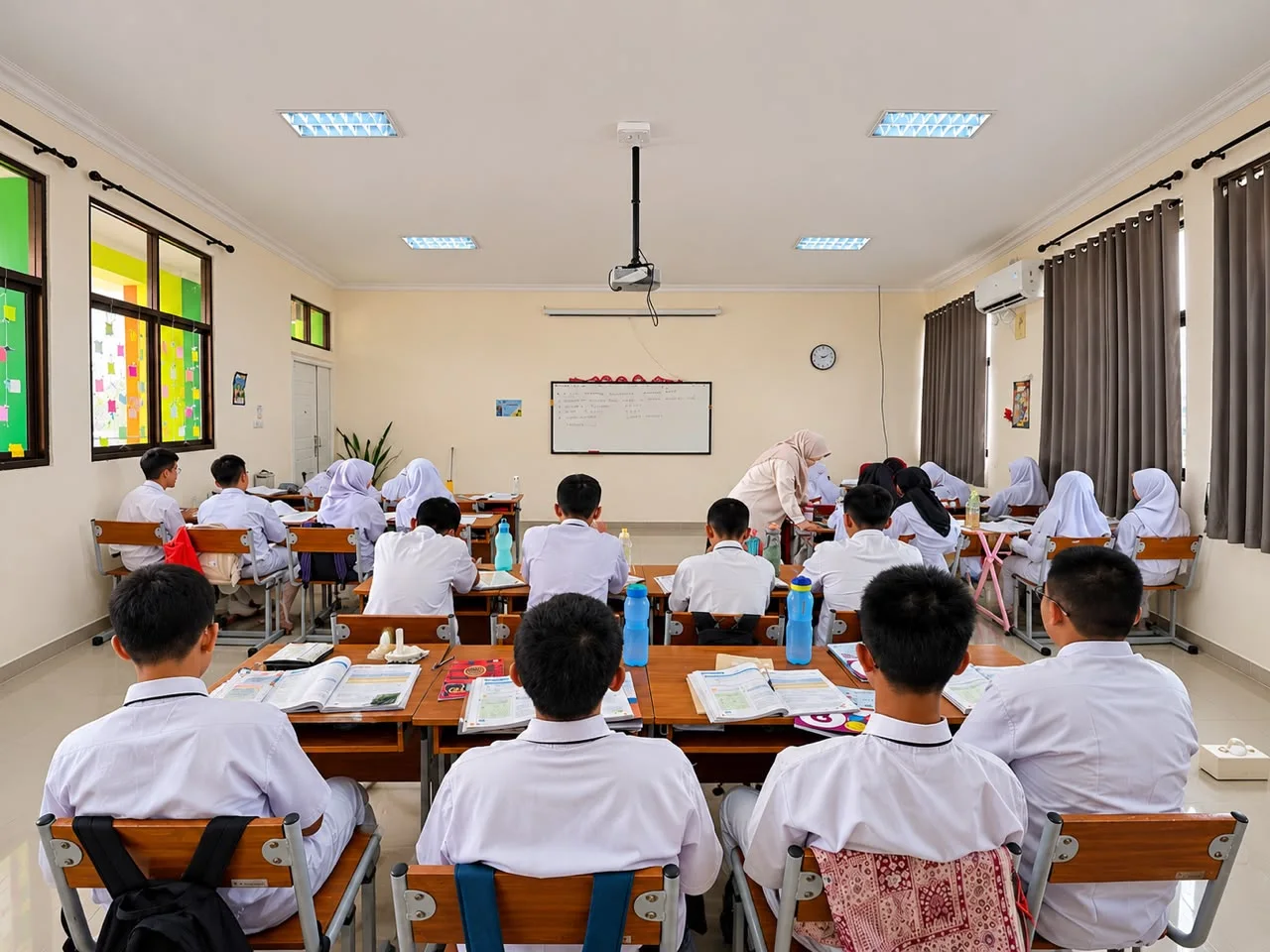
Learning Is More Than Just Sitting and Listening
Have you ever seen a classroom so quiet that you could barely hear a student's voice? At first glance, such an atmosphere might seem ideal. However, a quiet classroom does not necessarily mean that all students understand the lesson. Some may still be confused but choose to remain silent for fear of being wrong or feeling embarrassed to ask.
In reality, learning is not just about listening to a teacher's explanation. Students also need to think, ask questions, express opinions, and connect new material with their existing knowledge. Santrock and Roehrig (2024) explain that the learning process involves thinking, connecting prior knowledge, and evaluating one's own understanding.
One way to encourage student engagement is through simple questions and discussions. For example, in an English class, a teacher might ask students to recall previous material before moving on to a new topic. Questions and exercises are provided so that students do not merely receive information but actively attempt to grasp the material. When a student's answer is not quite right, the teacher provides follow-up questions or additional explanations so they can try again.
This approach demonstrates that questions are not just tools to test understanding, but also opportunities for students to learn. In this way, students do not just seek the correct answer, but also understand how that answer is derived.
The Right Support Makes Learning Easier for Students
Every student has different abilities and challenges. Some grasp material quickly, while others require simpler explanations or extra practice. Therefore, teachers cannot always use the same method to help every student.
In educational psychology, this approach is known as scaffolding. According to Santrock and Roehrig (2024), scaffolding is temporary support provided to students based on the abilities and difficulties they face.
This support can take the form of hints, examples, or guidance to make it easier for students to understand and complete tasks. As students begin to manage on their own, this support is gradually reduced until they can eventually learn independently.
For instance, in a Mathematics lesson, a student might understand fraction multiplication but still struggle with mixed numbers. The teacher can provide exercises specifically targeted at the areas the student has not yet mastered.
As students begin to understand the material, the teacher's support can be phased out until the students are capable of completing the work themselves. Meanwhile, other students can receive exercises tailored to their individual difficulties.
Therefore, the support provided is not just a repetition of the entire lesson, but is truly aligned with the students' needs. The goal is not to make students permanently dependent on the teacher, but to help them understand the material step-by-step until they can solve it independently.
Learning Can Also Come from Peers
Who says learning can only happen by listening to a teacher? Sometimes, an explanation from a peer feels easier to understand. Students can ask questions without feeling awkward, help each other with problems, or explain material using simpler language.
This way of learning is known as peer tutoring. According to Santrock and Roehrig (2024), peer tutoring is an activity where one student helps another understand material they have not yet grasped.
In Mathematics, teachers also provide opportunities for students to help one another when someone encounters difficulty. The teacher continues to monitor the process to ensure the explanations provided are accurate to the material.
Such interactions not only help students understand the lesson but also build social relationships within the classroom. Positive relationships between students and teachers, as well as interactions among students, play a role in supporting student engagement in learning (Gao, 2026).
This means that a good learning atmosphere is shaped not only by the material and teaching methods but also by the relationships formed within the classroom.
Praise and Correction That Encourage Students to Try
Getting an answer wrong does not mean someone is incapable of learning. On the contrary, mistakes can be an opportunity to identify which parts still need improvement. Therefore, how a teacher responds to student work plays a crucial role.
Praise can make students feel valued for their effort and success. This aligns with the concept of reinforcement , which is a consequence that increases the likelihood of a behavior being repeated (Santrock & Roehrig, 2024).
Praise from a teacher is a form of positive reinforcement that can encourage students to maintain positive behaviors, such as diligence, participation, and effort in learning.
However, students also need clear input when they make mistakes. For example, rather than immediately providing the correct answer, a teacher can invite students to re-examine their work and discover the source of their error themselves.
This approach is evident in learning activities. Students are given the opportunity to check their work, identify the incorrect parts, and then correct them on their own. The teacher does not always point out the answer immediately but helps the student understand the process that needs improvement.
This relates to the importance of self-assessment in the learning process (Santrock & Roehrig, 2024). Brandmo and Gamlem (2025) also explain that clear teacher feedback tailored to student needs can support motivation and engagement.
Thus, correction is not just about pointing out mistakes, but also about helping students understand how they can grow.
A Comfortable Classroom Still Needs Rules
A fun classroom does not mean a classroom without rules. Students may joke, discuss, and interact with friends as long as those activities do not disrupt the learning process. An atmosphere that is too serious can actually make students hesitant to share opinions or ask questions.
Good classroom management is not just about keeping students quiet and orderly. Teachers also need to build warm relationships, create open communication, and foster a sense of responsibility.
Santrock and Roehrig (2024) explain that classroom management is not just about order, but also about warm relationships and a sense of responsibility.
This aligns with Karasova and Nehyba (2023), who emphasize the importance of student-centered communication to create a positive learning environment.
Comfort can also be built through the way a teacher delivers material simply. Such things make learning feel more aligned with student needs.
Grades Are More Than Just Numbers
Have you ever received an unsatisfactory test grade? That grade does not mean someone has failed to understand the entire subject. It could be that there are certain parts that simply need to be studied again.
In learning, formative assessment helps teachers determine the extent to which students understand the material. The results can be used to decide the next steps, such as reviewing material, providing extra practice, or assisting students who need support (Santrock & Roehrig, 2024).
Ultimately, a grade is not just a number, but an opportunity to identify mistakes and develop into something better.
This is also evident in the use of daily quizzes. Through the results of student work, teachers can identify who has not yet mastered the material. This information can then serve as a basis for determining follow-up actions with the homeroom teacher.
Thus, assessment should not be viewed merely as a number. Grades can also serve as a guide for teachers and students to identify which parts have been understood and which parts still need improvement.
Bibliography
Brandmo, C., & Gamlem, S. M. (2025). Students’ perceptions and outcome of teacher feedback: A systematic review. Frontiers in Education, 10. https://doi.org/10.3389/feduc.2025.1572950
Gao, G. (2026). The role of teacher-student relationships in mediating the impact of peer relationships and grit on student engagement. Scientific Reports, 16(1). https://doi.org/10.1038/s41598-026-55996-7
Karasova, J., & Nehyba, J. (2023). Student-centered teacher responses to student behavior in the classroom: A systematic review. Frontiers in Education, 8. https://doi.org/10.3389/feduc.2023.1156530
Santrock, J. W., & Roehrig, A. D. (2024). Educational psychology (8th ed., international student ed.). McGraw Hill.


Comments 0
Write a Comment Share your response