

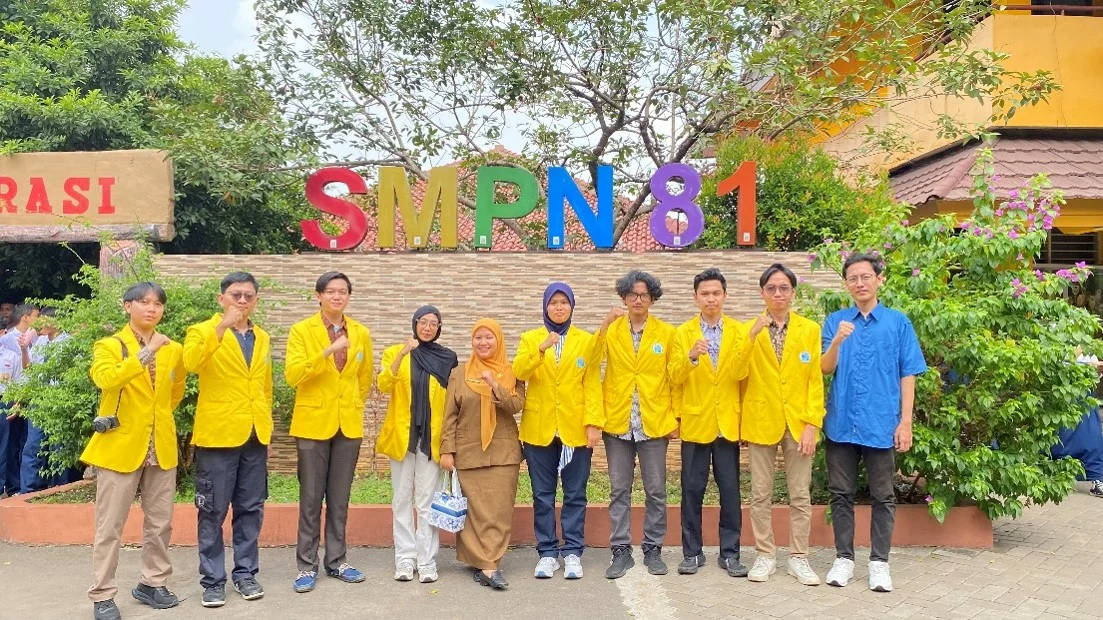
JAKARTA, JurnalPost.com — Students from the Electrical Engineering Department at the Jakarta State Polytechnic (PNJ) provided digital literacy education to students at SMP Negeri 81 Jakarta regarding the wise, critical, and responsible use of artificial intelligence (AI).
The outreach activity took place on Monday (2/11/2026) at SMP Negeri 81 Jakarta, located in Lubang Buaya Village, Cipayung District, East Jakarta.
Carrying the theme "Using AI for Learning and How to Filter Information Wisely in the Digital Era," this activity aimed to improve students' understanding of how to utilize AI technology to support their studies while anticipating the negative impacts of its use.
The session was conducted interactively through material presentations, discussions, quizzes, and various educational games. Students were not only introduced to the development of AI technology but were also encouraged to think critically when receiving, processing, and verifying information in the digital space.
This activity was part of the final project requirements for the Pancasila Education course for PNJ Electrical Engineering students. Through this outreach, the students sought to implement the values of Pancasila in society by contributing to the fields of education and digital literacy.
Introducing the Benefits and Risks of AI Use
The workshop material was organized into five main modules, covering AI development, the positive impacts of AI, the negative impacts of AI, ethics and policies for AI use, and techniques for filtering information.
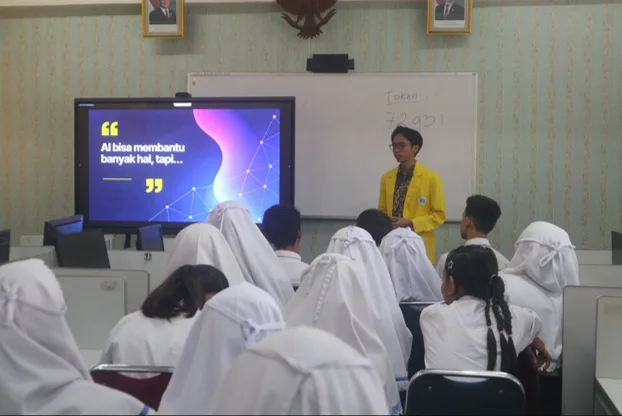
These five modules were designed to provide a comprehensive understanding of the benefits of technology, the risks of its use, and the responsibilities that users must observe.
Understanding AI has become increasingly important as the technology has become a part of students' daily lives. Various features such as content recommendations, automatic translators, and chatbots are examples of AI applications that can assist human activities.
However, this convenience must be balanced with the user's ability to assess the accuracy of the information produced.
One of the speakers, Daffa Firmansyah, explained that AI has great potential to support the learning process. Nevertheless, users must maintain control and not become entirely dependent on the technology.
"AI can help us think, explore ideas, and understand difficult lesson materials, but we must still verify the results. The main message is to use AI as a tool, not as a replacement for our own critical thinking skills," said Daffa Firmansyah.
Teacher Highlights Students' Habit of Copying AI Answers
The importance of education regarding AI use is also evident from conditions observed in the school environment.
Elsa, a teacher at SMP Negeri 81 Jakarta, revealed that the habit of using AI instantly has begun to appear when students complete school assignments.
Some students tend to use the answers generated by AI directly without performing further checks on the content or the accuracy of the information.
"Currently, many students, when given an assignment, immediately copy the answers from AI without checking or re-reading them first. I hope that with this outreach, they become more aware that they can verify AI answers," said Elsa.
Responding to this situation, the speaker team introduced the phenomenon of AI hallucinations, a condition where artificial intelligence systems produce information that looks convincing but actually contains errors or is not factual.
This phenomenon is one of the important reasons for users not to trust all answers generated by AI immediately.
Students Encouraged to Become Information Detectives
To build critical thinking habits, PNJ students introduced three practical steps to the students so they could become "information detectives" in the digital space.
The first step is to double-check facts, both in text and visual formats. One method introduced was the use of Google Lens to help trace the source or context of an image.
The second step is to check the authenticity and credibility of reference sources. Students were encouraged not to rely on just one source of information but to verify with other relevant sources.
The third step is to use one's own reasoning before believing or sharing information with others.
In addition to the ability to filter information, students were also given an understanding of the importance of maintaining personal data security in the digital space.
They were reminded not to enter confidential information into AI chatbot services and to be more careful in managing social media account privacy.
This is important because activities in the digital space can leave traces that have the potential to be stored and spread in the long term.
Student Answer Accuracy Reaches 83.43 Percent
To evaluate the understanding of the material presented, PNJ students held a web-based interactive quiz consisting of 14 questions with three levels of difficulty: easy, medium, and hard.
The questions were displayed via a Smart TV at the front of the class, while students used their respective mobile phones to select answers directly.
Based on the recapitulation of the quiz results followed by 34 participants, the average accuracy of answers reached 83.43 percent, with an average of 11.68 correct answers out of a total of 14 questions.
These results provide an overview of the students' ability to answer questions related to the outreach material.
After the quiz session, the activity continued with an AI-generated vs. real image guessing game. Through this game, students were invited to identify the differences between images produced by artificial intelligence and real images.
This activity served as a means to reinforce the material while providing a more enjoyable learning experience. The student team also provided prizes for participants who achieved the best results in the quiz and games.
Building a Critical and Responsible Generation
The outreach activity concluded with the distribution of prizes to the winners, the presentation of souvenirs to the school, and a group photo session with PNJ students and SMP Negeri 81 Jakarta.
Through this educational activity, students from the PNJ Electrical Engineering Department contributed to improving digital literacy in the educational environment, specifically in building habits of using AI ethically, critically, and safely.
This education is expected to be a foundation for students in facing the increasingly rapid development of digital technology.
With the right understanding, artificial intelligence can be utilized as a means to support learning and knowledge development without eliminating the critical thinking skills, independence, and responsibility of its users.
Author: Pandu Muhammad Fazri, Nazarudin Zidan, and David Vernando
Institution: Department of Electrical Engineering, Jakarta State Polytechnic (PNJ)





Comments 0
Write a Comment Share your response