

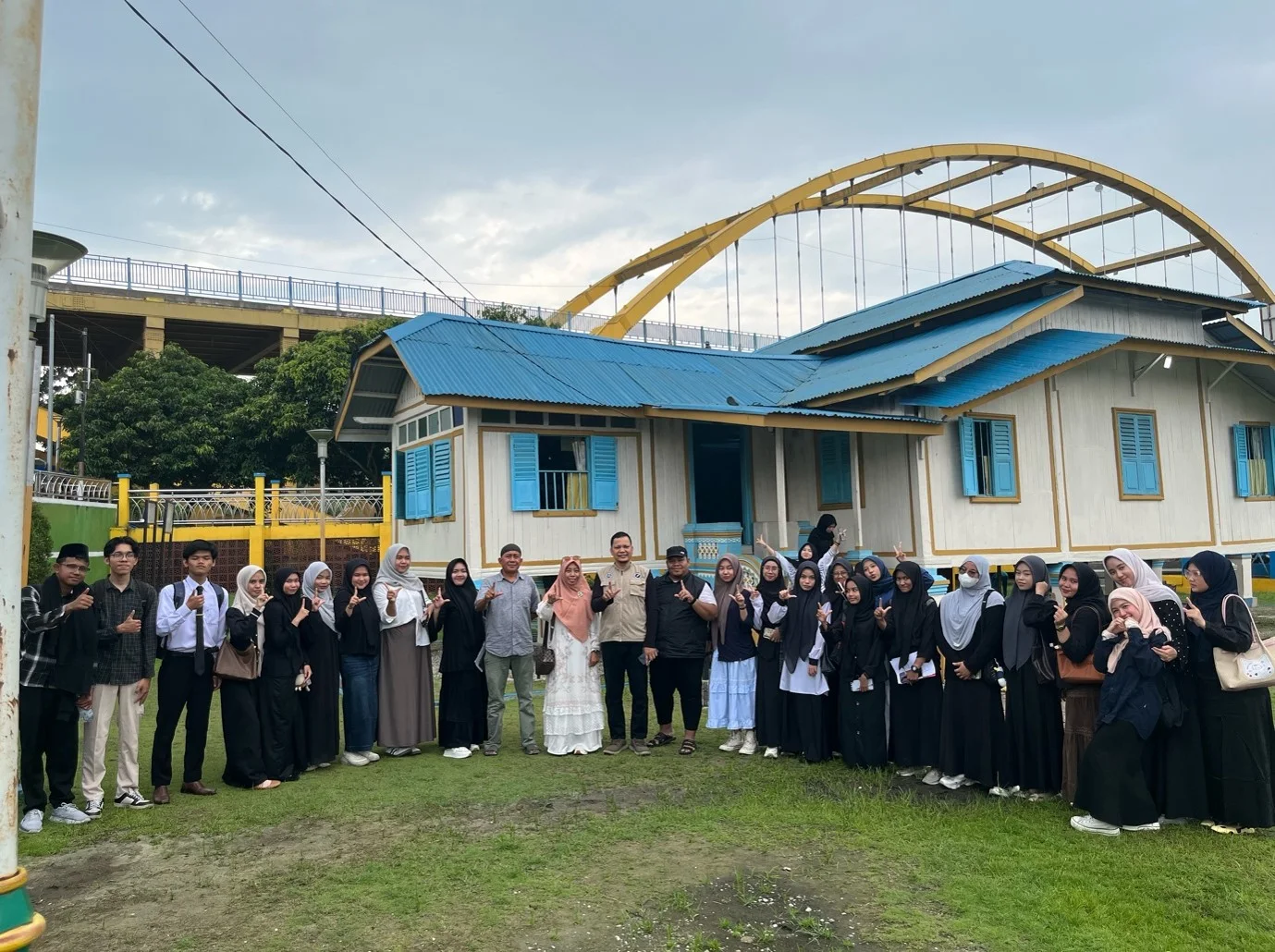
PEKANBARU — Amidst the rapid technological advancements reshaping daily life, safeguarding cultural identity has become increasingly vital. Driven by this spirit, students from the English Education Study Program at the Islamic University of Riau (UIR) conducted an educational visit to the Tuan Kadi Guest House, one of the oldest historic Malay cultural heritage buildings in Pekanbaru.
The visit was organized by Fitri Wulandari, M.Pd., the lecturer for the News Writing and Reporting course. The activity aimed to provide students with hands-on experience in journalistic reporting while deepening their understanding of local history and culture.
Beyond studying journalism in the classroom, students observed various historical artifacts, interviewed cultural activists, and documented information directly on-site.
This activity demonstrates that journalism is not merely about writing news, but also serves as a medium to preserve the stories that shape a community's identity.
Exploring the History of the Tuan Kadi Guest House
Standing on the banks of the Siak River, the Tuan Kadi Guest House remains a symbol of Malay civilization that has endured to this day in Pekanbaru.
According to Syarifuddin, S.S., a cultural guide from the Lancang Kuning Malay Cultural Center, the traditional house was built around 1895 and represents the authentic architectural style of the Malay community.
Its Limas Pancung-shaped roof is a hallmark of traditional Malay houses, easily recognizable and continuing to attract visitors from various regions.
During the visit, students learned that every part of the building holds profound cultural and religious significance.
The five steps leading to the main entrance symbolize the five pillars of Islam, reflecting the close bond between Malay customs and Islamic values.
Near the entrance, there is a water basin that was once used by guests to wash their feet or perform ablution before entering the house. This tradition symbolizes respect and the importance of maintaining cleanliness.
The Seclusion Room and Malay Architectural Philosophy
Another unique feature is the Bilik Pingit, or seclusion room, located on the upper floor. In the past, this room was reserved for unmarried women approaching marriage.
From this room, a woman could discreetly observe men arriving for the taaruf process, while upholding the customs and values cherished by the Malay community.
Students also studied the building's construction techniques. The use of vertically arranged wooden planks required a significant amount of timber, indicating that the homeowner at the time was from a well-to-do family.
Despite undergoing various preservation efforts, the house has maintained its authenticity.
Most of the furniture currently on display consists of carefully crafted replicas designed to depict the lives of people in the past, while protecting original heritage items from damage.
Efforts to Preserve Cultural Heritage
According to the site management, the Tuan Kadi Guest House is currently preserved under the supervision of the local Culture and Tourism Office.
Conservation officers routinely inspect the wooden structure, provide preservative treatments when necessary, and report any structural damage for follow-up restoration.
These ongoing efforts ensure that this historic building remains a resource for education, research, and tourism.
The cultural guide also explained that the title 'Tuan Kadi' refers to an Islamic religious judge appointed by the Sultan of Siak. In addition to serving as a religious authority, the Tuan Kadi also acted as an advisor to the Sultan.
This historical role highlights the close connection between the Tuan Kadi Guest House and the Siak Sultanate, which contributed significantly to the early history of Pekanbaru's development.
Maintaining Cultural Identity Amidst Modernization
Today, the Tuan Kadi Guest House is more than just a historic building. It has become a center for cultural learning, a site for academic visits, photography, documentary film production, and various educational competitions.
Although modernization continues to change the urban landscape and societal lifestyles, the existence of this historic house serves as a reminder that development should not come at the expense of cultural identity.
At the end of the visit, students reflected on the importance of introducing local cultural heritage to the younger generation.
Through journalism, digital media, and various educational activities, cultural values can be introduced to a wider audience, extending beyond the local community.
Therefore, modern technology should not be viewed as a threat to tradition, but rather as an effective tool to preserve and promote cultural heritage.
The educational visit concluded with a shared understanding that progress and tradition do not have to be contradictory. Instead, they can complement and strengthen one another.
As innovation continues to evolve in society, cultural heritage must remain an essential part of education and public life.
Only by understanding the past can future generations move toward the future with confidence without losing their identity.
By Maysa Thahira
English Education Study Program, Faculty of Teacher Training and Education (FKIP), Universitas Islam Riau
Sources:
Fitri Wulandari, M.Pd., Lecturer for the News Writing and Reporting course, Universitas Islam Riau.
Syarifuddin, S.S., Cultural Guide at the Lancang Kuning Malay Cultural Center.
Management of the Tuan Kadi Guest House.
Field observations and interviews conducted by students of the English Education Study Program, Universitas Islam Riau, during the educational visit.









Comments 0
Write a Comment Share your response