

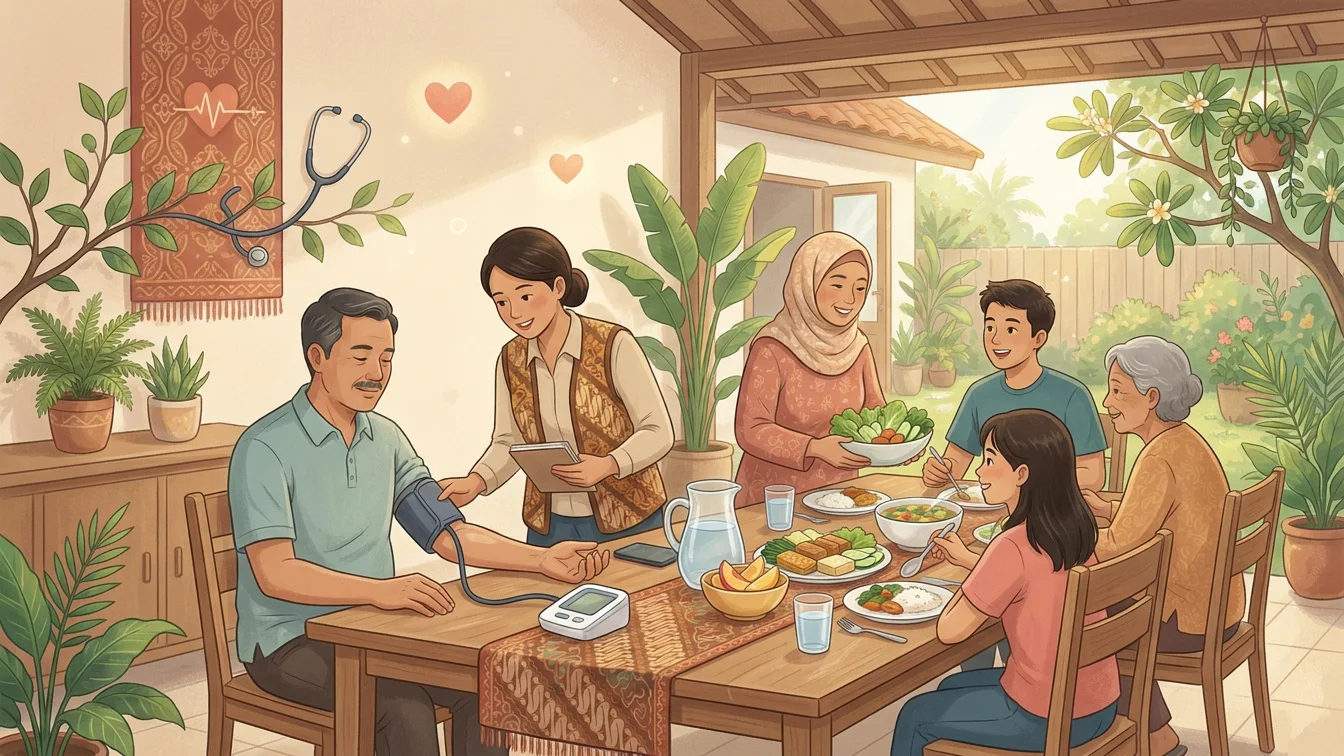
JurnalPost.com - In Indonesia, hypertension remains a major public health challenge. It is often dubbed the silent killer because it frequently presents no clear symptoms, yet it significantly increases the risk of heart disease, stroke, and other complications. According to the Indonesia hypertension profile published by the WHO (2025), the prevalence of hypertension among the population aged 30–79 years is estimated to reach 43% or approximately 61.5 million people. Of this number, about 58.5 million individuals have not achieved controlled blood pressure. This figure indicates that the hypertension issue is not merely a matter of high blood pressure, but also a challenge in maintaining consistent long-term disease management.
The Socio-Cultural Role Behind Hypertension Control Behavior
Thus far, approaches to hypertension management have tended to place the burden of responsibility on the individual, such as medication adherence, routine blood pressure checks, and lifestyle modifications. The question is, does every individual have the equal privilege and capacity to implement these? Understanding the importance of a low-salt diet often clashes with family culinary traditions, food access, economic limitations, and environmental pressures. Therefore, it is unfair to label the failure to control blood pressure solely as personal negligence; there are social, cultural, and ecological factors that dictate a person's health decisions.
This picture is reinforced by research from Usman et al., (2026) in Jatinangor, West Java. The study, which involved 24 informants (hypertension patients, family members, health cadres, and health workers), was conducted through interviews to identify various barriers to maintaining self-managementbehaviors. These barriers include limited information and misconceptions about hypertension, low perception of disease susceptibility and severity, lack of family support, social gathering habits and food culture, and skepticism regarding the benefits of treatment. These findings prove that hypertension control behavior is not formed in a vacuum but is influenced by an individual's interaction with their social environment.
On the other hand, public perception of hypertension also determines a person's decision to undergo treatment. Hypertension, which often shows no symptoms, can make many patients feel fit even though their blood pressure exceeds safe thresholds. Consequently, a mistaken perception arises that medication only needs to be taken when the body feels uncomfortable or when blood pressure spikes. In reality, hypertension is a chronic disease that requires regular, long-term control and treatment. Research by Alfian et al., (2025) on 53,668 hypertension respondents in the 2023 Indonesia Health Survey data shows that a lack of information regarding the importance of long-term antihypertensive treatment is associated with low patient adherence to treatment. These findings indicate that health education is not enough to just convey information; it also needs to improve public understanding of the importance of undergoing treatment regularly and sustainably.
Beyond individual perception, social norms and habits also play an important role. The habit of serving high-sodium dishes at the family dining table and the stigma that changing one's diet is difficult can be obstacles to hypertension control. Research by Rahman et al. (2025) on 380 hypertension patients in rural areas of Bondowoso Regency shows that attitudes, subjective norms, perceived behavioral control, and intentions are related to hypertension prevention behavior. This means that changing health behavior does not rely solely on individual knowledge. Support from family, the environment, and social norms that encourage healthy behavior is also necessary.
Self-Management Is Not Just an Individual Responsibility
Given this complexity, self-management approaches become highly relevant. Self-management is not just a person's ability to care for themselves, but a process of building knowledge, skills, and independence to manage their health condition. For hypertension patients, this practice includes dietary management, physical activity, adherence to medication as prescribed by health workers, regular blood pressure monitoring, and stress management. However, these efforts need to be supported by easily understood education, family involvement, health worker guidance, and an environment that allows individuals to maintain healthy behaviors.
Empowerment through self-management also does not mean that the entire responsibility for disease control is placed on the patient. Conversely, individuals have the right to receive opportunities and support to play an active role in maintaining their health. Health workers and cadres function as facilitators of contextual education, while families play a role in creating a household environment that supports healthy habits. This approach is in line with the findings of Rahman et al., (2025) which emphasizes the importance of social factors and perceived behavioral control in shaping hypertension prevention behavior.
In addition to lifestyle improvements and treatment adherence, complementary self-care skills can also be introduced as part of health education. One of these is self-acupressure , which is the skill of applying pressure to specific points that can be learned through education and guidance. Research by Jung and Kim (2023) shows changes in blood pressure and improvements in several domains of quality of life in groups that performed self-acupressure for eight weeks. Although these results still require further research, particularly with adequate control groups, acupressure can be considered as one of the complementary skills to support self-care. This practice is certainly not intended to replace antihypertensive medication or medical examinations.
Controlling Blood Pressure to Improve Quality of Life
Ultimately, the success of hypertension control should not be measured solely by the blood pressure numbers that have been successfully lowered. Quality of life also needs to be a concern because someone with hypertension must still be able to carry out daily activities, maintain social relationships, and have psychological well-being. Research by Wahyuni et al., (2025) on 204 individuals with hypertension in Medan shows a relationship between a number of biopsychosocial factors, such as stress levels, income, occupation, social support, and physical activity, with quality of life. These findings reinforce the view that the quality of life of hypertension patients is not only related to biological conditions but is also influenced by psychological and social situations.
It is now time for hypertension control to be oriented not only toward blood pressure checks and medication administration, but also toward efforts to build individual independence in managing their health. Health promotion programs need to be designed by considering the habits, values, beliefs, economic conditions, and social support existing in the community. Synergy between family and community is key so that health knowledge does not stop in the counseling room, but is internalized into sustainable daily habits.
Hypertension is not just a matter of numbers on a blood pressure monitor. Behind every number, there is an individual with a different life, habits, limitations, and needs. True hypertension control is not only measured by normal blood pressure, but also by ensuring every individual has the ability and support to live a healthier, more independent, and higher-quality life.
References
Alfian, S. D., et al. (2025). Factors influencing long-term antihypertensive treatment adherence based on 2023 Indonesia Health Survey data. Patient Preference and Adherence, 194141–4151. doi: 10.2147/PPA.S557301
Jung, H., & Kim, J. (2023). Effectiveness of self-acupressure for eight weeks on blood pressure and quality of life domains. Healthcare, 11(15), 2182. https://doi.org/10.3390/healthcare11152182
Rahman, A., et al. (2025). Relationship of attitudes, subjective norms, perceived behavioral control, and intentions toward hypertension prevention behavior in rural areas of Bondowoso Regency. Ethiop J Health Sci. 35(3):151–164. doi: 10.4314/ejhs.v35i3.2
Usman, S., et al. (2026). Socio-cultural and behavioral barriers in maintaining self-care for hypertension patients in Jatinangor, West Java. BMC Public Health. doi: 10.1186/s12889-026-27470-6
Wahyuni, S., et al. (2025). Relationship of biopsychosocial factors to the quality of life of hypertension patients in Medan. The Open Public Health Journal, 18, e18749445367472. DOI: 10.2174/0118749445367472250206101527
World Health Organization. (2025). Hypertension profile: Indonesia. https://www.who.int/publications/i/item/9789240115569


Comments 0
Write a Comment Share your response