

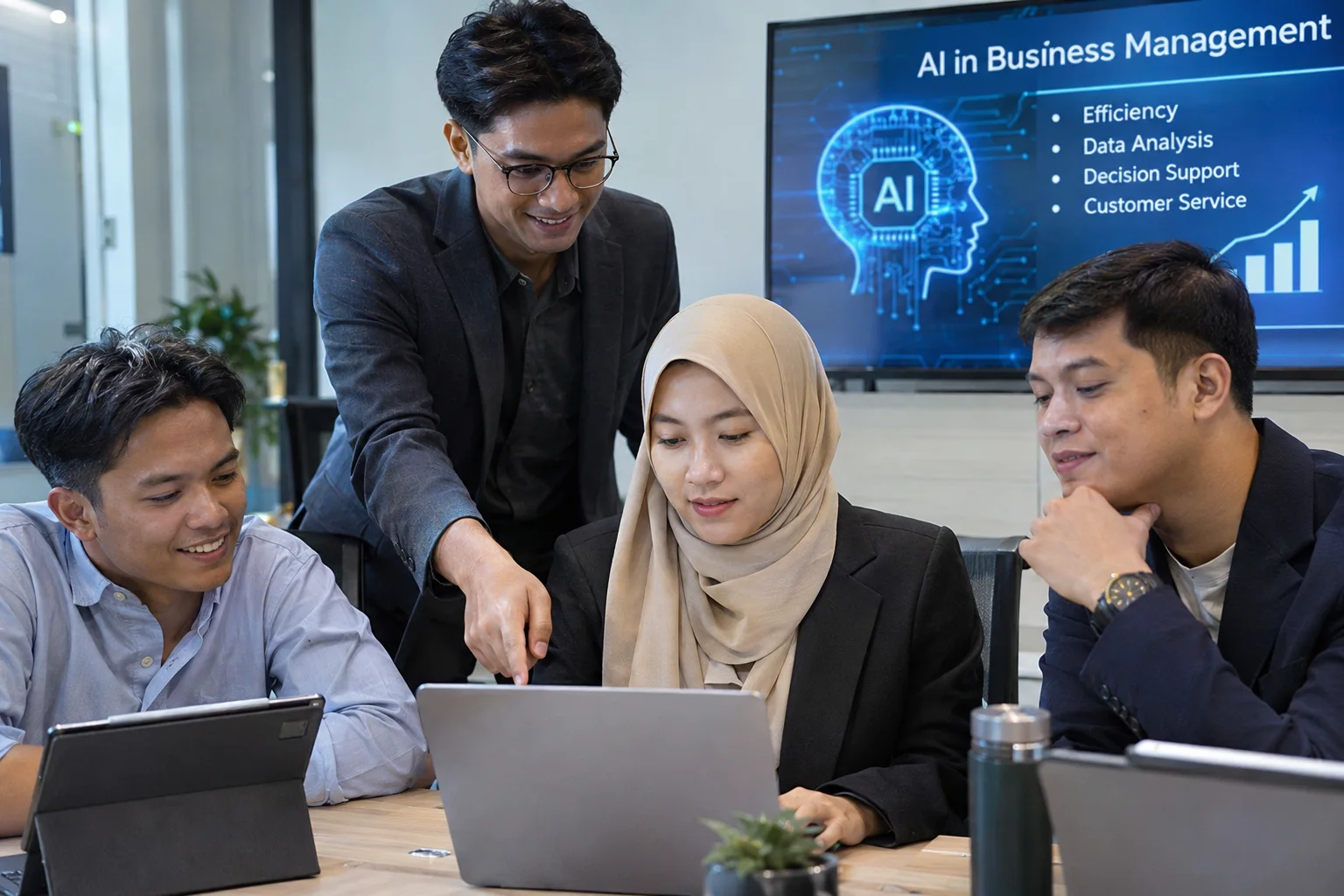
JurnalPost.com – The evolution of digital technology has fundamentally altered how companies conduct business. One of the most significant shifts gaining widespread attention is the emergence of artificial intelligence (AI).
This technology is capable of assisting with administrative tasks, processing data, drafting report summaries, handling customer inquiries, and supporting decision-making processes. Its presence offers companies the opportunity to operate with greater speed, productivity, and efficiency.
However, one crucial point must not be overlooked: sophisticated technology does not automatically equate to effective management.
In my view, the greatest challenge for companies today is not merely following the trend of AI adoption, but ensuring that this technology is genuinely utilized to achieve business objectives and enhance the quality of human work.
Companies that focus solely on purchasing hardware or subscribing to applications without preparing their human resources, work processes, and oversight systems risk wasting valuable resources.
Artificial Intelligence as Part of Business Strategy
This transformation is not just speculation. Microsoft, in its Work Trend Index report 2025, states that 97 percent of business leaders in Indonesia view the year 2025 as a momentum to review their company strategies and operations.
The same report notes that 59 percent of business leaders in Indonesia state that their companies have already utilized AI agents to automate workflows.
These figures indicate that the utilization of artificial intelligence has become an integral part of business strategy, rather than just a technological experiment.
Nevertheless, the implementation of AI must be placed within an appropriate management framework. The functions of planning, organizing, directing, and controlling remain essential foundations for running an organization.
During the planning stage, leadership must define the specific problems they intend to solve through technology. Does the company want to accelerate customer service, reduce data entry errors, improve sales analysis, or increase the accuracy of reporting?
Without clear objectives, the use of AI can easily turn into a project that looks modern but fails to deliver tangible impact for the company.
Balancing the Roles of Humans and Technology
In the organizing function, companies need to determine the division of roles between employees and AI systems. Not all tasks are suitable for full automation.
Routine and repetitive tasks can be assisted by technology. Meanwhile, tasks requiring empathy, negotiation, ethical judgment, creativity, and contextual understanding still require human involvement.
The division of responsibility must also be clear so that employees know who is reviewing AI outputs and who is accountable when errors occur.
The presence of technology should be an opportunity for humans to develop their skills, not merely an excuse to reduce their involvement in the organization.
With proper utilization, employees can allocate more time to strategic tasks that provide added value to the company.
Leadership Tested Amidst Digital Transformation
The directing function is equally important in facing technological change. Digital transformation often triggers anxiety, especially when employees feel their skills or jobs might be replaced.
This is where the quality of leadership is tested.
Leaders need to explain the reasons for change, listen to employee feedback, and provide training that aligns with organizational needs.
Employees should not only be asked to use new systems but also be given the opportunity to understand the benefits, limitations, and how to verify the results provided by the technology.
Examples can be seen in administrative and financial work. AI can assist in categorizing documents, summarizing transactions, or flagging unusual data.
However, these results still need to be reviewed by personnel who understand company policies and the context of the transactions.
Errors in reading numbers, interpreting documents, or entering data can impact the quality of reports and business decisions. Therefore, speed must not override accuracy and accountability.
Adaptive leaders are not only capable of following technological developments but are also able to guide human resources to grow alongside those changes.
The Importance of Oversight and AI Ethics
The controlling function must ensure that AI utilization is safe, effective, and compliant with regulations.
Companies need to have guidelines regarding the types of data that can be entered into AI applications, who is authorized to access them, mechanisms for verifying results, and procedures for reporting if errors occur.
Confidential company information, customer data, and financial documents should not be entered into digital services without ensuring security and authorization for their use.
Beyond data security, companies also need to pay attention to potential biases, inaccuracies in information, and the risks of over-reliance on technology.
Oversight is not intended to hinder innovation, but to ensure that innovation does not create new problems that harm the organization or society.
Three Strategic Steps for Facing the AI Era
In my opinion, there are three steps that companies need to prioritize in facing the development of artificial intelligence.
First, initiate AI implementation based on specific business needs, not merely the desire to follow trends.
Second, enhance employee competence through training in digital literacy, analytical skills, creativity, and critical thinking.
Third, conduct periodic evaluations using clear indicators, such as task completion time, error rates, service quality, and user satisfaction.
Through these steps, companies can assess whether the use of technology truly provides added value or instead creates new operational burdens.
The success of digital transformation is not determined solely by the sophistication of the devices, but by the organization's readiness to manage change.
The Future of Business Still Requires Humans
Ultimately, the future of business management is not a competition between humans and machines. That future is more accurately understood as a collaboration.
Technology helps process information and handle repetitive tasks, while humans set the direction, assess context, build relationships, and take responsibility for decisions.
Companies capable of combining both in a balanced manner will be better prepared to face changes and business competition.
Technology may become increasingly intelligent, but business success still requires leadership that is wise, principled, and responsible.
Therefore, the measure of a company's progress should not be how much technology is used, but how well that technology helps humans work, serve customers, and achieve organizational goals sustainably.
Artificial intelligence is a tool to strengthen management, not to replace the essence of human leadership.
Reference:
Microsoft. (2025, 23 June). Microsoft Releases Work Trend Index Report 2025: Boosting Indonesia's Potential Through Human and AI Collaboration. Microsoft Indonesia.



Comments 0
Write a Comment Share your response