

JurnalPost.com - Corruption does not always begin with the misappropriation of state funds; it can grow from small, normalized habits. Indonesia's Anti-Corruption Behavior Index (IPAK) in 2024 was recorded at 3.85 on a scale of 0–5, lower than the 2023 achievement of 3.92, which Statistics Indonesia interpreted as an increase in permissive attitudes toward corrupt behavior (Statistics Indonesia [BPS], 2024). In higher education, anti-corruption education still tends to stop at theoretical understanding and has not been followed by concrete action (Cahya et al., 2026). In fact, research on students shows a significant positive relationship between academic honesty and anti-corruption perceptions (Heryadi et al., 2022). Cultivating honesty in daily campus life is therefore relevant to the theme of Civic Integrity and the SDGs 16.
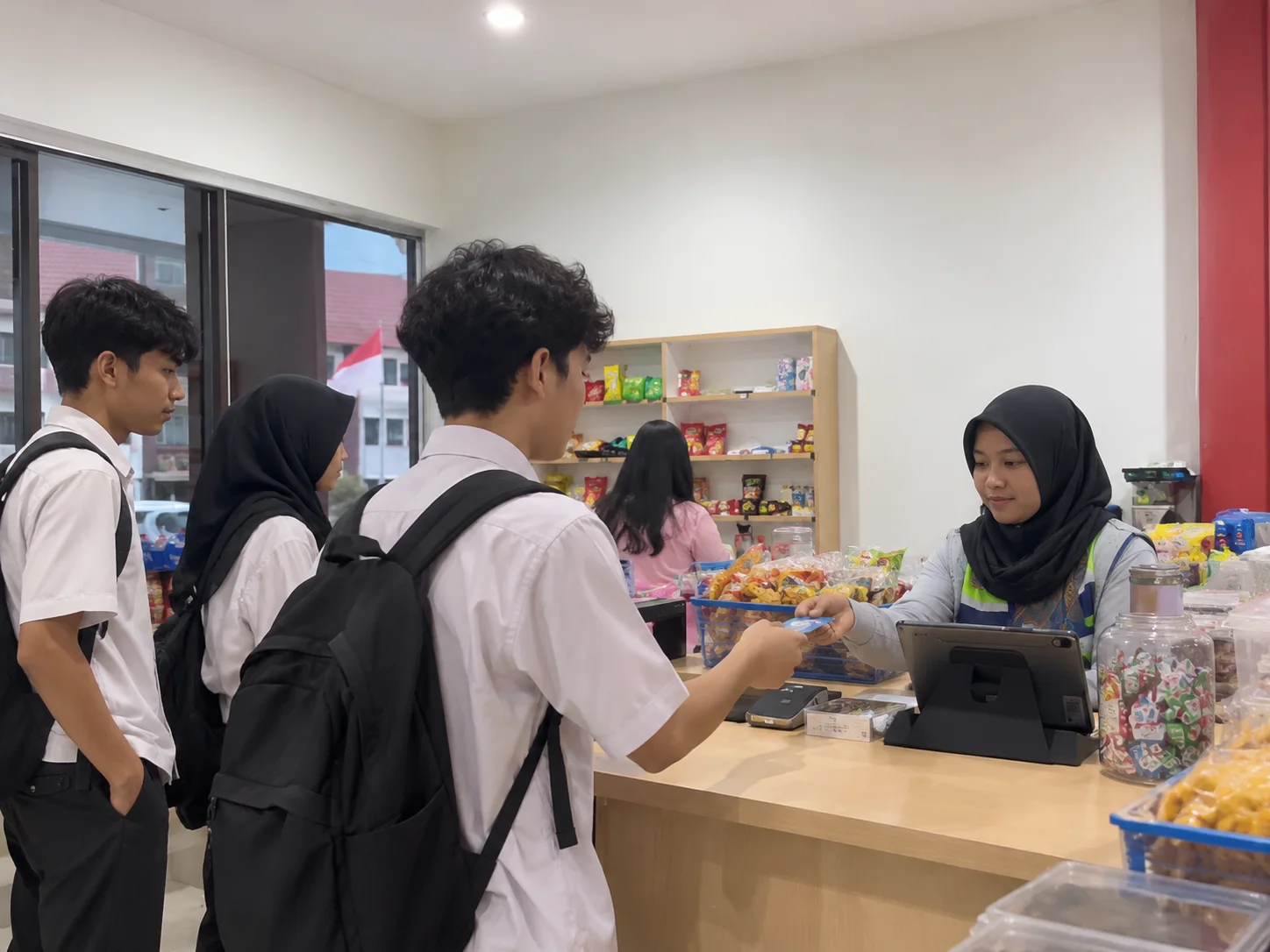
To observe these small habits in reality, we conducted interviews and a mini-research project in October 2026 at the Campus A canteen/minimarket, which has been operating since 2020 and is open from 07.00–18.00. The canteen is very crowded during class break times until the afternoon. According to the cashiers, students almost every day leave food at the counter without paying or take food directly outside, and the value must be covered by the cashier. Daily cash discrepancies also arise due to vendor stock differences during stock opname. In this paper, this behavior is referred to as small-scale corruption as an analogy—a breach of trust that harms others—rather than a criminal act of corruption.
The priority issues for our partners are twofold: (1) taking items without payment and failing to return excess change, and (2) disorganized queues due to proxy payments and individual inputting of fried snacks. Our planned solution consists of a dual intervention: a moral approach through educational posters and a systemic approach through queue management and recommendations for improving the cashier application. This design follows input from the cashiers as partners and refers to similar community service practices (Afandi & Rizqullah, 2025; Hartono et al., 2026). The planned outputs include a package of educational posters, queue order signage, a recommendation document for management, evaluation instruments, and this article. It must be emphasized that as of the writing of this article, only the mini-research and design stages have been completed; the described actions have not yet been implemented, so no results have been reported.
Reviewing Food Transaction Issues at the Campus A Canteen
The mini-research was conducted at the Campus A canteen/minimarket in October 2026, with two cashiers, hereafter referred to as Cashier A and Cashier B, and the canteen manager as partners. The identities of the interviewees were masked for ethical considerations. A descriptive qualitative approach was used. Data were collected through direct interviews, observation of transaction flows (especially fried snack queues), and documentation. The interview guide covered eight points: length of operation and business hours, conditions during peak times, incidents of taking items without payment, honesty regarding change, daily cash discrepancies, transaction obstacles, suggestions for improvement along with views on educational posters, and permission for poster installation. Qualitative data were then analyzed descriptively and linked to the values of Pancasila.
Interview findings show that congestion peaks during class break times until the afternoon (around 08.00–14.00). During these hours, taking items without payment occurs almost every day: food is left at the counter or taken outside, and the cashier covers the cost. Excess change is generally returned, but not always. Cash discrepancies occur daily, both due to unpaid items and vendor stock differences, and the cashiers cover the losses. Queue obstacles stem from inputting fried snacks one by one and proxy payments. The cashiers' suggestions include queue order and improvements to the cashier application; the cashiers also believe the posters will be helpful and have authorized their installation on walls or tripods. It should be noted that this data is qualitative from two interviewees and does not yet contain measurable incident counts, so quantitative measurement is designed for the monitoring stage.
These findings indicate two layers of problems. First, a behavioral problem: the opportunity to take items without paying increases when cashiers are overwhelmed during peak hours. Second, a systemic problem: slow and disorganized queues increase these opportunities. This picture is in line with the findings of Astuti et al. (2025) in a school context, where taking items without paying at the canteen is influenced by the ease of reaching items, impulsive attitudes, and peer pressure, and that queue order during break times is not always optimal. Because the problems are layered, our action plan is also layered: encouraging students to behave honestly while managing the systems that create opportunities.
Honesty within the Framework of Pancasila Values
Taking items without payment contradicts the Second Sila (Principle) because it shows a lack of manners and empathy toward the cashiers who bear the losses. The same behavior violates the Fifth Sila because the burden of loss is not borne by the party causing it, resulting in an imbalance of rights and obligations. The First Sila is relevant as the basis for the moral responsibility to remain honest when not being watched.
Bahiyah (2025) emphasizes that the internalization of Pancasila values in higher education is carried out not only through formal learning but also through non-academic activities, academic culture, and role modeling. Arnol and Charlin (2026) also conclude that anti-corruption education shapes academic ethics through the values of honesty, responsibility, and discipline. These are the values we have used as the foundation for the planned posters and signage.
Action Plan: Posters, Queue Signage, and Cashier Application Recommendations
The action plan was compiled based on cashier input and literature review, and it is entirely designed to be carried out by students within one semester without changing the canteen system. The activity stages follow the anti-corruption education service pattern: needs analysis, design, socialization and education, implementation, and monitoring and evaluation (Hartono et al., 2026). We are currently in the design stage. The chosen method is awareness-raising through poster media and consultation with management.
The first action is an honesty education poster that will be installed on the wall near the checkout and on a tripod in the queue line. The basis from the partners is the cashiers' assessment that posters can increase awareness, accompanied by installation permission. The theoretical basis is the use of posters and infographics in strategic campus locations (Cahya et al., 2026) and posters in anti-corruption education (Afandi & Rizqullah, 2025). The poster content is designed to be contextual, positive, and non-preachy, consisting of a brief invitation that links honesty with justice as a Pancasila value. This arrangement is in line with the idea of nudge, which is the arrangement of the physical environment to encourage ethical choices without coercion (Thaler & Sunstein, 2021).
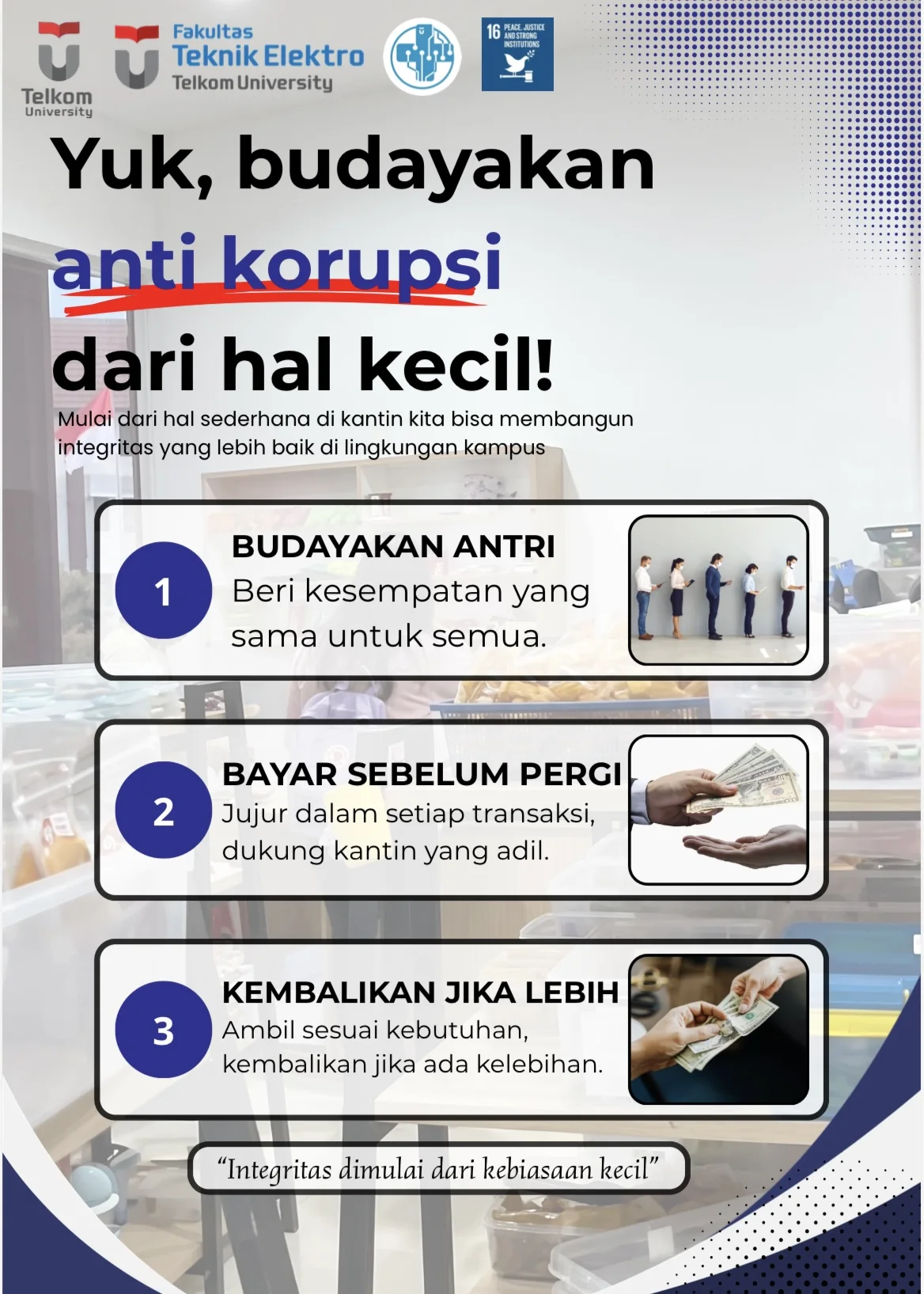
We have prepared the initial poster design (Figure 2) in size A2 so that it is easily readable from the queue line; the size can be adjusted if space on the tripod is limited. The title is “Let’s cultivate anti-corruption from small things!” with a subtitle inviting students to build integrity from simple things in the canteen. It contains three numbered messages, each answering a field finding:
- Cultivate queuing. “Give equal opportunity to everyone.” This message addresses disorganized queues and proxy payments.
- Pay before leaving. “Be honest in every transaction, support a fair canteen.” This message addresses food left behind or taken out without payment.
- Return if there is excess. “Take according to your needs, return if there is excess.” This message addresses excess change that is not always returned.
The poster closes with the quote “Integrity starts from small habits” and features a canteen atmosphere background so that it feels close to its readers. Institutional identity and the SDG 16 logo on the printed version are not displayed in Figure 2. In the next refinement, a note that losses from unpaid items are borne by the cashier can be added as a supporting sentence, if approved by the cashier and management.
The second action is queue order signage in the form of an instruction sheet with two messages: queue in a single line and pay before taking food out. The basis from the partners is the cashiers' request for queue order and their complaints regarding proxy payments, while the theoretical basis is that opportunity and queue order influence taking items without payment (Astuti et al., 2025) and that environmental arrangement encourages ethical choices (Thaler & Sunstein, 2021). The signage is a laminated A3 printed instruction sheet installed near the checkout or on a tripod in the queue line. It contains only two short command sentences: “Queue in a single line” and “Pay before food is taken out.” Unlike the poster, which invites and explains the reasons for behaving honestly, the signage provides action instructions when the buyer is at the checkout. The signage does not prohibit proxy payments, does not change the canteen system, and does not require application changes, so its installation only requires the cashier's permission. Floor marking stickers for the queue line are optional and will only be installed if approved by management. Because there is no data that signage reduces incidents of items taken without payment at the Campus A canteen, its effectiveness will be tested through cashier records at the evaluation stage.
The third action is a written recommendation to management to speed up fried snack input. This action stems from the cashiers' request for cashier application improvements and is based on assistance based on partner needs analysis (Hartono et al., 2026). Finally, evaluation is planned through a short questionnaire before and after poster installation for student buyers, similar to attitude measurement before and after anti-corruption education service (Ardiansyah et al., 2026), as well as cashier recording of the number of incidents of items taken without payment for two weeks before and two weeks after the intervention. This recording is possible because the cashiers know the daily incidents, and periodic monitoring and evaluation are in line with Hartono et al. (2026).
Planning to Measure Impact and Maintain Sustainability
The success indicators we have set are an increase in honesty awareness questionnaire scores, a decrease in the number of incidents of items taken without payment according to cashier records, and the implementation of recommendations by management. The identified supporting factors are installation permission and the openness of the cashiers. The anticipated inhibiting factors are peak hour congestion, the authority for application changes resting with management, and the possibility of posters being ignored over time. Astuti et al. (2025) show that value learning and habituation complement each other, so posters need to be updated periodically and linked to Civic Education material. Because the action has not been implemented, results in the form of questionnaire scores, incident counts, and installation documentation are not yet available and will be reported after the activities are carried out.
To be sustainable, the program is planned to run in stages. Sustainability is supported by handing over equipment to management and involving student organizations. In the short term (current semester), the activities are poster and signage installation, recommendations to management, and before-after evaluation, with indicators of posters installed and questionnaire scores increasing. In the medium term (next semester), the poster package and guide are handed over to management, HIMA/BEM are involved, and posters are updated every month, with indicators of a person in charge and well-maintained posters. In the long term, honesty material is proposed for new student orientation, poster material is updated, and follow-up on cashier application updates is proposed, with indicators of campus or management approval and a decrease in cash discrepancies.
Building Integrity from Simple Habits
Mini-research in October 2026 shows that transaction dishonesty at the Campus A canteen, in the form of taking items without payment, unreturned excess change, and disorganized queues, harms the cashiers and contradicts the Second and Fifth Sila of Pancasila. This problem has both behavioral and systemic dimensions, thus requiring dual intervention. The concrete actions we planned are educational posters, queue order signage, and recommendations for cashier application improvements, which were determined based on partner input and literature review and will be evaluated in a measurable way. The supporting factor is partner openness, while the inhibiting factors are peak hour congestion and the system authority resting with management.
Management is advised to follow up on the recommendation to speed up fried snack input and maintain the posters periodically after installation. The student group is advised to immediately implement this plan and supplement the data with a larger number of respondents and follow-up measurements so that the sustainability of the impact can be assessed. The authors thank the two cashiers and the Campus A canteen management for their willingness to be interviewees, as well as the lecturer for the Civic Education course.
References
Afandi, M. R., & Rizqullah, M. N. (2025). The role of students in anti-corruption education: Service learning-based community service. Sarwahita: Journal of Community Service, 22(2). https://doi.org/10.21009/sarwahita.222.9
Ardiansyah, S., Yusup, N. F., Mandala, O. S., Yorman, Y., Tahir, M., & Nurhafni, N. (2026). Participatory anti-corruption culture education training as a strategy for strengthening student accountability in higher education. SELAPARANG: Journal of Progressive Community Service, 10(2), 1671–1683. https://journal.ummat.ac.id/index.php/jpmb/article/view/37828
Arnol, G. M., & Charlin, A. S. (2026). The role of anti-corruption education in shaping student academic ethics: A literature study. Journal of Community Service and Educational Research, 4(3), 21350–21359. https://jerkin.org/index.php/jerkin/article/view/5644
Astuti, A. T., Anderson, I., & Candra, A. A. (2025). Honesty canteen as an anti-corruption education medium to form honest character in grade VII students of SMP Negeri 7 Jambi City. Journal of Civic Education, 9(1). https://doi.org/10.31571/jpkn.v9i1.7613
Statistics Indonesia. (2024). Anti-corruption behavior index 2024. BPS. https://www.bps.go.id/id/publication/2024/12/06/66e636bc0a8fa4f90e0d6c6d
Bahiyah, K. (2025). Pancasila and anti-corruption education: Internalization of Pancasila values in anti-corruption education in higher education. Maliki Interdisciplinary Journal, 3(11), 207–212. https://urj.uin-malang.ac.id/index.php/mij/article/download/19839/6076
Cahya, D. E., Monalvia, O., & Nastiti, D. P. (2026). From the classroom to social action: The impact of project based learning on students’ anti-corruption awareness in higher education. Journal of Citizenship, 10(1), 85–95. https://journal.upy.ac.id/index.php/pkn/article/view/9891
Hartono, H., Mastikawati, M., Yuliana, Y., & Darmansyah, R. (2026). Anti-corruption education through the implementation of an honesty canteen in the MAN 1 Batanghari environment. Journal of Community Service and Educational Research, 4(3), 16365–16372. https://doi.org/10.31004/jerkin.v4i3.4275
Heryadi, A., Jayanti, A. M., & Zetta, C. V. E. (2022). Student academic honesty and anti-corruption perception. Journal of Counseling Psychology, 21(2). https://doi.org/10.24114/konseling.v21i2.41112
Thaler, R. H., & Sunstein, C. R. (2021). Nudge: The final edition. Penguin.






Comments 0
Write a Comment Share your response