

JurnalPost.com - Corruption is often associated with high-profile cases, ranging from government budget misappropriation and sting operations to state losses reaching trillions of rupiah. However, behavior leading to corruption does not always start with large-scale issues. Small habits in managing shared money and resources without clear accountability can become serious problems if left unchecked.
Data from the Central Statistics Agency (BPS) shows that Indonesia's Anti-Corruption Behavior Index (IPAK) in 2024 fell to 3.85. This decline is an indicator that requires attention in efforts to build public awareness regarding the importance of anti-corruption behavior.
The Corruption Eradication Commission (KPK) also emphasized in an anti-corruption education forum on 2024 that small-scale corrupt practices can become the seeds for larger corruption.
This condition shows that preventing corruption is not enough through law enforcement alone. Character building, honesty, and the habit of being responsible also play an important role, including within the university environment.
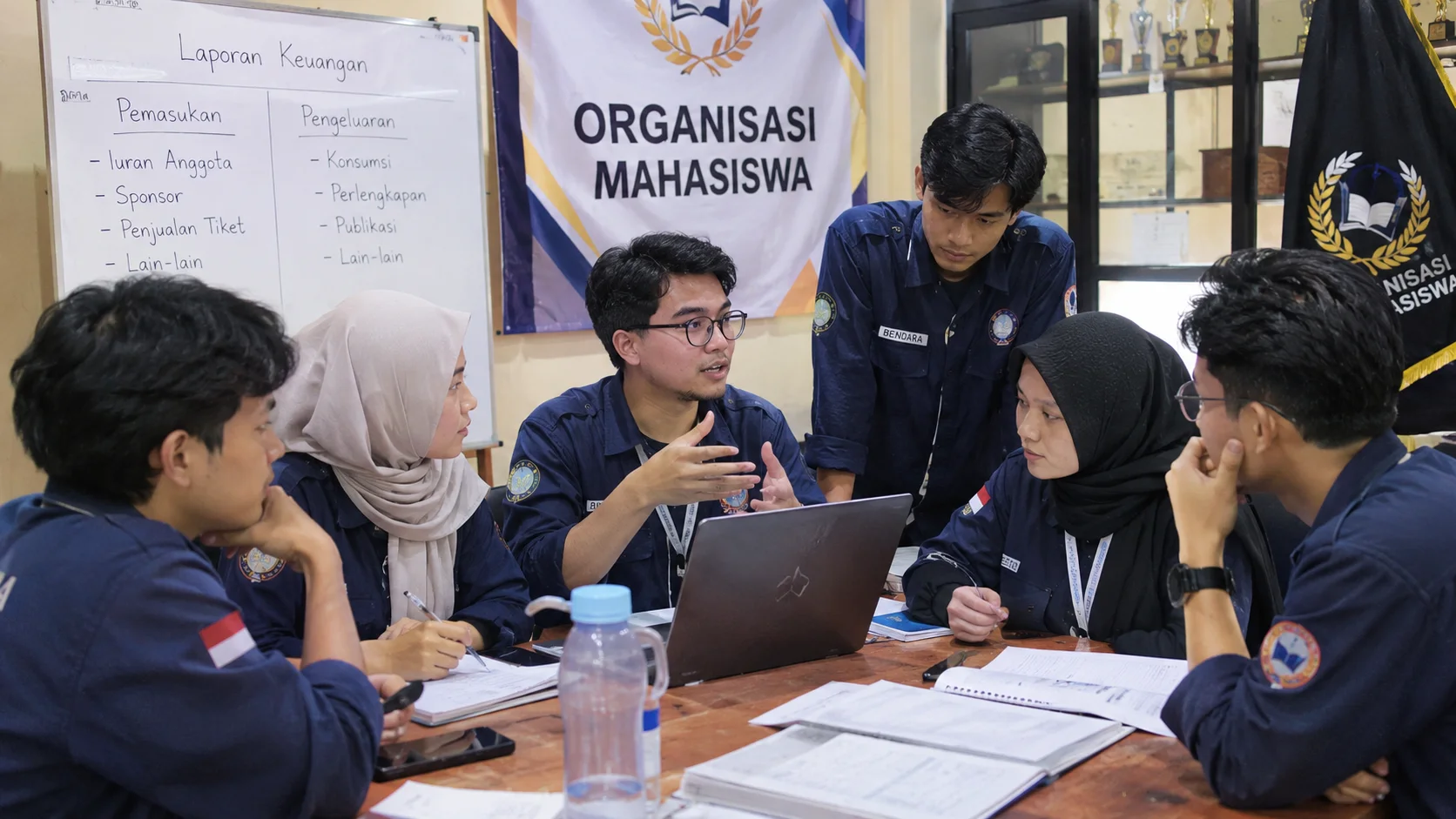
One place where students can apply these values is in student organizations. Through student associations, Student Activity Units (UKM), Student Executive Boards (BEM), Student Representative Councils (DPM), or event committees, students learn not only about leadership but also about financial management and shared responsibility.
Almost every organization has activities involving funds, whether from membership dues, student grants, sponsorships, or business ventures. The management of these funds is often considered the sole responsibility of the treasurer. In reality, because the money is used for the organization's interests, all members have a stake in knowing how funds are obtained, used, and accounted for.
Anti-corruption education through student activities is also supported by the Ministry of Research, Technology and Higher Education Regulation Number 33 of 2019, which opens space for implementing anti-corruption education not only through lectures but also through student activities.
Financial Transparency Is More Than Just Administrative Reporting
In an organization, financial reports should not be viewed merely as documents compiled when a term of office ends. More than that, financial reports are a form of accountability from the board for the trust placed in them by members.
Transparency means that information regarding the receipt and use of funds is available clearly and can be accessed by interested parties.
Meanwhile, accountability requires officials with authority to explain every decision and action to members or the forum entitled to conduct evaluations.
Bovens (2007) explains that accountability involves a relationship between those who carry out responsibilities and the forum that has the authority to request explanations and conduct evaluations.
This principle is closely related to integrity, which is consistency in upholding ethical values and prioritizing the common interest, as explained by the OECD (2017).
In addition to transparency, accountability, and integrity, member participation is also necessary. Organization members are not just recipients of reports; they have the right to ask questions, provide input, and oversee the use of funds.
The problem is that the application of these principles is not always consistent.
Survey of 61 Respondents: Transparency Is Considered Important, but Not Yet Consistent
To determine student perspectives on organizational fund transparency, a survey was conducted via an online questionnaire using Google Forms from 31 October to 1 November 2026.
The survey involved 61 respondents, consisting of 58 active students or 95.1 percent, and three other respondents who are final-year students.
Based on organizational experience, 32 respondents or 52.5 percent are currently active in an organization. Furthermore, 17 respondents or 27.9 percent have previously been involved in an organization, while 12 respondents or 19.7 percent have never been involved in an organization.
The respondents' organizational experience includes student associations for 17 people, UKM for 15 people, committees for 10 people, BEM or DPM for six people, and student press for one person.
The questionnaire consisted of 15 questions covering organizational experience, financial information disclosure, delivery of fund reports, opportunities for members to ask questions, and attitudes toward the use of funds without transaction proof.
Respondents were also asked to provide their views on barriers to transparency and steps that can be taken to improve organizational governance.
Data were analyzed descriptively using frequency, percentage, cross-tabulation based on organizational experience, and thematic grouping from 60 open-ended suggestions received.
Three questions whose results were stored as numerical codes without answer descriptions were not included in the interpretation.
Interviews with treasurers, organization heads, members, and student affairs officials, as well as examinations of accountability report documents, are planned as further stages of the study.
Thus, the results of this survey reflect the perceptions of the respondents, not the condition of all students. These findings also cannot be used as evidence that corrupt practices have occurred in specific organizations.
High Student Awareness, but Openness Is Not Yet a Habit
The survey results show that all respondents consider the transparency of organizational fund management to be important.
A total of 52 respondents or 85.2 percent consider transparency very important, while nine respondents or 14.8 percent stated it is important.
Not a single respondent considered financial transparency unimportant.
However, this high level of awareness is not fully aligned with their experience regarding the practice of organizational financial openness.
A total of 42 respondents or 68.9 percent stated they had seen reports on the use of organizational funds. If calculated only from the 49 respondents who are currently or have previously been in an organization, the proportion reaches 85.7 percent.
This means that financial reports are actually known to most respondents who have organizational experience.
The problem arises when respondents are asked to assess how often organizations provide financial information openly.
A total of 26 respondents or 42.6 percent answered that information disclosure is only done occasionally. Meanwhile, 18 respondents or 29.5 percent stated often, and only five respondents or 8.2 percent answered always.
On the other hand, four respondents or 6.6 percent stated they never received information disclosure, while eight respondents or 13.1 percent did not know how such information was conveyed.
The answers of never and do not know came entirely from respondents who have no organizational experience.
Among respondents who are currently or have previously been in an organization, 53.1 percent stated that financial information is only provided sometimes. Meanwhile, only 10.2 percent assessed that the organization is always open.
These findings show that transparency has not fully become a habit practiced on an ongoing basis.
In some organizations, the submission of financial reports is still potentially understood as an administrative obligation performed at the end of a term or during a general assembly.
One respondent criticized this practice.
"Do not let transparency be just a formality on paper during the general assembly."
This statement reflects the hope that financial openness does not stop at the submission of reports but is realized through information that is routine, easily accessible, and can be questioned by members.
The Right to Ask Questions Is an Important Part of Accountability
Transparency is not just about the availability of financial reports. Organization members also need to be given the opportunity to request explanations if there is any use of funds that is not understood.
Based on the survey results, 39 respondents or 63.9 percent feel they have or very much have the opportunity to question the use of organizational funds.
Of that number, 42.6 percent stated they have the opportunity and 21.3 percent feel they very much have the opportunity.
However, there are still 11 respondents or 18 percent who feel the opportunity to ask questions is lacking. Three respondents or 4.9 percent stated they never received such an opportunity, while eight respondents or 13.1 percent did not know the mechanism.
Among respondents with organizational experience, about one in five people feel the space to ask questions is still lacking.
This is a concern because financial reports that are available without a clarification mechanism do not fully meet the principle of accountability.
Members need to have the opportunity to know the reasons why an expenditure was made, how budget decisions were made, and whether the use of funds is in accordance with the purpose of the activity.
Interestingly, the survey results show that most students choose an approach that prioritizes clarification when facing suspected misuse of funds.
A total of 31 respondents or 50.8 percent chose to ask for an explanation first. Then, 14 respondents or 23 percent chose to report to the authorities, while 13 respondents or 21.3 percent would first discuss it with other members.
Only three respondents or 4.9 percent chose not to get involved.
These findings show a tendency among respondents to seek clarity before drawing conclusions.
Nevertheless, an official clarification mechanism is still needed so that members' questions can be handled fairly and not develop into prejudice or internal conflict.
Transaction Proof Is Considered Important to Prevent Misuse of Funds
Another issue of concern in the survey is the use of organizational money without proof of expenditure.
The results show that 40 respondents or 65.6 percent consider expenditures without proof to be very unacceptable.
A total of 16 respondents or 26.2 percent stated that such actions are unacceptable.
If combined, 91.8 percent of respondents reject the practice of spending funds without clear transaction proof.
Meanwhile, five respondents or 8.2 percent can still tolerate such conditions in certain circumstances, for example, when there is a sudden need during the implementation of an activity.
One respondent suggested that expenditures without official receipts should still be accompanied by a substitute receipt signed by a witness.
This view shows that students understand the importance of financial documentation while also realizing the possibility of field conditions that do not always allow for the issuance of formal transaction proof.
Invoices, receipts, and payment records are part of an audit trail or audit trail that allows every expenditure to be traced back.
Expenditures without proof do not necessarily indicate corruption. However, the absence of supporting documents can complicate the examination process and increase the risk of administrative errors or misuse of funds.
Conversely, orderly record-keeping can protect officials, including treasurers, from baseless accusations.
The findings of this survey show that students already have a high awareness of the importance of fund transparency. The next challenge is to translate that awareness into consistent organizational practice.
Providing reports periodically, opening access to information, providing space for clarification, and ensuring the completeness of transaction proof can be the first steps toward building a more accountable student organization.
By getting used to managing funds honestly and openly while on campus, students have the opportunity to cultivate integrity as part of an anti-corruption culture in their daily lives.







Comments 0
Write a Comment Share your response