

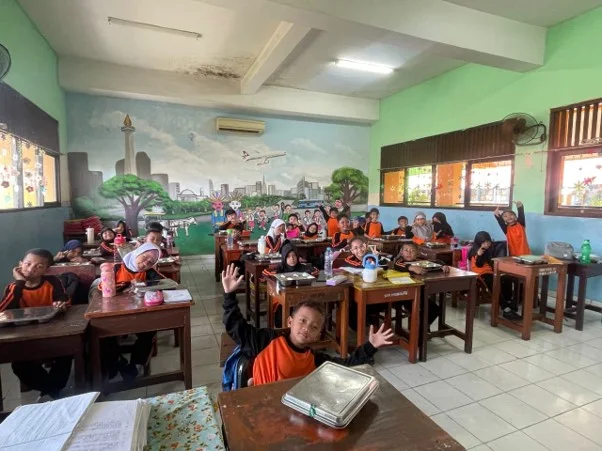
JurnalPost.com - The Free Nutritious Meal (MBG) program is a government policy aimed at meeting the nutritional needs of the public, particularly school-aged children. This program deserves appreciation as it addresses a genuine issue: the ongoing struggle of children to access healthy and adequate food. However, good intentions do not automatically guarantee successful implementation.
Recently, the implementation of the MBG program has drawn public concern following reports of suspected food poisoning in several regions. Data presented during a meeting of Commission IX of the House of Representatives on 3 September 2026, based on records as of 2 September 2026, indicated that there were 50,059 people affected across 460 poisoning incidents in 36 provinces and 245 regencies/cities.
These figures certainly cannot be viewed as a minor issue, as they involve the safety of the program's beneficiaries.
I support the goals of the MBG program. What I question is its execution. A program intended to improve public health should not create new health risks for its recipients.
It is at this point that the government must realize the success of the MBG program is measured not only by the volume of food distributed or the number of beneficiaries, but also by the guarantee that the food is safe for consumption.
Good Intentions Must Be Accompanied by Safety Guarantees
Fundamentally, a policy providing nutritious meals is a relevant step toward supporting child growth and development. However, a nationwide program requires meticulous planning, ranging from the selection of food ingredients and processing methods to kitchen hygiene, storage, and distribution.
Each of these stages carries risks if not seriously monitored. Nutritious food is not necessarily safe if the processing does not meet food hygiene and safety standards.
Therefore, the government must not focus solely on the speed of program expansion; it must also ensure the readiness of every Nutrition Fulfillment Service Unit (SPPG) tasked with its execution.
The government has taken corrective steps. In a statement from the Coordinating Ministry for Food Affairs on 26 August 2026, it was noted that 455 SPPGs failing to meet the requirements for a Hygiene and Sanitation Feasibility Certificate (SLHS) would be permanently closed.
Additionally, there are 3,515 SPPGs that do not yet possess an SLHS, with 3,060 having not yet applied for the certificate and 455 deemed as not meeting the requirements.
This action demonstrates that hygiene standards must receive serious attention. However, enforcement should not stop at closing kitchens once problems arise. Oversight must be conducted before food is produced and distributed to beneficiaries.
When Oversight Only Follows Casualties
The emergence of suspected food poisoning cases shows that oversight of the MBG program needs to be strengthened. The issue is not merely whether a kitchen has a certificate, but whether the entire food provision process truly adheres to food safety standards.
The Hygiene and Sanitation Feasibility Certificate is an important instrument, but its existence should not be considered an absolute guarantee that no problems will occur.
Oversight must be conducted periodically, including inspections of food ingredient quality, equipment cleanliness, the condition of processing facilities, and the punctuality of distribution.
This is crucial because MBG beneficiaries, especially children, often lack the ability to assess the safety of the food they receive. They rely on the food provided by program organizers and depend on the oversight system established by the government.
Therefore, when suspected poisoning occurs, it is not enough for the government to simply offer apologies or temporarily suspend kitchen operations.
There must be a transparent investigation into the cause of the incident, the parties responsible, and recovery support for the victims. Effective oversight should prevent casualties, rather than merely reacting after the public has been harmed.
The Right to Health Is a State Responsibility
The MBG issue cannot be separated from the state's constitutional obligations. Article 28H paragraph (1) of the 1945 Constitution guarantees everyone the right to receive health services.
Meanwhile, Article 28B paragraph (2) affirms the child's right to life, growth, and development, as well as protection from violence and discrimination.
These guarantees demonstrate that protecting children's health and safety is not merely a technical matter of program implementation, but part of the state's responsibility to fulfill the rights of its citizens.
Article 28I paragraph (4) of the 1945 Constitution also asserts that the protection, promotion, enforcement, and fulfillment of human rights are the responsibility of the state, particularly the government.
Furthermore, Law Number 18 of 2012 concerning Food, through Article 67 and Article 68, stipulates that food safety is a vital component of food provision. The central and regional governments also hold responsibility for food safety oversight.
This means that when the government implements a food provision program for the public, its responsibility does not end with budget allocation and distribution. The government must also ensure that the food provided is safe, high-quality, and fit for consumption.
Presidential Regulation Number 115 of 2025 on the Governance of the Free Nutritious Meal Program also regulates aspects of ensuring and overseeing food safety and quality.
Thus, oversight is not an optional task to be performed if time or budget permits, but an integral part of the program's governance.
Who Should Be Held Accountable?
When food poisoning occurs, questions regarding legal liability are inevitable. However, to determine who is responsible, an investigation and evidentiary process are required, rather than simply blaming one party.
Parties involved in the MBG supply chain—from kitchen managers and food suppliers to processing staff and those with oversight authority—must be examined based on their respective roles and obligations.
If negligence is found that results in injury or death, criminal provisions may be considered in accordance with the elements fulfilled.
One such provision is Article 474 of Law Number 1 of 2023 concerning the Criminal Code (KUHP), which regulates criminal acts resulting from negligence.
On the other hand, victims may also have grounds to sue for damages if the elements of an unlawful act as regulated in Article 1365 of the Civil Code (KUHPerdata) are proven to be met.
Of course, the application of these provisions must consider the facts, causal relationships, and the nature of the losses suffered by the victims.
It must be emphasized that legal responsibility should not stop at field staff if the issues found are related to a weak oversight system, operational standards, or policy-making.
The government must ensure a comprehensive evaluation of program governance, including mechanisms for accountability and recovery for those harmed.
Do Not Expand the Program Before Being Ready
Moving forward, the government needs to place the safety of beneficiaries as the primary measure of the MBG program's success.
Program expansion should be carried out in stages, considering the readiness of kitchens, processing staff, food ingredient availability, storage facilities, and distribution capabilities in each region.
Furthermore, inspections of SPPGs must be conducted routinely, and the results of this oversight should be communicated openly to the public.
Data regarding poisoning incidents, inspection results, follow-up actions, and forms of accountability must be accessible to the public. Such transparency is essential so that the public is not merely a recipient of the program, but can also participate in monitoring its implementation.
The government also needs to provide easily accessible complaint mechanisms and ensure that victims receive proper medical treatment and recovery support.
Victims' families should not have to face additional hardships just to obtain clarity regarding the accountability of program organizers.
Child Safety Is Non-Negotiable
The MBG program should be a policy that brings benefits, not one that causes anxiety for parents when their children receive meals at school.
The goal of improving public nutrition is certainly important, but it must go hand-in-hand with protecting the health and safety of the beneficiaries.
A misallocated budget can still be evaluated and corrected in the following year. However, the health of a child who has been harmed cannot simply be restored to its original state.
Therefore, the government must ensure that every stage of the program is implemented with clear standards, consistent oversight, and firm accountability.
Ultimately, the success of the MBG program is not just about how much food is successfully distributed, but about how safe that food is to consume and how much it benefits the community.
A good welfare program should not force the public to choose between obtaining nutritious food and maintaining their personal safety.
The state may have grand ambitions to improve the nutritional quality of the next generation. However, those ambitions must be accompanied by an equally grand sense of responsibility.
Because in policies involving children, safety is not just an additional target, but the primary factor that cannot be negotiated.






Comments 0
Write a Comment Share your response