

JurnalPost.com Across most campuses, a familiar pattern repeats every semester: the habit of opening course materials only when exam schedules are imminent. During the regular academic term, lecture slides or notes often remain tucked away in notebooks or on mobile devices, rarely revisited or reviewed.
This situation shifts dramatically as students enter the Midterm (UTS) or Final Exam (UAS) phase. It is during this period that students scramble to read notes and memorize vast amounts of material within a very short, limited timeframe.
The habit of last-minute studying, often referred to as 'cramming,' has become a common phenomenon among university students. Many view this approach as normal, with some even feeling they can only achieve full concentration when the exam deadline is looming.
However, when viewed in the context of academic goals and long-term learning outcomes, this last-minute approach can cause various problems that disadvantage students, both in terms of the quality of their knowledge and their physical health.
Factors Driving Last-Minute Study Habits
The emergence of this habit is triggered by several interconnected factors in daily life.
The first factor is the perception that the time remaining until the exam is still sufficient. At the start of the semester, midterms are usually seven to eight weeks away, while final exams are held after fourteen to sixteen weeks of classes.
This perceived abundance of time leads students to feel no urgency to review lessons. The belief that course material can be studied at another time causes independent study to be postponed from one week to the next.
The second factor relates to the density of student activities outside of lecture hours. Campus life is not just about listening to lecturers; it also involves various personal development activities.
Many students are active in student organizations, faculty or university event committees, student activity units (UKM), or even part-time jobs.
Furthermore, almost every course assigns weekly tasks, such as group presentations or papers, with overlapping deadlines.
In such a busy schedule, students tend to deprioritize independent study. Because reviewing course material lacks a direct submission deadline graded by a lecturer, it is often pushed to the bottom of the priority list.
The third factor is the time consumed by social media. After exhausting lectures, many students choose to relax by opening social media apps, watching entertainment videos, or playing games.
The problem is that rest periods intended to last only fifteen or thirty minutes often stretch into hours without the student realizing it.
When the night grows late and the body begins to tire, the plan to open books or review course material is ultimately abandoned.
This cycle repeats, causing course materials to pile up from the first meeting to the last without ever being studied incrementally.
The fourth factor is a reliance on notes or summaries from classmates. In university culture, sharing photos of notes or summary files the day before an exam is often seen as a form of solidarity.
However, the ease of obtaining these ready-to-read summaries indirectly makes some students feel they do not need to take notes or pay serious attention to the lecturer from the start of the semester.
They feel secure relying on a friend's notes, which they plan to read quickly hours before the exam. Consequently, the process of independent understanding is neglected.
The fifth factor is the lack of periodic learning evaluations throughout the semester. Not all courses hold routine quizzes every few meetings.
In courses where grades depend solely on group assignments, attendance, midterms, and finals, students often fail to realize the extent of their understanding of the taught material.
Students only realize that many concepts or formulas remain unclear when they begin reviewing all the material one day before the exam.
The Phenomenon of Last-Minute Cramming
When the exam schedule is set and the date is only one or two days away, the shift in student behavior becomes very apparent.
Class chat groups, usually quiet, suddenly buzz with questions. Common topics include exam tips from lecturers, the scope of chapters covered, the format of questions (multiple choice or essay), and requests for copies of notes from the first meeting.
Students who have not touched their textbooks for weeks begin frantically printing dozens of pages of material and copying friends' notes in bulk.
On the night before the exam, many students choose to pull an all-nighter to catch up on a semester's worth of material.
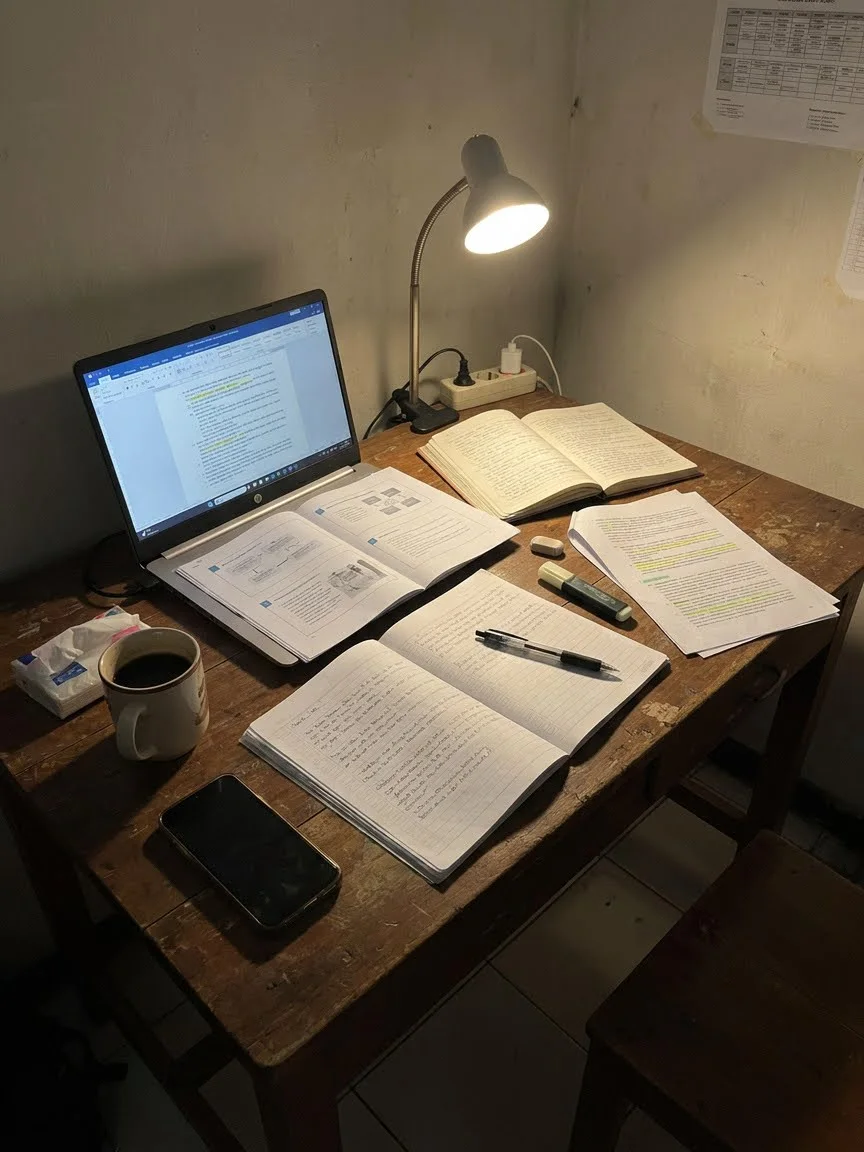
Study desks become cluttered with stacks of notes, reference books, running laptops, and caffeinated drinks to stave off sleep.
In just a few hours, the brain is forced to absorb definitions, theories, calculation formulas, and case studies that should have been studied gradually over several months.
In such desperate situations, studying is no longer aimed at understanding the logic of a subject, but merely at memorizing as much information as possible to answer questions the next day.
This tension continues until minutes before the exam begins. Outside the classroom or in the hallway, many students stand or sit, reading notes hurriedly while waiting for the lecturer to distribute the exam papers.
They attempt to repeat their final memorization in the hope that the material will not vanish the moment the exam starts.
However, after the exam is over and papers are collected, common complaints include exam questions that feel different from the memorized notes, or material read just the night before suddenly being forgotten while sitting in the exam chair.
Negative Impacts of Last-Minute Studying
Although cramming can sometimes help students achieve a passing grade, this method carries various negative consequences.
Low Quality of Knowledge Understanding
The most obvious impact is the low quality of understanding of the subject matter.
The human brain requires repetition and rest to help consolidate information into long-term memory.
When material is studied in a rush overnight, the information tends to be retained only for a short time. Consequently, students might remember the material during the exam, but forget it shortly after.
This shallow understanding can cause difficulties in subsequent semesters.
University curricula are structured sequentially and are interconnected, where foundational courses serve as the basis for understanding more complex advanced courses.
If mastery of early semester material is based only on overnight memorization, students may face obstacles when taking advanced courses that require analytical skills.
Furthermore, weak foundational knowledge can hinder students when writing research proposals, working on a thesis or final project, and reduce their readiness when entering a professional world that demands the practical application of knowledge.
Decline in Physical Health and Concentration
The second impact relates to a decline in physical health and concentration levels.
Forcing the body to stay awake before an exam deprives students of the rest the brain desperately needs.
Sleep deprivation can lower concentration, reduce accuracy when reading exam instructions, and slow down logical thinking processes.
Many students feel dizzy, weak, or extremely sleepy during the exam because their physical condition is already exhausted from the previous night.
Psychologically, studying under extreme time pressure can trigger excessive anxiety and stress, which disrupts focus during the exam.
Increased Risk of Academic Dishonesty
The third impact is the increased potential for academic dishonesty.
Students who arrive at the exam room with minimal preparation are under pressure, fearing poor grades or having to retake the course.
In a state of panic and lack of confidence, the urge to cheat, use crib sheets, secretly check a phone, or ask a friend during the exam becomes much stronger.
Thus, the habit of last-minute studying potentially encourages dishonest behavior that violates the rules and academic ethics of the university.
Steps to Change Student Study Patterns
Changing last-minute study habits requires gradual adjustments that fit into a student's daily routine.
Many students fail to improve their study habits because they set unrealistic, overly ambitious targets, such as scheduling three full hours of independent study every night.
Such heavy targets are generally only sustainable for a few days before being abandoned due to conflicts with organizational schedules, other assignments, and fatigue.
Reviewing Material Routinely
The easiest first step is to adopt the method of reviewing material in short but consistent durations.
Students can set aside 15 to 20 minutes each day after classes to review notes from that day's lectures.
This relatively short duration is easier to integrate with organizational activities and rest time.
If this simple habit is performed consistently every day, students can understand course material bit by bit, making the study load before exam week much lighter.
Creating Summaries in Your Own Words
The second step is to get into the habit of summarizing material using your own words.
When a lecturer explains a topic in class, students should not rely solely on photos of the whiteboard or presentation slides.
Recording key points using simple sentences that are easy to understand helps the brain process information actively.
Personal summaries compiled from the start of the semester also save time when reviewed before midterms or finals, compared to reading thick textbooks from scratch.
Managing Time and Forming Study Groups
The third step is to manage daily time more effectively.
Students need to create a weekly priority schedule that balances lectures, individual assignments, organizational activities, rest, and independent study time.
Reducing social media or digital entertainment usage by 30 minutes each day is enough to be redirected toward reviewing course material.
Additionally, forming small study groups with two or three friends can be a great alternative for discussing and explaining material that is not yet understood, provided it is done well before the exam date.
Conclusion
The habit of last-minute cramming has indeed become a common pattern among students. However, this habit should not be maintained.
University life is not just a formal process to collect grades on a transcript, but a means to build knowledge, critical thinking, and professional skills for the future.
Exams serve to measure how well students have mastered the material learned over a semester, not just to test the ability to memorize information in one night.
Changing study patterns from cramming to gradual learning requires discipline and self-awareness.
However, by applying simple steps such as reviewing material for 20 minutes daily, creating personal notes, and managing free time more wisely, students can avoid pre-exam panic.
Preparation done regularly from the start of the semester will make the exam period run more calmly, keep physical health well-maintained, and result in a much more meaningful mastery of knowledge.










Comments 0
Write a Comment Share your response