

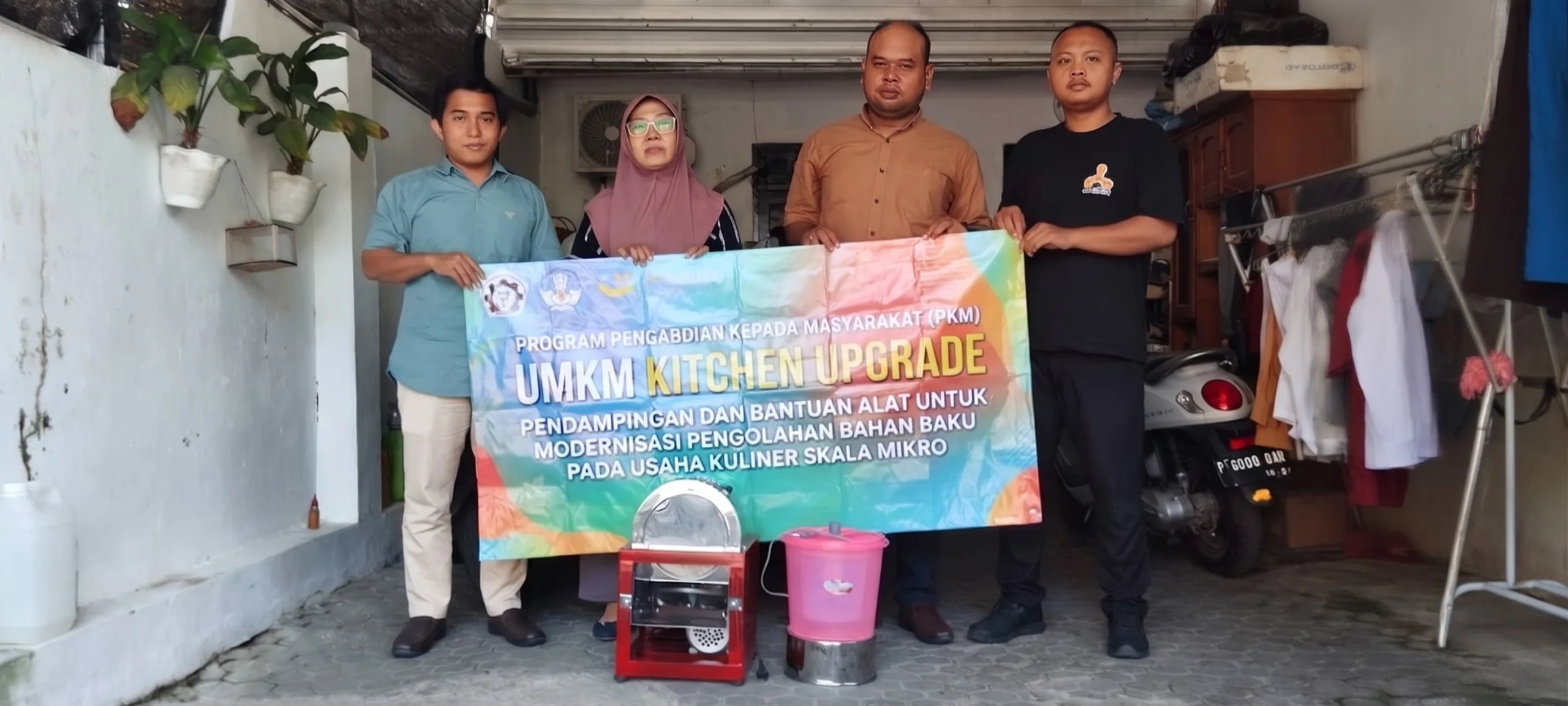
BANYUWANGI, JurnalPost.com – A community service team from the Banyuwangi State Polytechnic (Poliwangi) has introduced appropriate technology innovations to improve the efficiency and production capacity of the HOMIE culinary SME in Jurangjero Hamlet, Kalirejo Village, Kabat District, Banyuwangi Regency.
The innovation was realized through the handover of two machine units: a mechanical onion slicer and a centrifugal oil spinner. Both machines were designed to overcome production bottlenecks that previously relied on traditional equipment.
The community service project is led by Ir. Rochmad Eko Prasetyaning Utomo, S.T., M.Eng., alongside team members Prabuditya Bhisma Wisnu Wardhana, S.T., M.Eng., and Asmar Finali, S.T., M.T., with the involvement of Poliwangi Mechanical Engineering students.
This program is funded by the Directorate General of Research and Development, Ministry of Higher Education, Science, and Technology, under the Community Empowerment (PM) Scheme for the year 2026.
Addressing HOMIE SME Production Constraints
HOMIE SME is known for its signature dry chicken noodle product, which uses a traditional family recipe. A key feature of the product is the crispy fried shallot topping that complements its flavor profile.
However, the manual processing of shallots has been a major obstacle to increasing production capacity. Beyond being time-consuming, the process also affected worker comfort and the uniformity of the slices.
“Previously, to slice 4 kilograms of shallots, workers had to cut them manually with kitchen knives for 1.2 to 2 hours every morning. In addition to taking a long time, the sulfur fumes from the shallots caused painful eye irritation, and the slice thickness was inconsistent,” said Rochmad Eko Prasetyaning Utomo, head of the Poliwangi service team.
Another constraint was the oil drainage process after frying. Using bamboo trays and relying on gravity resulted in a relatively high residual oil content in the product, exceeding 25 percent, according to the team's data.
This condition caused the fried shallots to turn rancid quickly and lose their crunch within about one week.
Food-Grade Appropriate Technology Innovation
To address these issues, the Poliwangi team designed and manufactured two units using 304 stainless steel, which is suitable for food processing applications.
1. Mechanical Onion Slicer
This machine, with a capacity of 2 kilograms, uses a rotary disc slicer system equipped with a safety hopper and an ergonomic workstation.
The technology is capable of producing shallot slices with a uniform thickness between 1 and 3 millimeters. Using the machine also helps accelerate the processing time while reducing worker exposure to shallot compounds that trigger eye irritation.
2. Centrifugal Oil Spinner
The oil spinner, with a rotation speed of 1,400 RPM, uses an electric motor and a perforated drum to separate residual oil from the fried shallots.
By utilizing centrifugal force, the drainage process can be completed in approximately 2 to 3 minutes per cycle. This technology helps produce fried shallots with lower oil content and longer-lasting crispness.
In addition to providing the equipment, the team also conducted training on machine operation and provided guidance on implementing hygienic Standard Operating Procedures (SOPs) for production.
Production Capacity Increased to 20 Kilograms per Day
Based on the results reported by the service team, the implementation of this appropriate technology has brought several changes to the HOMIE SME production process.
| Indicator | Before Assistance | After Assistance |
|---|---|---|
| Slicing time | 1.2–2 hours | 30–45 minutes |
| Production capacity | 2–4 kg per day | 15–20 kg per day |
| Residual oil content | Above 25 percent | Below 15 percent |
| Product shelf life | 1 week | 3–4 weeks |
| Work safety | Eye irritation and fatigue | More ergonomic and minimal irritation |
This increase in production capacity opens opportunities for HOMIE SME to meet larger consumer demand.
Meanwhile, the reduction in oil content helps maintain the quality and crispness of the fried shallots, thereby supporting the expansion of the product's market reach.
SME Owner Appreciates Poliwangi's Support
HOMIE SME owner, Heni Puspitowati, expressed her appreciation for the machinery assistance and training provided by the Poliwangi community service team.
According to her, the use of this technology not only simplifies daily tasks but also provides opportunities to grow the business.
“This machine assistance and training have been very helpful to us. Workers no longer cry from eye irritation while slicing onions, and our fried shallots are now much crispier and last longer. We are now more confident in accepting large orders and expanding our marketing,” said Heni.
This community service program is a form of applying vocational higher education expertise to address the needs of local business owners.
Through collaboration between faculty, students, and SME owners, technological innovation is expected to not only increase productivity but also strengthen business competitiveness, product quality, and sustainable community welfare.
The application of appropriate technology at HOMIE Banyuwangi is also expected to serve as a reference for other culinary business owners in modernizing their production processes according to their specific needs and business scale.








Comments 0
Write a Comment Share your response