

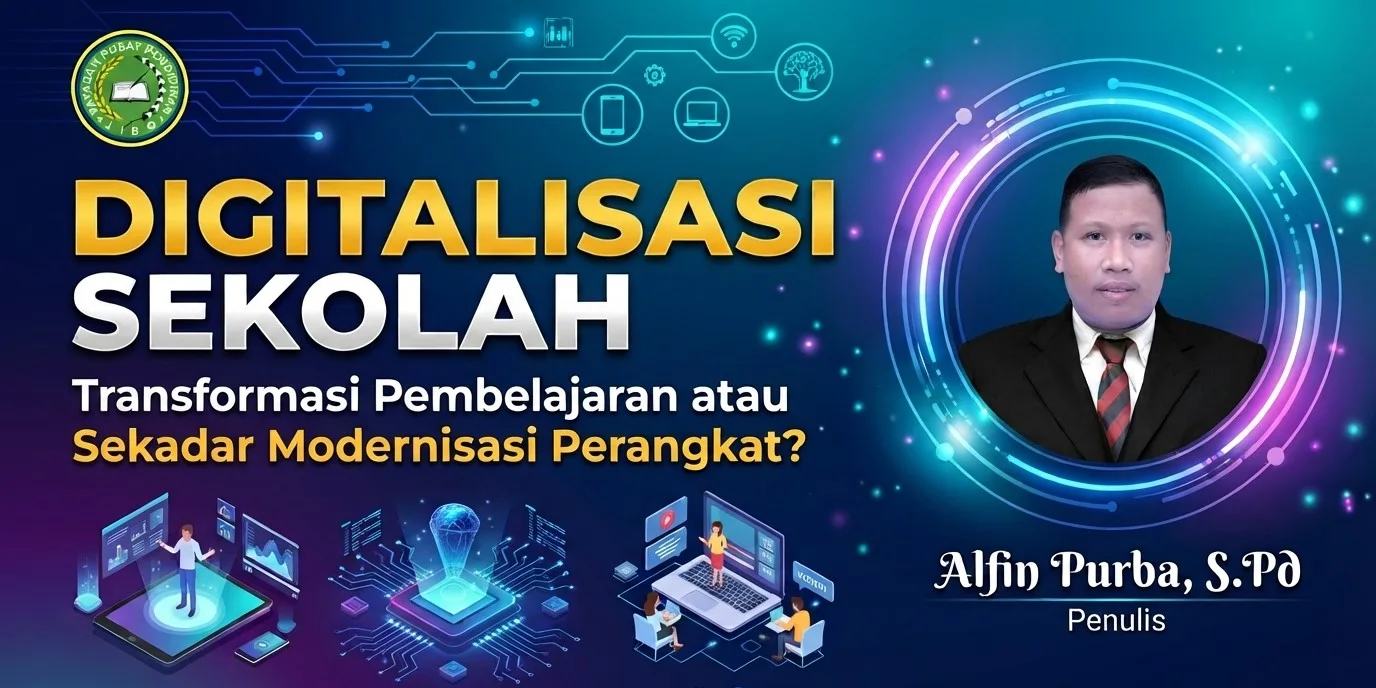
JurnalPost.com - The development of digital technology has brought major changes to various aspects of life, including education. Today, the use of computers, laptops, the internet, interactive projectors, digital learning platforms, and even Artificial Intelligence (AI) is becoming increasingly common in school environments. Digitalization in education has even become a key direction in efforts to improve the quality and equity of education in Indonesia. Digitalization is not just about replacing chalkboards with screens. One of the misconceptions in implementing educational digitalization is assuming that learning has become modern simply because teachers use laptops, projectors, or digital applications.
In reality, the use of technology does not automatically make learning higher quality. In practice, there are still instances where learning merely involves moving material from textbooks to presentation screens. Teachers deliver material via PowerPoint, students watch the presentation, and then complete assignments digitally. The media used may have changed, but the learning approach has not necessarily evolved. The core issue is not the technology itself, but how it is utilized to improve pedagogical processes. Quality learning requires interaction, dialogue, exploration, problem-solving, collaboration, and meaningful learning experiences.
UNESCO, through its Global Education Monitoring Report 2023: Technology in Education – A Tool on Whose Terms?, emphasizes that technology should be used based on student needs, contextual relevance, equitable access, and proven benefits. Technology must complement human interaction in learning, not replace the role of the teacher.
This means that the success of educational digitalization should not be measured solely by the availability of devices, but by the improvement in the quality of students' learning experiences. The digital divide and the challenge of teacher quality remain significant hurdles. Another challenge is the uneven distribution of Interactive Flat Panels (IFP) in classrooms on the 2 and 3 floors. Limitations in electrical power, lack of internet connectivity in classrooms, insufficient learning devices, and a lack of prepared human resources persist. The Indonesia Education Report Card 2026 published by the Center for Education Standards and Policy shows that our numeracy and literacy skills still require improvement. In the year 2026, the number of IFPs at our school increased to 8 units, and our teacher competence is supported by 15 certified teachers out of 25 active teachers. This is certainly a positive factor for the digitalization of education.
It is not enough for teachers to simply be able to operate applications or use digital devices. Teachers need to understand how to select technology that aligns with learning objectives, student characteristics, and the material being taught. This is where the importance of continuous professional development for teachers lies. Digitalization training must be carried out continuously, not just to introduce applications, but to touch upon learning design, pedagogical strategies, learning outcome evaluation, digital literacy, and the ethical and responsible use of technology by teachers at SD IT AR RAHMAN.
The Principal Must Lead the Transformation of Learning. Educational digitalization is also a matter of school management. Alfin Purba has a significant responsibility to ensure that technology investments truly provide benefits in improving the quality of learning for teachers and student outcomes, creating an enjoyable learning environment. From the perspective of educational management, Alfin Purba cannot merely act as an administrator and facility provider. He must perform the function of instructional leadership by guiding teachers to utilize technology appropriately.
There are three steps that I have implemented at my school:
1. Developing a digitalization program based on learning needs. Our school develops digitalization programs oriented toward learning requirements, such as: Teacher Digitalization Training every Saturday, held from 13.30 to 15.00 in the multimedia room; STEM training attended every 2 weeks on Thursdays from 13.30 to 15.00 via Zoom meeting, organized by the Ministry of Basic and Secondary Education; and training for the 'Si Penilai' and E-Rapor applications (developed by the school by Angli Anggragani, S.Kom, Nurhalizah, S.Pd, and Alfin Purba, S.Pd). Devices are provided by the school, such as laptops and computers, though some teachers use their own tablets and laptops. This is based on a needs analysis, not just following technological trends or policy fads.
2. Strengthening teacher competence continuously. Alfin Purba continues to strengthen teacher competence through learning communities, practice-based training, peer mentoring, and academic supervision. Teachers must be given the opportunity to experiment, evaluate, and improve digital-based learning.
3. Building a monitoring and evaluation system. I have designed a 2-way evaluation and communication system and must establish a sustainable monitoring and evaluation framework. At the end of each month, I meet with homeroom teachers and subject teachers for self-evaluation regarding their classes and any issues encountered, ensuring 2-way communication and assessing the digital learning process in their classrooms. The use of technology must be measured based on its impact on student engagement, material comprehension, assessment quality, and the development of their competencies. Thus, digitalization becomes part of the school's quality improvement strategy, not just a facility procurement program. Do not let technology overshadow character building. There is one thing that requires special attention in educational digitalization: student character building.
As an integrated Islamic school, SD IT Ar Rahman is not only responsible for producing students who are proficient in using technology but also for forming a generation that possesses noble character, responsibility, discipline, social awareness, and faith. The use of digital devices must be accompanied by ethical guidance. Under the guidance of Mr. Angli Anggragani, S.Kom, children need to understand that technology is not just for entertainment, but also for learning, creating, seeking information, and developing self-capabilities. Direct interaction between teachers and students must remain an important part of learning. Reading books, discussing, writing, practicing, playing together, and learning from the surrounding environment cannot be replaced by screen-based activities. This is because there are educational values that grow through role modeling, communication, togetherness, and real-world experiences that cannot be fully obtained through digital devices.
Technology Must Strengthen, Not Replace Education. Educational digitalization is an unavoidable necessity. Technological developments have brought major changes to various aspects of life, including the world of education. Schools are required to be able to adapt to the times so that students possess skills relevant to future challenges. However, amidst the rapid development of technology, there is one thing that must not be forgotten: education is not just a process of transferring information, but a process of building human beings. For SD IT Ar Rahman Tebing Tinggi, technological development is both an opportunity and a challenge. As an integrated Islamic educational institution, the school has a responsibility to develop students' intellectual intelligence without neglecting character building, morality, discipline, and Islamic values. Technology should be a means to strengthen these goals, not to shift the essence of education itself.
Building the Future of Education at SD IT Ar Rahman. Moving forward, SD IT Ar Rahman will continue to build a directed and sustainable culture of digitalization. Technology must be used based on learning needs, not just following trends. Teachers must be encouraged to produce creative and interactive learning. Students must be given the opportunity to use technology productively. Meanwhile, the vice principal for curriculum and student affairs must ensure that every digitalization program has clear goals, implementation, and evaluation. No less important, Islamic educational values must remain the foundation of every innovation undertaken. We do not want to produce a generation that is only proficient in operating digital devices but lacks care, responsibility, and character. We want to form a generation capable of utilizing technology while possessing the wisdom to use it. Teachers remain educators. Islamic character remains the foundation. Students remain the center of attention. Technology may become more sophisticated, but the human touch in education must not be lost. Do not let educational technology advance while the quality of learning lags behind. Because technology should strengthen education, not replace the meaning of education itself.
"Happy National Teacher's Day, 25 November 2026"
Great Teachers, Strong Indonesia

Comments 0
Write a Comment Share your response