

When was the last time you felt truly energized, rather than just "finished with work"?
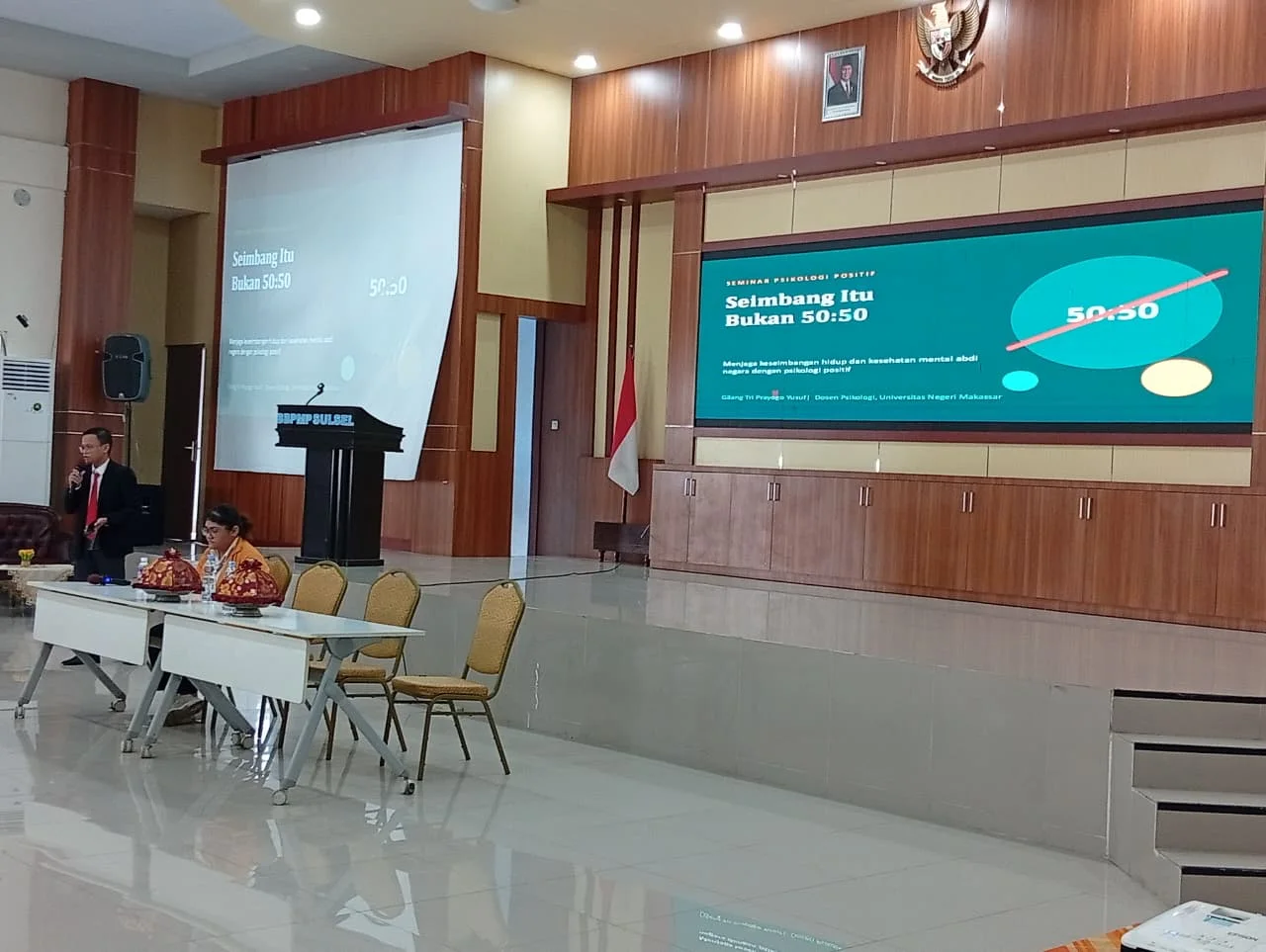
I posed that question to participants at a positive psychology seminar at BBPMP South Sulawesi on 23 November 2026, and the answers were often uncomfortable. Many civil servants arrive on time, complete their reports, and meet their targets, yet return home with exhausted bodies and empty hearts.
From that question, the idea I presented began: life balance is not about dividing the day 50:50 between work and family. Balance is about quality and energy.
There are three myths we need to leave behind.
First, balance is often thought to mean eight hours for work and eight hours for family. In reality, someone can be at home all evening, but their mind remains at the office.
Second, exhaustion is often seen as a sign of lacking resilience. In fact, exhaustion is better read as a signal that personal resources are running low, not as a character flaw.
Third, rest is considered a waste of time. On the contrary, recovery is an investment that maintains both performance and mental health.
If demands arrive continuously without a break for recovery, psychological conditions are affected. Chronic stress can develop into burnout, a condition characterized by emotional exhaustion, cynicism, and a sense of ineffectiveness (Maslach & Leiter, 2016).
Sleep becomes disrupted because thoughts about work follow you to bed. Relationships can also fray. A person may be physically present but emotionally distant.
Work messages arriving late at night do not just disrupt rest; they also rob us of the opportunity to be fully present with our families. If these signs persist for weeks, do not ignore them. Seek help from a psychologist or utilize counseling services.
Positive psychology invites us to ask broader questions: not just what is wrong in life, but what makes a person's life flourish.
Not being sick does not necessarily mean being healthy (Keyes, 2002). Seligman (2011) formulated the foundation of a flourishing life through five elements: positive emotion, engagement, relationships, meaning, and accomplishment. These five elements can be nurtured through small actions performed consciously and consistently.
The first step is simple. Write down three good things that happened every night, then enjoy one small moment with full awareness.
Turn off work notifications at night so your mind can truly rest. Also, take time to walk for ten minutes.
We do not have to change jobs to find balance. Sometimes, what needs to change is the way we approach that work.
For example, completing heavy tasks during hours when energy levels are at their highest, while remembering who is helped by the services we provide as civil servants.
At home, try to enjoy dinner with family without screen distractions. Express gratitude sincerely and treat yourself withself-compassion, as explained by Neff (2003).
We can say to ourselves, “I have tried. Today is enough, I will continue tomorrow.”
However, no matter how disciplined a person is, they cannot maintain life balance alone. Employee well-being is a shared responsibility, including that of the organization where they work.
Work units can start with simple steps, such as providing assignment information as early as possible so employees' families can prepare, providing recovery space after long duty periods, and limiting the sending of non-urgent work messages to working hours only.
Additionally, organizations need to provide easily accessible counseling services while maintaining confidentiality.
Ultimately, health is something to be nurtured, not waited for. One small habit performed consistently is far more valuable than a grand plan that is never executed.
Balance is not a 50:50 ratio, but a state where we still have the energy to be fully present, both at work and at home.









Comments 0
Write a Comment Share your response