

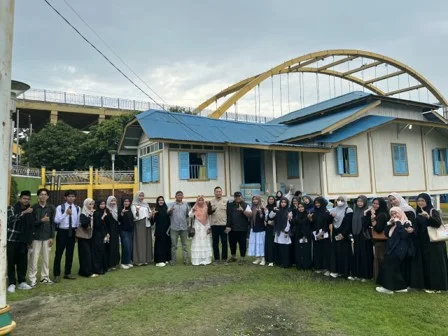
PEKANBARU, JurnalPost.com — Standing along the banks of the Siak River in Pekanbaru, Riau Province, the Tuan Kadi Guest House is a historic building that reflects the rich cultural heritage of the Malay community. The name Tuan Kadi is closely linked to Haji Zakaria bin Abdul Mutallib, a historical figure whose name remains synonymous with this traditional house to this day.
In the past, this building served as a resting place for Tuan Kadi and his royal entourage when visiting the Senapelan area, which is now part of Pekanbaru. The existence of the house holds significant historical value and serves as a symbol of the local community's cultural identity.
One of the main attractions of the Tuan Kadi Guest House lies in its traditional Malay architecture, which possesses distinct characteristics. Every part of the structure not only serves a practical function but also embodies cultural meanings and religious values passed down through generations.
According to Syaripudin, S.S., who was interviewed regarding the history and architectural characteristics of the building, the Tuan Kadi Guest House features a distinctive roof shape known as Limas Pancung, a classic form of traditional Malay architecture.
Originally, the house had two floors. The upper floor was used as a bilik pingit, a private room designed to ensure the privacy of its occupants.
Another unique feature is the arrangement of the building's walls, which are installed vertically. This design further reinforces the Malay architectural character inherent in this historic home.
At the front of the house, there is a water basin that was historically used as a gesture of respect and hospitality toward guests. The presence of this basin reflects Malay cultural values that uphold mutual respect, politeness, and honor for visitors.
Beyond its structure, the staircase of the Tuan Kadi Guest House also holds philosophical significance closely related to Islamic teachings.
According to Syaripudin, S.S., the staircase, which consists of five steps, symbolizes the five Pillars of Islam. This meaning demonstrates how Islamic values have become an inseparable part of the life and traditional architecture of the Malay community.
This fusion of Malay culture and Islamic values gives the Tuan Kadi Guest House a unique distinction compared to other historical buildings.
The house's location near the Siak River also carries historical weight. In the past, the river played a vital role as a hub for transportation, trade, and the development of life in Pekanbaru.
The presence of the Tuan Kadi Guest House in this area serves as a reminder of the close relationship between urban development, community activity, and the history of Malay culture in Riau.
Today, the Tuan Kadi Guest House is recognized as a protected cultural heritage site with significant potential to be developed into a historical and cultural tourism destination.
Through its unique architecture and historical background, this building can serve as an educational tool for both locals and tourists to understand the relationship between Malay traditions and Islamic influence in Riau society.
Efforts to preserve the Tuan Kadi Guest House cannot rely solely on maintaining the physical condition of the building. Public awareness, the involvement of the local community, and support from the regional government all play crucial roles in upholding the historical and cultural values contained within.
Introducing the Tuan Kadi Guest House to the international community is a step toward broadening global knowledge regarding Indonesia's cultural diversity.
So far, destinations like Bali and Jakarta may be more familiar to international tourists. Yet, various other regions, including Riau, possess historical relics and cultural wealth that deserve wider attention.
Through sustainable historical tourism development, the Tuan Kadi Guest House has the potential to become a cultural landmark for Pekanbaru while introducing the distinctiveness of Malay civilization to travelers from around the world.
For the people of Pekanbaru, preserving the Tuan Kadi Guest House is not merely about maintaining an old building. More importantly, this preservation is a form of respect for history, an effort to safeguard Malay cultural identity, and a commitment to passing down noble values to future generations.
Thus, the Tuan Kadi Guest House stands not only as a silent witness to the history of Pekanbaru but also as a part of Indonesia's cultural wealth that deserves to be recognized and appreciated by the global community.




Comments 0
Write a Comment Share your response