

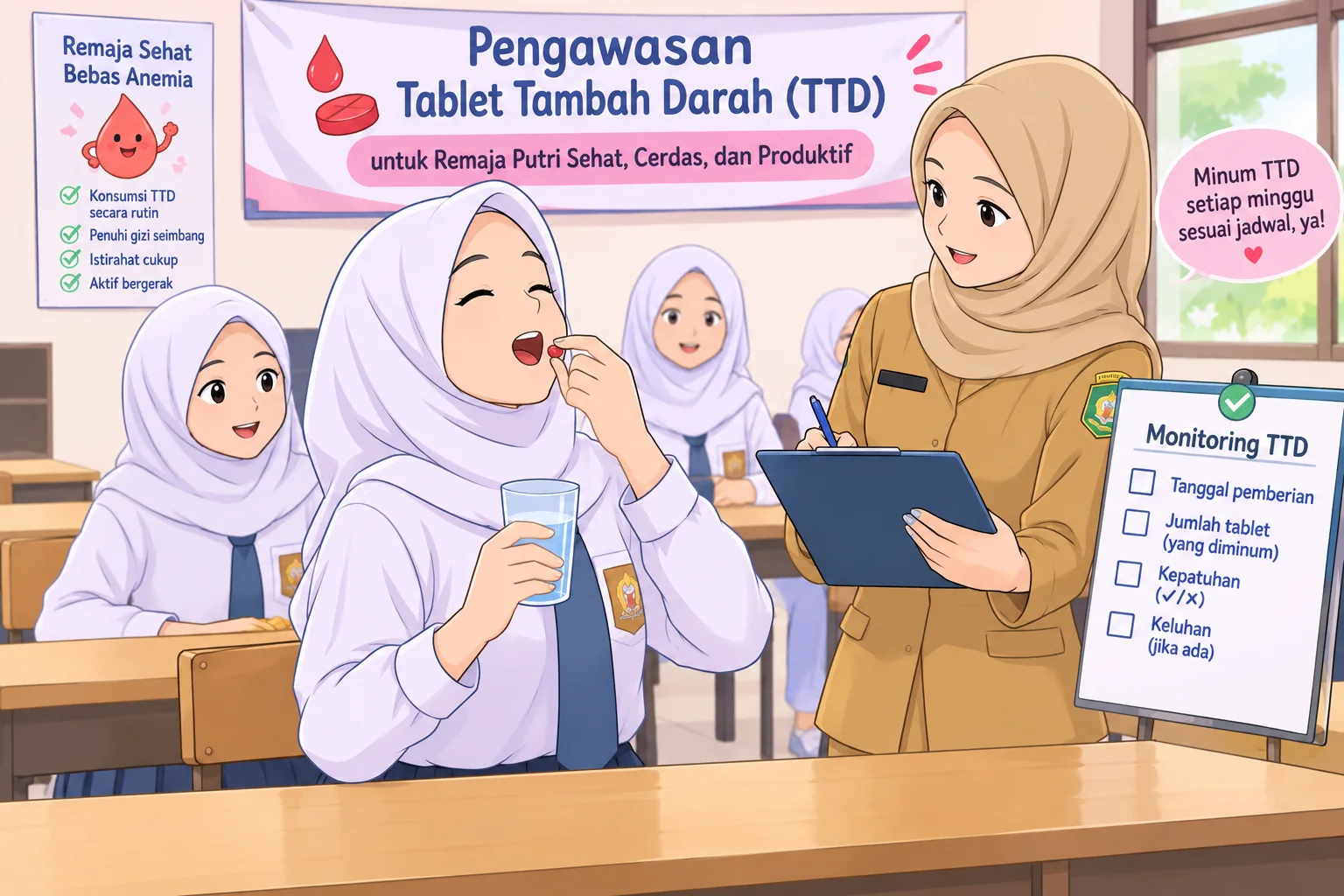
JurnalPost.com - One public health issue that still requires serious attention is anemia among adolescent girls. The vulnerability of adolescent girls to anemia is caused by an increased need for iron during growth spurts and blood loss during menstruation. Therefore, the government issued a policy for the provision of Iron Tablets (TTD) for adolescent girls as an effort to prevent anemia through the Minister of Health Regulation Number 88 of 2014. This program is implemented through educational institutions with a recommendation to consume one tablet weekly throughout the year. The benefit for these adolescent girls, who are future mothers, is to prepare for reproductive health and ensure a better future generation.
The policy has indeed been implemented weekly by distributing iron tablets to adolescent girls through educational institutions. However, are these iron tablets actually being consumed by the adolescent girls?
Why Are Iron Tablets Not Being Consumed?
The reason is easy to guess: discomfort. Iron tablets have side effects such as nausea, heartburn, constipation, and a fishy taste that discourage adolescent girls from taking them. Moreover, there is a misconception that if the body feels healthy, there is no need to consume iron tablets. In reality, there are simple tips rarely shared, such as taking the tablet with fruit or after a meal to avoid nausea and the fishy taste.
A lack of education leads adolescent girls to believe that iron tablets are merely a school requirement. Furthermore, some girls worry that taking iron tablets will cause weight gain, disrupt their health, or cause other side effects. Misconceptions, such as the belief that taking iron tablets during menstruation increases blood flow, spread quickly because adolescent girls often trust their peers more than health workers.
At this point, supervision becomes a crucial step. When tablets are simply distributed to girls without monitoring, the responsibility for consumption falls entirely on them. However, adolescent girls are not yet fully motivated to consume iron tablets. Therefore, the success of the program cannot be measured solely by distribution, but must also be based on the girls' compliance in consuming the tablets.
Distribution Is Not a Guarantee of Compliance
The problem in implementing this program is the gap between the coverage of iron tablet distribution and actual consumption compliance. Data from the SKI in 2023 shows that the coverage of iron tablet distribution for adolescent girls has reached 78.9%. However, this figure does not directly reflect the success of routine iron tablet consumption.
In reality, the compliance of adolescent girls in consuming iron tablets is concerning. A report from UNICEF data in 2024 shows that only 6.1% of adolescent girls were reported to receive iron tablets routinely every week, and only 3% of the 6.1% of girls who received tablets throughout the year consumed them routinely.
Therefore, distributing iron tablets without monitoring consumption has the potential to be a futile program that serves only as an administrative activity. The distributed tablets will indeed result in good distribution reports, but the desired outcomes will not be achieved if compliance remains low.
Has Supervision Been Conducted?
Supervision of iron tablet consumption is a vital step that should be inseparable from program implementation. In reality, supervision is often focused solely on administrative record-keeping. The supervision conducted often consists only of distributing tablets or reminding students of the consumption schedule without ensuring that the girls actually take them.
Teachers and school health unit (UKS) staff have many other duties and limited time. Community health centers (Puskesmas) sometimes lack the time to monitor each of their partner schools individually. Parents are often unaware that their children are carrying iron tablets that must be consumed. Consequently, the responsibility for supervision is fragmented among many parties, leaving no one fully accountable.
We often stop at the word “monitoring” without asking about the mechanism. There needs to be a system that ensures adolescent girls actually consume the tablets, understand their benefits, and receive support when facing obstacles. Thus, the issue of supervision is not just a technical problem, but part of the challenge of public health program governance.
What Can Be Done?
The iron tablet program is the responsibility of various parties, not just teachers and health workers. Good cooperation from all sides is needed for this program to succeed and to create a sustainable supervision system. The solutions offered do not have to be difficult or expensive. Some steps that can be considered include:
Collective consumption movement at school. Iron tablets should be consumed immediately after distribution under the direct supervision of a teacher, turning it into a collective habit. Once it becomes a habit, it will increase compliance and the necessity of iron tablet consumption.
Involving peers. Adolescents are more likely to listen to their peers than to health workers. Therefore, training adolescent health ambassadors can help shift the perception of taking tablets from a chore to a habit, while simultaneously debunking circulating rumors.
Education on managing side effects. Adolescent girls need to know how to manage the side effects of iron tablets so they feel confident in consuming them. Side effects can be mitigated by taking the tablets after meals or before bed to reduce nausea.
Involving families. Families play an important role in building the habit of iron tablet consumption. Information regarding the tablets can be shared through parent groups, and parents can supervise their children's consumption, especially during school holidays.
Periodic evaluation. Puskesmas need to conduct routine evaluations. Evaluation should not only look at the number of iron tablets distributed but also assess the number of girls who consume them routinely as recommended. Puskesmas can also create consumption monitoring cards to ensure supervision runs optimally.
Conclusion
The policy of distributing iron tablets to adolescent girls is the right approach to preventing anemia. Distributing the tablets is the easy part. However, the difficult and most influential part is ensuring that the iron tablets are actually consumed by the adolescent girls. As long as supervision remains weak, we are merely running an administrative program without achieving the expected benefits.
The government needs to evaluate the iron tablet consumption supervision system. The indicators for the program's success should emphasize consumption compliance, not just distribution coverage. It is time for success to be measured by how many adolescent girls are actually consuming iron tablets routinely, rather than just how many tablets are distributed.
References
Indonesian Ministry of Health. (2014). REGULATION OF THE MINISTER OF HEALTH OF THE REPUBLIC OF INDONESIA NUMBER 88 OF 2014 CONCERNING STANDARDS FOR IRON TABLETS FOR WOMEN OF CHILDBEARING AGE AND PREGNANT WOMEN. Ministry of Health of the Republic of Indonesia.
SKI. (2023). Indonesian Health Survey (SKI) 2023. Health Development Policy Agency.
UNICEF. (2024). MOVING FOR NUTRITION IMPROVEMENT: Indonesian Healthy Breakfast Action Pilot Program. United Nations Children’s Fund, Jakarta.



Comments 0
Write a Comment Share your response