


JurnalPost.com — The Department of Plant Pests and Diseases (HPT) at the Faculty of Agriculture, Universitas Gadjah Mada (UGM), conducted a community service program titled “Strengthening the Capacity of Snake Fruit Farmers in Pest and Disease Management Based on Integrated Pest Management in the Turi Snake Fruit Center Area” on Thursday, 19 November 2026. The activity, led by Dr. Suputa, S.P., M.P., took place at the Mitra Turindo Snake Fruit Farmers' Association in Imorejo, Wonokerto, Turi, Sleman, to strengthen farmers' skills in addressing Plant-Disturbing Organisms (OPT) effectively and sustainably.
Preserving Turi Snake Fruit as a Leading Export Commodity
Pondoh snake fruit is a high-value, export-oriented economic commodity in Sleman, yet it is susceptible to fruit flies, root-damaging pests, and plant diseases that can degrade quality and violate the phytosanitary standards of destination countries. Pest control must be implemented from the orchard to post-harvest stages through monitoring, sanitation, coordination among farmers, and the application of Integrated Pest Management (IPM).
Dr. Suputa: Fruit Fly Control Must Be Conducted on a Regional Scale
In his presentation, Dr. Suputa emphasized Area-Wide Management (AWM), or the coordinated management of fruit fly populations across a specific area, as these pests easily migrate between orchards. This strategy includes the use of protein bait (a protein lure combined with authorized insecticides in an attract-and-kill method for female flies), methyl eugenol, and the Male Annihilation Technique (MAT) for male flies, as well as population monitoring and the sanitation of infested fruit.
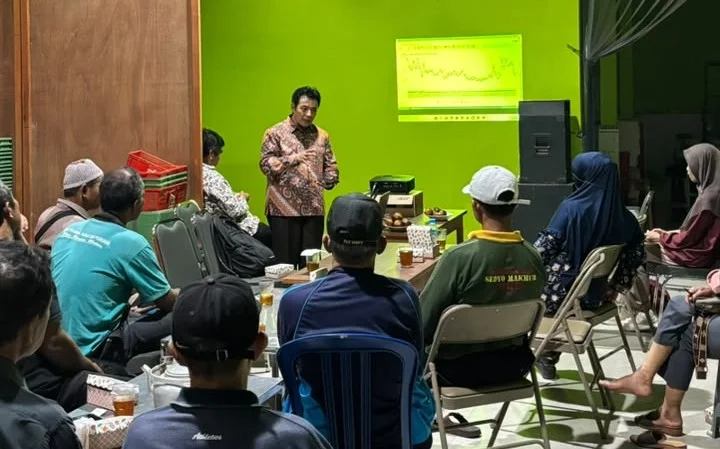
Dr. Tri Harjaka and Dr. Ady Bayu Prakoso: Bioecology of Root-Damaging Pests and Biological Control, and Identifying and Controlling Snake Fruit Diseases
Meanwhile, Dr. Tri Harjaka, S.P., M.P., reviewed the bioecology of root-damaging pests that hinder water and nutrient absorption, as well as the potential of entomopathogenic fungi such as Beauveria bassiana and Metarhizium spp. within the IPM framework. Dr. Ady Bayu Prakoso, S.P., discussed the diagnosis and management of fungal diseases—such as fruit rot, root rot, and leaf spot—through sanitation, healthy plant maintenance, and antagonistic biological agents.

Prof. Siti Subandiyah: Snake Fruit Quality and Health Determine Export Competitiveness
Regarding export quality, Prof. Dr. Ir. Siti Subandiyah, M.Agr.Sc., highlighted the importance of plant health, hygiene, harvest maturity, organic practices, post-harvest handling according to destination country standards, vigilance against antimicrobial resistance (AMR), and the regeneration of orchards and young farmers.
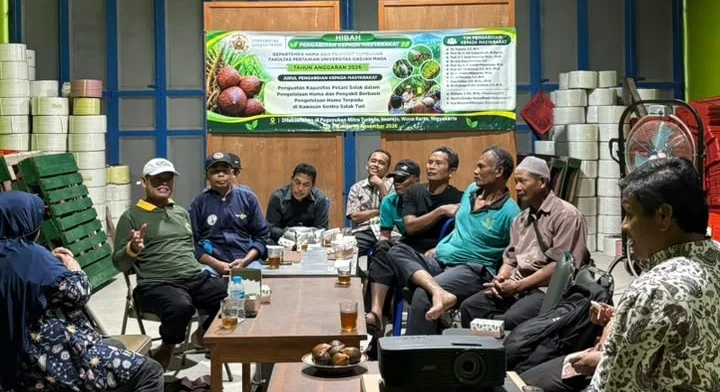
Academic and Farmer Collaboration for Sustainable Agriculture
This community service team involves Dr. Suputa, S.P., M.P.; Prof. Dr. Ir. Siti Subandiyah, M.Agr.Sc.; Prof. Ir. Y. Andi Trisyono, M.Sc., Ph.D.; Dr. Ady Bayu Prakoso, S.P.; Prof. Dr. Ir. Achmadi Priyatmojo, M.Sc.; Prof. Ani Widiastuti, S.P., M.P., Ph.D.; Dr. Ir. Arman Wijonarko, M.Sc.; Dr. Tri Harjaka, S.P., M.P.; Alan Soffan, S.P., M.Sc., Ph.D.; and Dr. Prayogo Probo Asmoro, S.P., M.Si., assisted by students Dirham, Hanifa Riezky Ramadhani, and Eva Monica Wibisono. In line with the Smart Bioecoproduction initiative of the UGM Faculty of Agriculture, this collaboration with the Mitra Turindo Association is expected to strengthen farmer independence and the competitiveness of Turi snake fruit in both domestic and global markets.




Comments 0
Write a Comment Share your response