


PACITAN, JurnalPost.com – Enhancing the competitiveness of regional flagship products depends not only on product quality and brand development but also on the ability of business owners to manage production costs accurately. Sound financial management is a critical factor in maintaining business sustainability while improving the welfare of producers.
This issue was the focus of the Workshop on Improving Communal Branding Product Quality organized by the East Java Cooperative and SMEs Office in collaboration with the Universitas Pembangunan Nasional (UPN) Veteran East Java on Thursday (19/11/2026) at the Integrated Business Service Center (PLUT) for KUMKM in Pacitan.
The activity focused on strengthening the managerial capacity of farmers and Micro, Small, and Medium Enterprise (MSME) players in the coconut sugar sector, specifically in understanding and applying Cost of Goods Sold (COGS) calculations.
Calculating COGS is a fundamental aspect of business management as it helps producers determine rational selling prices and identify the actual profit from each product generated.
To date, one of the challenges faced by coconut sugar producers is determining selling prices based on comprehensive cost calculations. In practice, pricing often relies on market rates or transactional habits without being supported by systematic recording of production costs.
Consequently, various cost components—such as labor, fuel for sap boiling, auxiliary materials, packaging, and distribution—risk being inadequately accounted for.
The Importance of COGS Calculation for Coconut Sugar Farmers
Through the material presented in the workshop, participants were encouraged to understand that the economic value of coconut sugar is determined not only by the quantity produced but also by the total resources utilized during the production process.
Structured cost recording and calculation allow farmers to determine the total production cost for a single processingbatchas well as the costs incurred to produce each unit of product.
By understanding these cost components, farmers can identify their largest expenses, evaluate production process efficiency, and set selling prices that incorporate a reasonable profit margin.
This understanding is expected to shift business management patterns from a focus solely on increasing production volume to one that also prioritizes efficiency, value-added, and profitability.
Supporting the Competitiveness of Pacitan's Flagship Products
The workshop is also part of an effort to develop East Java's flagship commodities through a collective production approach managed by real-sector cooperatives.
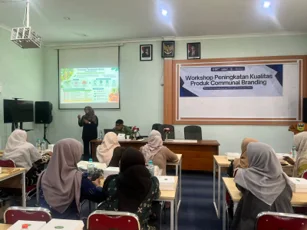
For coconut sugar farmers in Pacitan Regency, improving their ability to calculate COGS is expected to serve as a foundation for building a more efficient, competitive, and sustainable business.
Beyond assisting with pricing, proper production cost recording serves as a basis for business evaluation. Farmers can determine whether their production activities are generating sufficient profit or if improvements are needed in the use of raw materials, labor, and other resources.
The application of COGS calculation becomes increasingly vital when coconut sugar products are developed through a communal branding strategy. Improved product quality and identity must be balanced with cost management so that increased sales value translates into tangible economic benefits for producers.
Through this activity, the collaboration between local government and academia is expected to contribute significantly to strengthening the capacity of MSMEs, particularly in business management and economic decision-making.
Ultimately, enhancing the competitiveness of regional products must begin with the producers' ability to understand and manage their business operations. Quality products supported by precise cost calculations will have a stronger foundation to grow and compete in the market.










Comments 0
Write a Comment Share your response