

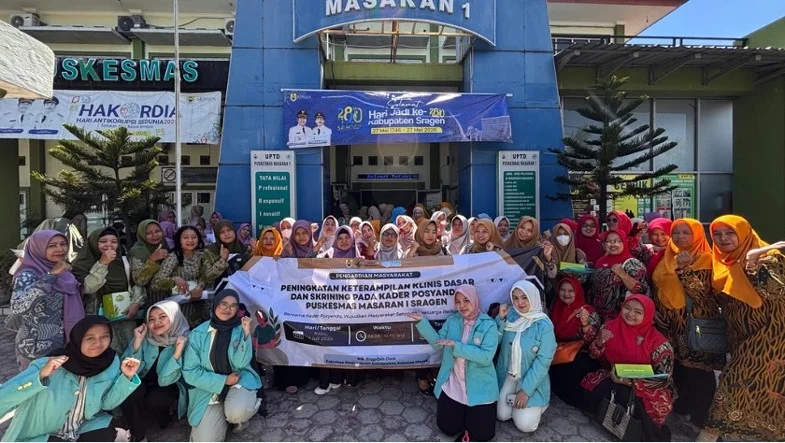
SRAGEN, JurnalPost.com — A total of 80 Posyandu cadres in the working area of Puskesmas Masaran 1, Sragen Regency, Central Java, participated in basic clinical skills and disease screening training organized by the Faculty of Medicine at Universitas Sebelas Maret (FK UNS) on Wednesday (1/7/2026).
The training is part of an effort to improve the cadres' capabilities in supporting the revitalization of Posyandu toward the Integrated Primary Healthcare (ILP) model. Through this approach, public health services are directed to be more comprehensive, covering infants, children, adolescents, adults, and the elderly.
The activity was carried out by the Tropibio.Com Research Group (RG) of FK UNS in collaboration with Recognition Community Service Program (KKN) students through a Community Service (P2M) program.
Carrying the theme “Improving Basic Clinical Skills and Disease Screening for Posyandu Cadres at Puskesmas Masaran I, Sragen,” the training took place at Puskesmas Masaran 1 by combining material delivery, discussions, and practical basic health examination sessions.
This program is designed to equip cadres with the knowledge and skills necessary for providing community services, particularly in identifying risk factors and early signs of health issues.
Strengthening the Role of Cadres in Early Disease Detection
The training was opened by the Head of Puskesmas Masaran 1, Dr. Endah Riswandari, alongside the Head of the FK UNS Tropibio.Com Research Group, Dr. Lilik Wijayanti, dr., M.Kes.
During the opening, both emphasized the importance of increasing the capacity of Posyandu cadres as part of strengthening health services at the community level.
Cadres play a vital role as they interact directly with residents through various health service activities. The ability to perform basic measurements and recognize conditions that require further examination is an aspect that needs continuous development.
In the ILP Posyandu system, services are not only focused on maternal and child health but also include health monitoring for other age groups.
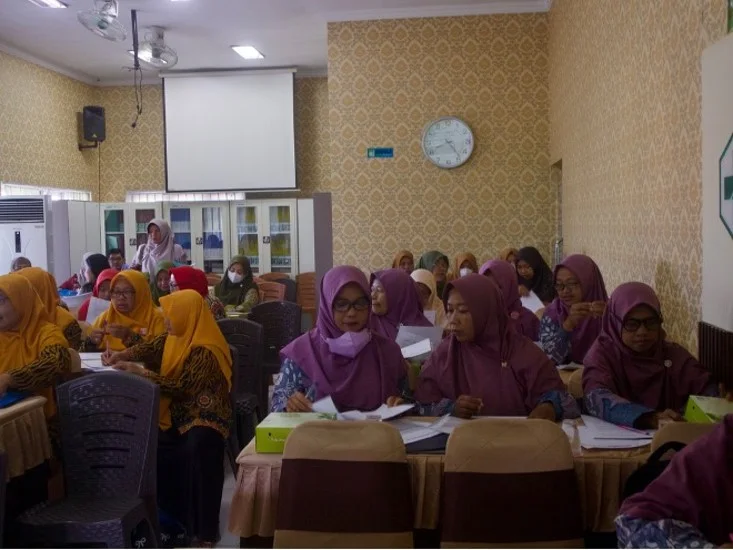
Therefore, cadres need to understand the differing examination needs for each age group so that screening activities can be conducted accurately and the results can be followed up by health professionals.
Several academics from FK UNS were present as speakers to provide insights into life-cycle-based health examinations.
Dr. Siti Ma'rufah, M.Sc., apt., delivered material on the ILP Posyandu screening flow based on age groups. The discussion focused on the importance of health examinations tailored to the needs of the community at every stage of life.
Meanwhile, Dr. dr. Endang Listyaningsih, M.Kes., provided material on stunting prevention, including the importance of monitoring child growth as part of efforts to identify growth disorders early.
Other material was presented by Dr. Lilik Wijayanti, who discussed non-communicable disease (NCD) screening, specifically in Posyandu services for adult and elderly groups.
Following the presentation of the material, participants engaged in a panel discussion to deepen their understanding of implementing health screening in Posyandu activities.
Cadres Practice Anthropometric Measurements and Obesity Screening
Beyond theoretical explanations, all participants had the opportunity to engage in practical basic clinical skills training.
The practice session was guided by Dr. Novan Adi Setyawan, Sp.PA, with the assistance of five FK UNS students involved in the Recognition KKN program.
During the session, the cadres practiced anthropometric measurements on infants and the elderly. These skills are necessary to support the monitoring of physical conditions and the nutritional status of the community.
Participants also learned how to read growth charts based on standard deviation (SD) as part of monitoring child growth and detecting stunting risks.
Additionally, cadres were trained to calculate body mass index (BMI), measure mid-upper arm circumference (MUAC), and perform waist circumference measurements to help identify the risk of central obesity.
These skills are expected to be applied in routine Posyandu activities. The results of initial examinations can serve as information for health workers to determine the need for further examination or follow-up.
However, screening results do not constitute a formal diagnosis. Further examination by health professionals remains necessary if conditions requiring medical intervention are found.
FK UNS Donates Medical Equipment
As a form of support for the implementation of health services, the organizing team also handed over several medical devices to Puskesmas Masaran 1.
The assistance provided included tensimeters, measuring tapes, stethoscopes, digital scales, and thermoguns.
The equipment is expected to support measurement and basic health examination activities, while also facilitating the application of the skills acquired by participants during the training.
This activity is also part of the implementation of the Merdeka Campus policy through the Recognition KKN P2M scheme for the Undergraduate Study Program S1 of Medicine at FK UNS.
Through this program, students have the opportunity to engage in community service activities by applying the medical knowledge learned during their studies.
The involvement of students alongside lecturers and health workers also opens up opportunities for direct learning regarding the community's health service needs at the community health center and Posyandu levels.
The training of these 80 cadres is expected to strengthen the readiness of Posyandu in the Puskesmas Masaran 1 area in implementing integrated primary healthcare.
With improved basic examination skills, cadres are expected to assist in the early detection of health problems and support services that reach the community across various age groups.



Comments 0
Write a Comment Share your response