

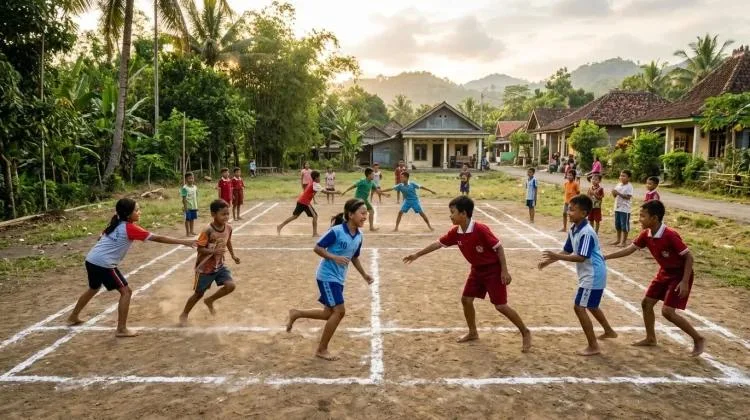
JurnalPost.com - The decline in traditional play activities among young children has become a concern in the field of Early Childhood Education (PAUD). Games such as jamuran, gobak sodor, hide-and-seek, and cublak-cublak suweng, which were once staples of childhood, are increasingly rare. Conversely, the use of digital devices is now dominating children's playtime.
This situation highlights the importance of reviving traditional children's games as a form of developmental stimulation. Traditional games not only carry cultural value but also provide learning experiences that support the development of empathy, teamwork, communication, and emotional regulation.
Nuzulul Pawestri, a doctoral student in the Early Childhood Education program at the State University of Surabaya (Unesa) 3, explains that traditional games play a crucial role in supporting early childhood development, particularly in the social-emotional aspect.
“For young children, play is not just a way to fill spare time. It is a necessity and a vital learning process. Through traditional games, children learn to interact, understand the feelings of others, work together, and manage their emotions,” she said.
Traditional Games as a Tool for Social-Emotional Learning
Nuzulul believes that the decline in traditional play should be a shared concern, especially for educators and parents. This is critical because direct play experiences provide children with opportunities to develop various social skills needed in daily life.
“When children spend too much time on digital devices, opportunities for direct interaction with peers diminish. Yet, social-emotional skills cannot be taught through explanation alone; they must be practiced through real-life experience. This includes games that involve movement, communication, rules, and cooperation,” she explained.
Through collaborative play, children learn to understand rules, communicate with peers, accept differing opinions, and navigate various social situations firsthand.
These experiences are essential components in the process of character building and social-emotional development from an early age.
According to Nuzulul, every traditional game holds learning potential that can be adapted to the needs and developmental stages of the child.
“In gobak sodor, children learn to strategize and work as a team. In jamuran, they learn to follow rules and wait for their turn. Meanwhile, through cublak-cublak suweng, children can learn about honesty, patience, and togetherness. These values are highly relevant for building character from an early age,” she added.
The values embedded in traditional games demonstrate that play is more than just entertainment. Through simple games, children gain the opportunity to develop skills that are beneficial for their social lives.
The 'Jumat Dolanan' Program as an Alternative for PAUD Learning
To revive traditional games, Nuzulul encourages PAUD institutions to integrate traditional children's games into their learning activities in a planned and sustainable manner.
One alternative that can be implemented is the 'Jumat Dolanan' (Playful Friday) program, which provides space for children to learn and practice various traditional games with their peers.
“I see the 'Jumat Dolanan' program as a viable alternative. This activity does not require expensive facilities. Teachers can utilize games familiar to the children's lives and then guide them so that the play experience becomes a meaningful learning process,” she stated.
Through these activities, teachers can select games that are appropriate for the children's age, abilities, and developmental needs.
Beyond reintroducing cultural heritage, this program can also serve as a means to build habits of interaction, cooperation, and direct communication in a fun environment.
Implementation does not have to rely on special facilities or equipment. Various traditional games can be played using the school environment and simple tools, provided that the safety and comfort of the children remain a priority.
Technology Should Support, Not Replace, Children's Play Experiences
Amidst the rapid development of digital technology, the use of devices in children's lives is an issue that must be addressed wisely.
Technology can be beneficial if used appropriately, including as a medium to support learning. However, excessive use has the potential to reduce children's opportunities for physical activity and direct interaction with their surroundings.
Nuzulul emphasizes that efforts to preserve traditional games do not mean rejecting technological progress in education.
“Technology can still be utilized in early childhood education. However, its use must be managed wisely. Children still need the experience of playing directly, moving, communicating, and building relationships with their peers. Technology should support the child's learning experience, not replace it,” she concluded.
This perspective underscores the importance of balancing the use of technology with opportunities for direct, hands-on play.
Young children still require space to move, explore, imagine, and build social relationships through real-life experiences with peers and the adults around them.
Collaboration Between Family, School, and Community
The revitalization of traditional children's games should not stop at merely reintroducing them. This effort must be realized through sustainable play activities within the family, PAUD institutions, and the community.
Parents have a role in providing time and opportunities for play at home. Meanwhile, educators can develop learning activities that incorporate traditional games as part of developmental stimulation.
Community support is also needed to create a safe, fun play environment that provides space for children to interact directly.
Collaboration among various parties is essential so that children have broader opportunities to grow and develop through meaningful play experiences.
Ultimately, reviving traditional children's games is not just about preserving cultural heritage so it is not lost to the passage of time. More than that, traditional games are an educational tool that can help build a generation that is not only cognitively developed but also possesses empathy, care, teamwork skills, and social-emotional maturity.
Because, through simple games, children learn to understand themselves, respect others, and build a life together. A childhood filled with play experiences is a precious part of the growth process that should not be entirely replaced by digital screens.







Comments 0
Write a Comment Share your response