

JurnalPost.com - When hearing the word Batak, many people outside of North Sumatra might immediately imagine individuals with surnames like Simanjuntak, Sihombing, Simbolon, Nainggolan, or Nasution. While this image is not entirely incorrect, it is insufficient to explain the vast diversity of identities and cultures that exist within the Batak community.
In common understanding, there are six groups or clans often placed within the Batak cultural cluster: Angkola, Karo, Mandailing, Pakpak, Simalungun, and Toba. Each possesses its own distinct language, customs, kinship systems, and historical trajectory.
These six can be likened to siblings in a large family. There are commonalities that connect them, yet there are also differences that shape their individual identities.
The challenge is: how can these commonalities become a unifying force without erasing the uniqueness of each clan? Furthermore, how can existing differences be viewed as cultural wealth rather than a pretext for mutual domination?
This question becomes crucial as cultural identity faces social change, technological advancement, and the currents of globalization.
Commonalities as a Binding Agent
There are several cultural values that demonstrate the close relationship among these six clans. One of the most prominent is the existence of clans and kinship systems.
The Toba, Angkola, and Mandailing societies are known for the Dalihan Na Tolu concept. Meanwhile, the Karo society has Rakut Sitelu, and the Pakpak recognize Sulang Silima. Although their structures and applications are not entirely identical, these systems all place kinship as a vital element in social life.
Through these kinship systems, society is taught to respect specific parties, maintain fraternal bonds, and understand responsibilities toward family and the group.
Another commonality is found in the appreciation for family life, success, and social honor. In the Batak Toba tradition, for example, there is the philosophy of hamoraon, hagabeon, and hasangapon which relate to prosperity, descendants, and honor.
Similar values, albeit with different terms and emphases, can also be found in the lives of other clans.
Relationships with ancestors and ancestral lands are also essential parts of forming cultural identity. Various traditional ceremonies, respect for ancestors, and the existence of customary land (tanah ulayat) demonstrate that the human connection to family and the environment holds profound meaning.
In terms of language, the languages used by the six clans share a kinship within the Austronesian family. However, each language has developed its own characteristics, meaning they are not always mutually intelligible to speakers of other clan languages.
From a social psychology perspective, these commonalities can serve as capital for building a collective identity.
Henri Tajfel, through social identity theory, explains that an individual's membership in a group can be a significant part of their self-identity formation. A sense of belonging to a group influences how a person understands themselves and relates to others.
Thus, awareness of cultural connections among various clans can be a social strength, provided that this awareness is not used to erase more specific identities.
Difference Is Not a Reason for Domination
Despite having several commonalities, the six clans cannot be treated as a completely uniform cultural group.
One error that persists is the assumption that all Batak culture is identical to Toba culture. In reality, each clan has its own characteristics that deserve to be recognized and respected.
The Karo people, for instance, have their own language and traditions, including the use of the greeting Mejuah-juah. The Simalungun people have their own language, history of kingdoms, and distinct customary instruments.
The Pakpak people recognize the Sulang Silima kinship system and possess a traditional textile heritage called oles. Meanwhile, the Mandailing people are known for the Gordang Sambilan tradition and various other cultural riches.
The Angkola also possess distinctiveness in language, customs, and social life that have developed through their own historical journey.
This diversity is also visible through traditional textiles. The Toba people recognize various types of ulos, the Karo have uis, the Simalungun know hiou, and the Pakpak have oles. The Mandailing also possess traditional textiles with their own patterns and functions.
Each textile is more than just a complement to traditional clothing. Within them lie symbols, values, and usage rules related to the lives of their owners.
Differences in religion and belief practices are also part of the social reality that must be respected. Islamic traditions have a strong influence on the lives of the Mandailing and Angkola people, while Christianity has developed extensively in parts of Toba, Karo, Simalungun, and Pakpak. Nevertheless, religious life in each group remains diverse.
Given this reality, it is inappropriate to consider one clan as the sole benchmark for determining the authenticity of other clans' identities.
The thoughts of philosopher Paul Ricoeur regarding identity and narrative can help in understanding this issue. Human identity is not formed in a closed space but develops through relationships and encounters with others.
In the context of Batak culture, this understanding invites each clan to view its identity as something unique, yet remain open to the cultural experiences of other groups.
One can maintain a Karo, Pakpak, Simalungun, Angkola, Mandailing, or Toba identity without having to demean the identities of other communities.
When one group considers its culture the most correct or the most representative of the entire group, a tendency toward ethnocentrism emerges.
William Graham Sumner used the term ethnocentrism to explain the tendency to judge other groups based on the cultural standards of one's own group.
If such an attitude develops in relationships between clans, differences that should enrich can instead turn into a source of tension.
Building Relationships through Dialogue
Unity cannot be built solely by emphasizing commonalities. Unity also requires a willingness to understand others.
Philosopher Martin Buber distinguished human relationships through the concepts of I-It and I-Thou, or Aku-Itu and Aku-Engkau.
In an I-It relationship, others tend to be viewed as objects. Conversely, an I-Thou relationship places the other as a whole person worthy of respect.
This principle is relevant in building relationships between clans.
When one group views another as a party that must follow its culture, the relationship built will be one-sided. However, when each group is willing to listen, appreciate, and learn about the culture of other groups, space opens up to build a more equal relationship.
The Toba people can learn about various Karo traditions in managing social and environmental relationships. The Karo people can learn more about the customs of the Angkola. Likewise, the Mandailing, Pakpak, and Simalungun people can share knowledge about their respective cultural values.
This process is a form of mutual learning or mutual learning.
Unity also demands the ability to transcend one's own group interests.
Viktor Frankl, through his thoughts on self-transcendence, emphasized the importance of humans finding meaning by directing themselves toward something that transcends personal interests.
In cultural life, this principle can be interpreted as the willingness of each clan not only to fight for the pride of its own group but also to appreciate the existence and progress of other groups.
Pride in one's own identity is certainly important. However, pride becomes more meaningful when it is not accompanied by a desire to diminish the identity of others.
Avoiding Homogenization and Division
There are two major challenges in building unity amidst cultural diversity.
The first challenge is homogenization in the name of unity.
If Batak identity is only described through the language, traditional clothing, or traditions of one clan, other groups potentially lose the space to showcase their uniqueness.
For example, when joint cultural activities only highlight ulos and Toba customs, while Karo uis, Simalungun hiou, and Pakpak oles receive less space, an imbalance in cultural representation arises.
Unity should not demand that all groups become the same.
John Rawls' thoughts on justice can serve as a foundation for seeing the importance of organizing communal life without ignoring the position of others.
The second challenge is when differences become a reason to close oneself off from broader historical and cultural relationships.
In reality, the mention of Batak identity is not always accepted or interpreted in the same way by every community. Some people prefer to emphasize their Karo, Mandailing, or their own clan name. This choice of identity needs to be respected as part of the community's right to define itself.
The most important thing is to ensure that different ways of understanding identity do not hinder fraternal relationships, dialogue, and cooperation.
Philosopher Charles Taylor, through the idea of politics of recognition or the politics of recognition, emphasized the importance of acknowledging identity in human life.
Sincere recognition does not mean forcing someone to be the same as us. Conversely, recognition opens space for others to be present with their own identities.
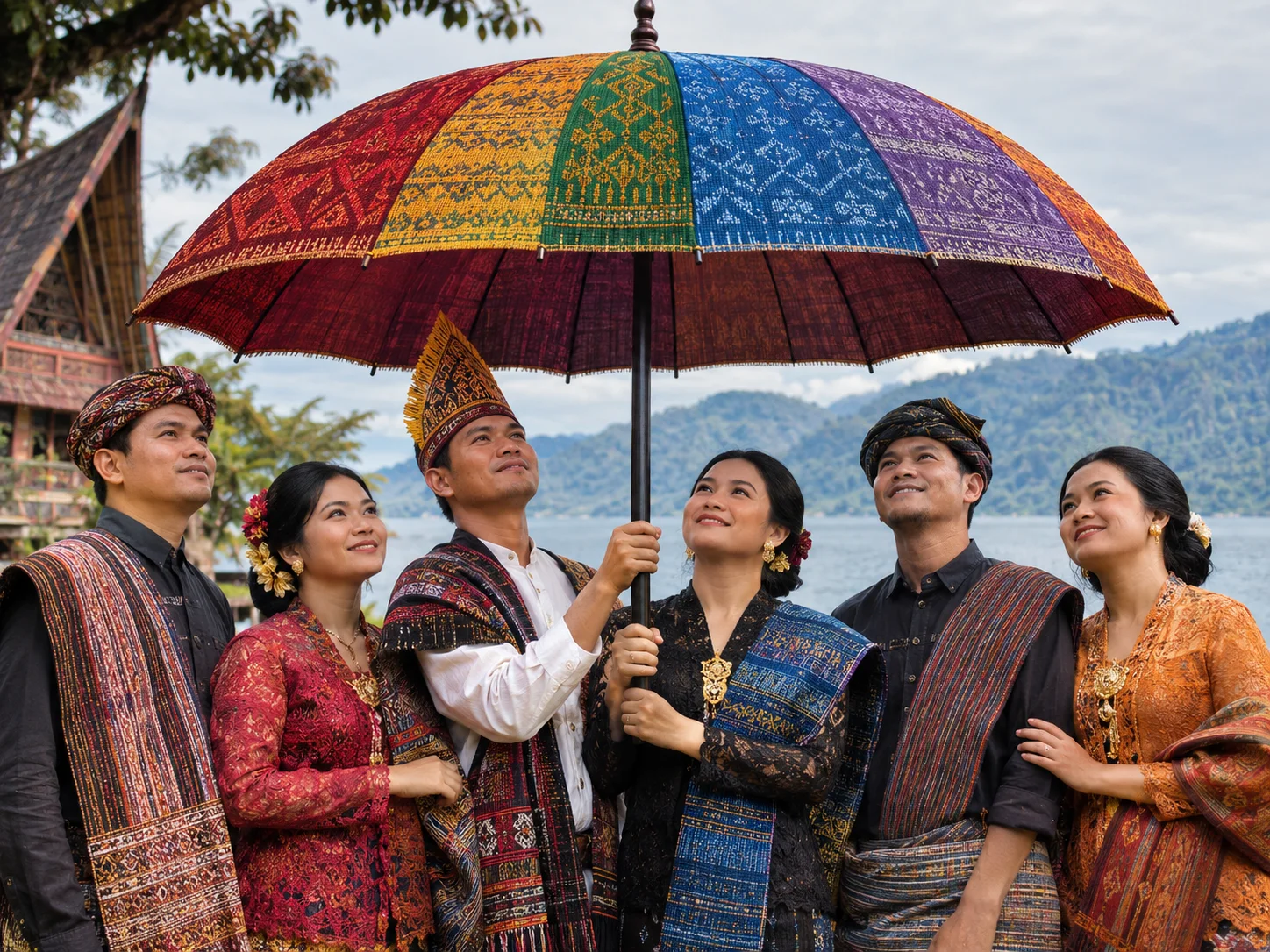
A Large Umbrella with Six Colors
Imagine a large umbrella that symbolizes the cultural relationship of the six Batak clans.
The pole of the umbrella represents the values that bring them together, such as kinship, respect for family, social solidarity, and relationships with ancestral heritage.
Meanwhile, the umbrella fabric consists of six colors representing the Angkola, Karo, Mandailing, Pakpak, Simalungun, and Toba.
Each color has its own beauty. No color should be erased so that others appear more prominent.
It is precisely the combination of these six colors that makes the umbrella beautiful.
If one color tries to cover another, the integrity of the umbrella will be disrupted. Likewise, if each part moves on its own without maintaining a relationship with the other parts, the umbrella will no longer be able to perform its function.
This simple illustration shows that unity is not homogenization. Unity is the ability to live together, work together, and respect one another despite having differences.
Caring for Culture in the Digital Era
Amidst technological development and globalization, cultural preservation requires concrete steps.
First, strengthen cross-cultural education. The younger generation needs to be introduced to the diversity of languages, customs, and history of communities in North Sumatra.
Cultural education in schools should not only introduce the traditions of the local community. Knowledge about the cultures of other groups is also important to build an attitude of mutual respect from an early age.
Children in Medan, Tarutung, Berastagi, Padangsidimpuan, and other regions can gain a broader understanding of the cultural diversity that lives around them.
Second, organize joint cultural activities that provide equal space for all clans.
Cultural festivals can be designed to present dances, music, traditional clothing, languages, and traditions from all six groups proportionally.
Thus, the festival is not just a performance stage, but also a space for intercultural encounters and learning.
Third, build a more inclusive digital narrative.
The younger generation has a great opportunity to introduce cultural wealth through videos, podcasts, documentaries, and various social media platforms.
Content regarding the Pakpak language, Mandailing traditions, the life philosophy of the Karo people, Simalungun history, Angkola customs, and Toba culture can be developed collaboratively.
Digital media should not only be a place to show pride in one's own group, but also a means to introduce, document, and respect the cultural wealth of other groups.
Ultimately, maintaining relationships among the six clans is not a matter of determining who is the oldest, the largest, or the most authentic.
Unity is more about the willingness to acknowledge, understand, and support one another.
An Indonesian proverb says, "berat sama dipikul, ringan sama dijinjing" (burdens are borne together, lightness is shared). This value can be a reminder that togetherness requires responsibility from all parties.
The cultural umbrella that shelters the six colors will only remain strong if each color is given the space to maintain its beauty.
We do not have to be uniform to live side by side. Differences make culture richer, while the willingness to respect one another keeps brotherhood preserved. (***)



Comments 0
Write a Comment Share your response