

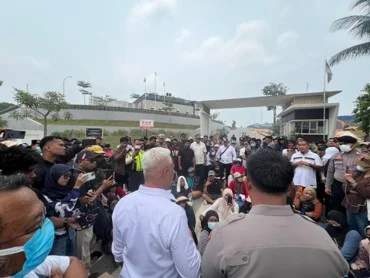
JurnalPost.com – Imagine turning on the tap at home only to find no water when you need to cook, bathe, or wash. For some residents of Nongsa, Batam, this is not just a hypothetical scenario that arises during the dry season.
On 5 October 2026, residents of Sambau held a protest in front of Nongsa Digital Park, carrying empty water jugs. They were protesting clean water supply disruptions that have persisted for months, hindering their daily activities.
This event raises a critical question: how can Indonesia pursue digital progress without neglecting the basic needs of its people?
Behind the Growth of the Digital Industry
Public complaints emerged as households struggled to access clean water, while data center activities continued to expand in the area.
Some residents reported having to purchase water to meet their cooking, bathing, and washing needs, which has increased their household expenses.
However, the allegation that data centers are the direct cause of the water crisis has not been proven based on available information. Water service operators have stated that drought caused by the dry season and the El Niño phenomenon has significantly reduced production at the Nongsa Reservoir.
According to a report by Mongabay Indonesia, water production at the Nongsa Reservoir dropped to approximately 30 liters per second from a normal capacity of about 80 liters per second.
Regardless of the cause of the crisis, the residents' concerns deserve serious attention from the government and regional management. The growth of the digital industry must go hand-in-hand with meeting the basic needs of the community.
Why Does Artificial Intelligence Need Water?
Behind the convenience of using artificial intelligence (AI) lies physical infrastructure that requires significant resources.

Data centers function to store and process information to run various digital services, including the AI technologies increasingly used in daily life.
In their operation, data centers require electricity to run computing devices. This activity generates heat, necessitating cooling systems to keep device temperatures stable.
Some data center cooling technologies utilize water. However, the water requirements of each facility vary, depending on the cooling technology, climate conditions, computing capacity, and the infrastructure design used.
Therefore, it is inaccurate to assume that all data centers have the same level of water consumption.
The growth of the digital industry needs to be accompanied by adequate water and energy infrastructure planning from the construction stage. Without careful planning, the industry's increasing resource demands could potentially add pressure to the environment and public facilities.
Seawater Desalination as an Alternative
The Batam government is encouraging data center developers to provide independent water sources through Sea Water Reverse Osmosis (SWRO) technology.
This technology allows seawater to be processed into fresh water through a filtration process using special membranes capable of separating salt and various dissolved substances.
The use of SWRO is expected to reduce the industry's dependence on reservoirs that also serve as water supply sources for the surrounding community.
However, desalination technology is not a challenge-free solution. The construction and operation of SWRO facilities require investment, energy, adequate production capacity, and a management system for the concentrated waste or brine produced during the desalination process.
If not managed properly, the discharge of high-salinity waste has the potential to put pressure on marine ecosystems.
Therefore, the government and companies must ensure that the use of such technology is carried out responsibly, accompanied by water quality monitoring and transparency regarding resource usage information for the public.
The Water Crisis from an Industrial Engineering Perspective
From an Industrial Engineering perspective, this issue is closely related to process efficiency, resource management, capacity planning, and the sustainability of industrial systems.
The success of an industry is not only measured by productivity and economic profit but also by its ability to manage resources efficiently and minimize environmental impact.
Companies can implement water reuse systems, more resource-efficient cooling technologies, and regular water consumption monitoring to reduce waste.
One indicator that can be used in data center management is Water Usage Effectiveness (WUE), which measures water usage in relation to the energy consumption of information technology equipment.
Through systematic measurement, companies can evaluate the efficiency of their water use and identify opportunities for improvement in operational processes.
Transparent reporting of water consumption is also important so that the public can know how the industry is managing available resources.
At the same time, the government needs to ensure that every development project accounts for environmental carrying capacity, water availability, and community needs before expanding operational capacity.
Technological Progress Must Go Hand-in-Hand with Public Welfare
The development of artificial intelligence and data centers opens various opportunities for Indonesia, ranging from increased investment and job creation to the acceleration of digital transformation.
However, such progress must not ignore environmental issues and public welfare.
The clean water crisis in Batam serves as a reminder that industrial development requires a balance between economic interests, environmental sustainability, and meeting the basic needs of residents.
The government, companies, academics, and the public need to build open communication to ensure that resource management is conducted fairly and responsibly.
Technology should be part of the solution to human life's problems, not an added burden for communities around industrial areas.
Ultimately, the measure of success for digital transformation lies not only in how sophisticated the technology developed is, but also in how much it benefits people's lives.
Technological progress should improve the quality of life, not make people worry every time they turn on the water tap at home.
References
Mongabay Indonesia. (2026, 10 October). Batam Krisis Air, Warga Demo Data Center.
The Jakarta Post. (2026, 8 October). Batam Residents Protest Data Center Expansion as Water Shortages Worsen.
Pemerintah Kota Batam. (2026, 25 September). Jaga Air Waduk untuk Masyarakat, Batam Siapkan Solusi Kebutuhan Air Data Center lewat SWRO.
The Jakarta Post. (2026, 30 September). BP Batam Requires Data Centers to Construct Desalination Plants After Water Crisis.









Comments 0
Write a Comment Share your response