

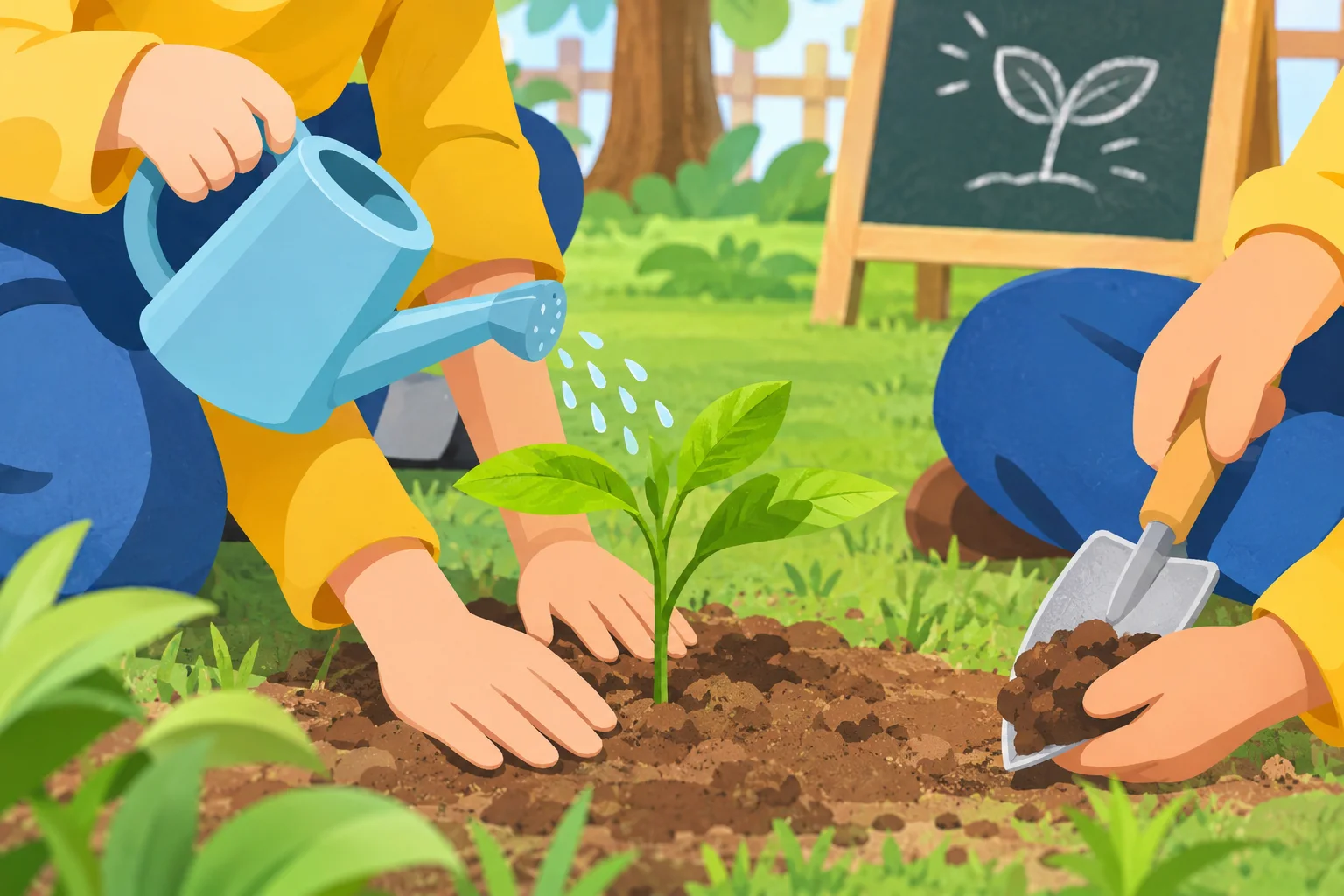
JurnalPost.com – For young children, learning does not always have to take place inside a classroom with books and whiteboards. In nature-based schools, the surrounding environment becomes an integral part of daily learning activities. Simple objects like stones and twigs, for instance, can be used to introduce counting concepts.
This demonstrates that a child's learning process can begin with simple things close to their daily lives.
Using stones and twigs does more than just make learning feel more enjoyable. Objects that can be seen and touched directly help children understand numerical concepts more easily.
In educational psychology, the use of such concrete objects is known as Math Manipulatives, which is the utilization of concrete items to help children grasp mathematical concepts (Santrock & Roehrig, 2024).
Thus, objects in a child's surroundings are not merely playthings but can also be utilized as part of the learning process.
The Natural Environment as a Learning Medium
The use of the environment as a learning medium is evident in various daily activities for children. They are encouraged to care for plants, decorate pots, exercise in open areas, and take walks around the school grounds.
This method of learning relates to the concept of Situated Cognition, which explains that the learning process is linked to the social situation and physical environment where an individual is active (Santrock & Roehrig, 2024).
This is also consistent with the discussion by Kiviranta et al. (2024) regarding the benefits of outdoor learning activities for early childhood.
Through this approach, children do not just understand something from a teacher's explanation, but also through the various things they encounter, observe, and do themselves.
Direct experience provides children with the opportunity to get to know their environment while developing understanding through activities close to their daily lives.
Social Interaction in the Child's Learning Process
A child's learning process does not only occur through interaction with the physical environment. Relationships with teachers and peers also provide experiences that help children understand various concepts.
In daily activities, some children are able to follow the teacher's instructions and even encourage their friends to do the same. Meanwhile, other children still require guidance because their attention is easily diverted.
This situation relates to Vygotsky's sociocultural perspective, which emphasizes the importance of social interaction and the assistance of others in the development of a child's understanding (Santrock & Roehrig, 2024).
In other words, children learn not only from what is around them but also from the people involved in their daily activities.
If viewed through the Ecological Theory of Bronfenbrenner, the school is part of the microsystem, which is the immediate environment that directly relates to a child's life.
It is in this environment that children gain experience through relationships with teachers, peers, and the various habits they practice every day (Santrock & Roehrig, 2024).
Building Independence through Daily Habits
Such social interaction is inseparable from the various habits built while children are at school.
Children are accustomed to taking care of personal belongings, following activity rules, and helping friends who are experiencing difficulties.
Routines like these are part of classroom management or Classroom Management. Teachers do not just manage the flow of learning activities, but also guide children to follow rules and cooperate with others (Santrock & Roehrig, 2024).
Through these habits, children gain the opportunity to learn responsibility, build independence, and develop the ability to interact with their social environment.
Learning that Adapts to a Child's Ability
Behind these various activities, teachers still play a crucial role in ensuring that every child receives learning appropriate to their abilities.
Based on observations, this is evident in how teachers adjust the difficulty level of materials to each child's capability.
Some children follow activities with simpler materials, while others receive more challenging tasks.
This adjustment aligns with the concept of Differentiated Instruction, which is learning tailored to the needs, readiness, and abilities of the students (Santrock & Roehrig, 2024).
This is also consistent with research by Windiastuti (2026), which discusses the implementation of differentiated learning in inclusive early childhood education by adjusting instruction based on the needs and characteristics of each child.
This approach provides every child with the opportunity to learn according to their readiness and developmental stage.
The Teacher's Role in Providing Support
In addition to adjusting materials, teachers also provide support when children encounter difficulties during activities.
One example is seen during center practice, when a child is asked to build a market shape using blocks. However, the child is still arranging the blocks randomly.
The teacher then helps guide the child so that the block arrangement can form a market building. After providing direction, the teacher gradually reduces assistance and lets the child continue the arrangement independently.
This form of support relates to the concept of Scaffolding, which is the provision of assistance tailored to a child's ability so they can complete tasks they are not yet able to perform independently (Santrock & Roehrig, 2024).
A similar point is discussed by Febrianni et al. (2024), who explain that gradual assistance can support the development of a child's motor, social, and cognitive skills while encouraging their independence.
Nature as Part of Child Development
Ultimately, a child's learning process does not only take place through materials delivered in the classroom. The natural environment, social relationships, and teacher support complement each other in providing learning experiences for children.
All three demonstrate that daily activities at school can be part of a child's process of getting to know the environment, understanding concepts, and developing their own abilities.
Therefore, nature is not just a place for children to play outdoors, but part of the environment that helps support their learning process and development.
Through direct experience, social interaction, and appropriate support, children gain the opportunity to grow into more independent individuals capable of understanding the world around them.
References
Febrianni, F., Haristawati, R. F., Annisa, R., & Humaero, Z. (2024). Scaffolding strategies in physical education learning evaluation at TK Murni Asih. Journal of Early Childhood Education Research and Development, 11(2), 67–72. DOI: 10.30870/jpppaud.v11i2.29806.
Kiviranta, L., Lindfors, E., Rönkkö, M. L., & Luukka, E. (2024). Outdoor learning in early childhood education: Exploring benefits and challenges. Educational Research, 66(1), 102–119. DOI: 10.1080/00131881.2023.2285762.
Santrock, J. W., & Roehrig, A. D. (2024). Educational Psychology (8th ed.). McGraw Hill.
Windiastuti, E. (2026). Differentiated learning in inclusive early childhood education: A case study at Budi Mulia Dua Sedayu Kindergarten. Journal of Holistic Integrative Early Childhood Education (AUDHI), 8(2), 117–132. DOI: 10.36722/jaudhi.v8i2.5100.






Comments 0
Write a Comment Share your response