

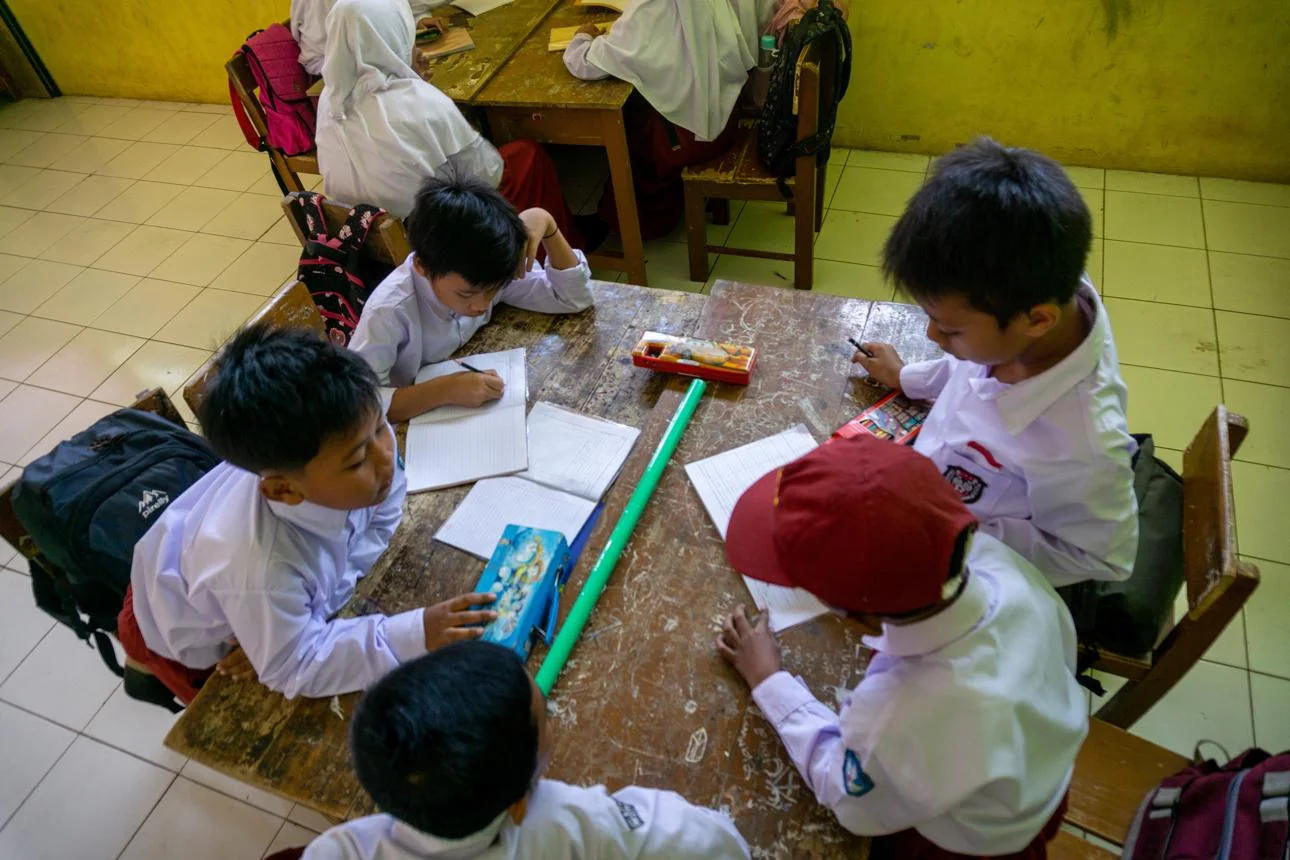
JurnalPost.com – Back when I was in school, I had a friend who was incredibly diligent at memorizing. Before every exam, their notes would be filled with colorful scribbles. They memorized every formula and definition one by one. The results were impressive: high grades and frequent praise from teachers.
However, when a question was slightly altered or they were asked to explain a concept in their own words, they would immediately become confused. From that experience, I began to wonder: what are we actually seeking in school—grades or genuine ability?
To me, a curriculum that only chases grades is like a house with a fresh coat of paint but a fragile foundation. It looks convincing from the outside, but it is not necessarily sturdy within.
I do not deny the importance of grades. Teachers need them to gauge how well students understand the material, and parents want to see their children's progress. The problem arises when numbers become the sole objective.
Students end up learning not because they want to understand something, but because they fear getting bad grades. Consequently, their approach to learning becomes shallow: memorizing just before an exam, only to forget it as soon as the test is over.
Every Student Has Different Potential
From my observations, this condition is still prevalent in many schools. Learning activities continue to revolve around quizzes, assignments, and final exams.
A child who answers questions quickly is considered smart, while a child who needs more time but possesses creative ideas often goes unnoticed.
In reality, every child has their own strengths. Some are skilled at mathematics, some are confident in public speaking, some are natural leaders, and others are adept at hands-on creation.
If everyone is measured by the same yardstick, many children's potential will never have the opportunity to flourish.
That is why developing student competency is crucial. This competency is not limited to academic fields but also encompasses critical thinking, problem-solving, collaboration, communication, and self-management.
These are the tools truly needed in real life. Almost no job or life situation asks what our math grade was when we were in the ninth grade.
The questions that arise more often relate to the ability to solve problems, work in teams, and learn new things.
The Makassar people have a saying: “Punna tena kaparaluang, tena nakurang”, which roughly translates to the importance of having sufficient provisions so as not to experience deficiency.
These are the provisions that schools should be preparing, not just numbers on a report card.
Preparing Students for a Changing World
The world is changing rapidly. Technology is evolving, new jobs are emerging, while some old jobs are slowly disappearing.
The knowledge we memorize today may no longer be relevant in a few years. Moreover, anyone can now find information in seconds through digital devices.
However, there are skills that do not easily lose their relevance: the ability to learn, filter information, think critically, and adapt to change.
If the curriculum does not prepare students for these, we risk producing graduates who are good at answering test questions but struggle to face real-world problems.
I realize that changing the direction of a curriculum is not an easy task. There are many challenges to face.
Teachers have long been accustomed to conventional assessment patterns, burdened by various administrative tasks, and sometimes forced to teach classes with too many students.
Parents also often measure a child's success based on rankings. On the other hand, many school and university entrance selection mechanisms still rely heavily on academic grades.
It is not surprising that schools feel trapped in this system. Nevertheless, difficulty should not be an excuse to stop making changes.
“Takunjunga bangunturu', nakugappa mange”, a proverb that teaches the importance of steadfastness in achieving goals despite facing various obstacles.
If the direction is correct, moving slowly is still better than stopping altogether.
Encouraging Competency-Oriented Learning
Curricula can begin to provide more space for project-based learning, discussions, presentations, and hands-on practice.
Assessments do not always have to be in the form of written tests. Teachers can pay attention to the learning process, not just the final result.
How students ask questions, work in groups, convey ideas, and correct mistakes are all part of the learning process that deserves recognition.
In this way, students who have felt unintelligent because they have average academic grades can discover their own potential and strengths.
That self-confidence is vital. Children who feel valued and are given the opportunity to grow tend to have better learning motivation.
Learning should not make students afraid of making mistakes. Instead, schools need to be spaces that allow them to try, explore ideas, and learn from experience.
The Teacher's Role in Building Student Confidence
The teacher's role is decisive in the success of this change. No matter how well a curriculum is designed, teachers are the ones who implement it directly in the classroom.
Teachers need to receive training as well as the trust to develop learning methods that suit student needs, rather than just being burdened with targets for finishing material and achieving grade completion.
I once had a teacher who always said:
“It is okay to be wrong, the important thing is that you are willing to try.”
A sentence as simple as that made us brave enough to speak, ask questions, and try new things without being too afraid of making mistakes.
The lessons from them are still remembered to this day, far longer than the formulas I once memorized.
That experience shows that a teacher's success is not only seen from the high grades of their students, but also from their ability to foster courage, curiosity, and self-confidence in their learners.
Character Education Must Not Be Neglected
One other thing that is often forgotten is character education.
Student competency is not only related to academic intelligence or technical skills, but also includes honesty, responsibility, mutual respect, and caring for others.
If schools only chase grades, students may be tempted to take shortcuts, such as cheating or copying a friend's work, because what is considered important is obtaining good results.
Conversely, when a curriculum emphasizes the process and the development of competency, students are encouraged to truly understand the material because their effort and progress are also valued.
The Bugis-Makassar community recognizes the value of sipakatau, which is the attitude of humanizing and respecting the dignity of others.
This value should also live in the classroom. Every student has the right to receive appreciation, learning opportunities, and support to develop their potential without being distinguished solely by academic achievement.
Successful education does not just produce intelligent humans, but also forms individuals with integrity who are capable of living alongside others.
Grades as a Reflection of Ability, Not the Final Goal
Ultimately, I do not mean to say that grades are unimportant. Grades are still needed as one of the indicators of learning success.
It is just that grades should be a reflection of a student's ability, not a final goal that stands alone.
A good curriculum is one that gives students the opportunity to grow holistically: intelligent in thinking, skilled in acting, and good in character.
Academic achievement should go hand in hand with the development of skills, creativity, independence, and the character of the learners.
My hope is that our schools become increasingly bold in changing the orientation of education, from merely printing students who are good at chasing numbers to forming a generation ready to face life.
Because school is not just a place to graduate, but a place to grow.








Comments 0
Write a Comment Share your response