

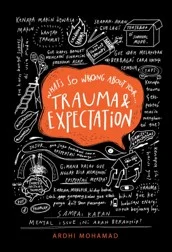
Book Identity
Book Title: What's So Wrong About Your Trauma & Expectation
Author: Ardhi Mohamad
Publisher: Alvi Ardhi Publishing, Jakarta
Year of Publication: 2023
Page Count: 296 pages
Genre: Self-improvement (self-improvement)
JurnalPost.com – In our daily lives, we often wonder why problems seem to multiply as we grow older. We carry past experiences that still linger, external demands, and anxieties about a future that remains uncertain.
These factors can leave one feeling exhausted, insecure, or pressured to simply endure. These issues are central to the book What's So Wrong About Your Trauma & Expectation by Ardhi Mohamad.
The book addresses issues close to home, particularly regarding trauma, expectations, and the process of maturing. The author divides the discussion into three major sections: Past Trauma, Future Expectations, and The Present State of Adulthood.
These sections contain interconnected chapters. Through this structure, the reader is invited to understand how past experiences, future hopes, and current circumstances influence one another.
Understanding Trauma and Past Wounds
In the first section, Past Trauma, the reader is encouraged to understand the negative experiences that may still be affecting them today.
Trauma is not always visible from the outside. Some experiences may seem trivial to others but leave deep wounds for those who endure them.
These experiences can stem from family environments, friendships, or other events that leave a person feeling powerless. This discussion also touches on mental health and depression, encouraging readers to better recognize their own state of mind.
One interesting aspect of the trauma discussion is the explanation of helplessness or the feeling of being powerless. In the review, this concept is explained alongside explanatory style, which is how a person interprets or views the negative events they experience.
There are several questions one can use to understand this perspective. For example, whether a problem is temporary or permanent, whether it affects only one part of life or many, whether it is controllable, and whether the cause lies within oneself or others.
This explanation helps readers think more clearly when facing problems. However, readers should understand that the explanations in this book are not a substitute for professional help from psychologists or mental health professionals.
Managing Expectations for the Future
The second section discusses Future Expectations. Here, the author invites readers to re-examine the meaning of happiness and success.
Today, we often view others' lives through social media. Some appear to have great jobs, fulfilling relationships, stable finances, or seemingly perfect lives.
Without realizing it, we may use others' lives as a benchmark for our own. Eventually, we feel we must achieve the same things to be considered successful.
In reality, everyone has different circumstances, opportunities, and timelines. What makes someone else happy does not necessarily bring the same happiness to us.
The book also distinguishes between hope and expectation. In one of the quotes included in the review, an expectation is described as a strong belief about something that will happen in the future, whereas hope does not carry the same level of certainty.
In my opinion, this discussion is very relevant to the lives of students. We often have specific targets for academic grades, careers, relationships, and the future.
Targets can be motivating. However, if they are too rigid, they can make us feel like failures when reality unfolds differently than expected.
Facing the Realities of Adulthood
The third section discusses The Present State of Adulthood. This section feels very relatable to many young people beginning to face greater responsibilities.
Becoming an adult is not just about aging; it is about navigating decisions, demands, anxieties, and thoughts that are sometimes difficult to silence.
The author discusses anxiety and overthinking, while encouraging readers to persevere even when the past feels heavy and the future remains unclear.
One concept discussed in this section is resilience , which is the ability to adapt and bounce back after facing unpleasant emotional experiences.
I believe this concept is important because life does not always go according to plan. We may not be able to change everything that has happened, but we can still learn to take the next step.
Endurance does not mean always having to appear strong. Sometimes, one needs to rest, talk to a trusted person, or seek appropriate support.
Strengths of the Book
What makes this book interesting is that it does not simply offer platitudes about positive thinking.
Based on the review and the sections read, the author introduces several psychological terms before presenting his perspective. This approach provides readers with new knowledge and the opportunity to connect it to their personal experiences.
The use of colloquial language makes the delivery feel like a conversation. For readers accustomed to everyday language, this style makes the book's content feel more accessible and easier to follow.
The themes discussed are also quite relevant to students and young people. Issues like comparing oneself to others, fear of failing to meet expectations, feeling left behind, and confusion about the future are experiences many have faced.
The book reminds us that everyone has a different life journey. We do not have to follow someone else's measure of success.
This message is a strength of the book, as readers can relate the discussion to their own current circumstances.
Weaknesses of the Book
Despite its strengths, some parts may require deeper understanding.
Several psychological terms are not always easy to grasp for readers who have not studied them. Some discussions also feel quite dense, requiring readers to re-read to fully understand the intent.
It would be more helpful if some concepts were accompanied by more simple examples or brief summaries. This would allow readers new to mental health topics to follow the discussion more easily.
Another drawback is that self-improvement books self-improvement like this can lead some readers to expect immediate solutions to their problems.
However, the process of understanding trauma and managing expectations cannot be solved by reading a single book. Everyone has different experiences, conditions, and needs.
Therefore, the book's content is best used as material for reflection and additional insight, rather than as a diagnostic tool or the sole method for addressing mental health issues.
Relevance for Students and Young People
Overall, the book What's So Wrong About Your Trauma & Expectation is suitable for late adolescents, students, and adults who want to understand the relationship between past experiences, future hopes, and their current state.
This book can also be a good read for someone who frequently compares themselves to others or feels burdened by specific demands.
In an increasingly competitive life, students and young people often face pressure to achieve success in various fields. This pressure can come from family, social circles, education, or self-imposed expectations.
Through its discussion, the book provides space for readers to re-examine these demands and understand that everyone has a different life journey.
Nevertheless, readers should remain critical and seek professional help if they experience mental health issues that interfere with their daily lives.
Conclusion
After reading and studying this book, I gained the understanding that being an adult does not mean having all the answers or being able to face every problem alone.
The past cannot be repeated, and the future may not go as planned. However, we still have the opportunity to improve how we view our circumstances and take small steps starting now.
For me, the most important message of the book What's So Wrong About Your Trauma & Expectation is to learn to understand oneself, not to be too harsh in self-judgment, and to give oneself time to go through every process of life.
We do not have to recover immediately or achieve success right away. Making peace with wounds and expectations is a journey that requires time, patience, and the courage to accept reality.
The most important thing is to keep trying to move forward and not let bad experiences define our entire lives.









Comments 0
Write a Comment Share your response