

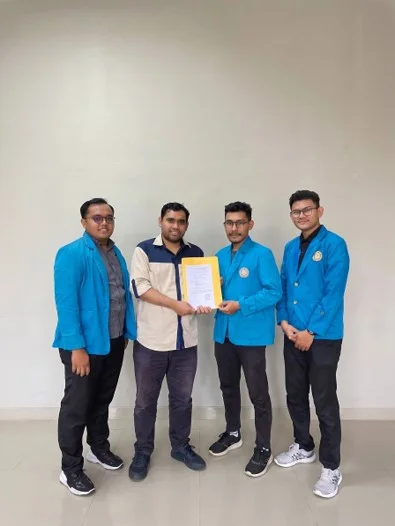
SOUTH TANGERANG, JurnalPost.com - Three students from Universitas Pamulang have collaborated with PT Aratech Nusantara Indonesia to develop a Human Resource Information System (HRIS), an information system designed to support the digitization of employee data management and administration within the company.
This collaboration involves Wanda Muharram, Sasa Mantiri, and Raden Muhammad Qobul Abdul Jabar Soerianata. The trio developed the system as part of their final project while providing a practical technological solution to address human resource administrative needs in the industrial sector.
In this partnership, PT Aratech Nusantara Indonesia was represented by Sonasa Rinusantoro, who supported the execution of the system development project.
Through this collaboration, the students not only gained the opportunity to apply the knowledge learned during their studies but also became directly involved in the technology design process based on the company's operational requirements.
The HRIS was designed as an integrated platform to help the company manage employee information more systematically, ranging from personnel data storage and organizational structure management to providing information required by the Human Resources (HR) department.
Addressing the Need for Employee Management Digitization
The development of the HRIS stemmed from the company's need for a more accurate, structured, and accessible employee data management system for authorized personnel.
In company activities, human resource information management is a critical aspect that supports operational efficiency. As the number of employees grows and the organization expands, administrative tasks can become increasingly complex.
Managing information through various documents or disconnected systems can lead to several obstacles, including slow data retrieval processes, difficulty in updating information, and the risk of data discrepancies between departments.
This situation served as a key consideration in the development of the HRIS by the Universitas Pamulang student team in partnership with PT Aratech Nusantara Indonesia.
With a centralized system, various employee-related information can be managed through a single platform, making administrative processes more organized and easier to track.
Beyond simplifying information management, this digital system is expected to support the company's needs in compiling reports and providing data for decision-making processes.
HRIS Designed to Integrate Employee Data
A primary focus of this project is to build a system capable of centralizing employee information.
Through this approach, personnel data that was previously scattered across various documents can be managed within a single system with access mechanisms tailored to user needs and authority.
The system is also designed to support the management of organizational structures, job information, and various other human resource administrative needs.
Data integration is a crucial part of HRIS development because employee information relates not only to personal identity but also to work structures and company administrative requirements.
With more structured management, the HR department is expected to obtain necessary information without having to search through multiple data sources separately.
The development of this system is also aimed at creating a foundation for human resource management that can be adapted to the company's future needs.
Developed Through Stages from Analysis to Testing
The HRIS development was carried out through a phased approach, considering both business and user requirements.
These stages included requirements analysis, system design, feature development, functional testing, and implementation preparation according to the project scope.
During the analysis phase, employee information management needs served as the basis for determining the functions and structure of the system to be built.
Subsequently, the design process was directed toward producing a platform that could support HR administrative activities more effectively.
Functional testing was also a vital part of ensuring that the developed features performed according to design goals before being deployed in an operational environment.
Furthermore, the HRIS modules were designed to allow for gradual future development. This approach provides the company with the flexibility to adjust system functions should there be changes in requirements or business processes.
Thus, the system is not only prepared to meet current administrative needs but is also positioned to keep pace with organizational growth.
Campus-Industry Collaboration Drives Technology Adoption
The partnership between Universitas Pamulang students and PT Aratech Nusantara Indonesia demonstrates how academic activities can be linked to the real-world needs of the business sector.
Through this project, students gained experience in translating user requirements into information system designs with practical objectives.
HRIS development requires an understanding of company business processes, database management, and how technology can be utilized to support administrative activities.
For the students, this experience is part of their learning process and the application of competencies in the field of information system development.
For the company, this collaboration opens opportunities to develop digital solutions tailored to internal needs.
The involvement of both parties is expected to produce a system that not only meets academic requirements but also provides tangible benefits for human resource management.
Becoming a Foundation for Corporate Digital Transformation
The development of the HRIS is a step toward more integrated, technology-based human resource management at PT Aratech Nusantara Indonesia.
Digitizing employee administration is fundamentally about more than just transitioning from conventional documents to electronic ones. It requires consistent data management, appropriate access mechanisms, and interconnected administrative processes.
Through this collaborative project, the Universitas Pamulang student team hopes the developed system will support the company's needs in improving the orderliness of employee information management.
Moving forward, the HRIS is expected to serve as a foundation for developing broader human resource administrative services, following the company's operational needs and growth.
This collaboration highlights the contribution of students in providing technological solutions relevant to industry needs and serves as an example of applying knowledge through cooperation between higher education institutions and the business world.




Comments 0
Write a Comment Share your response