

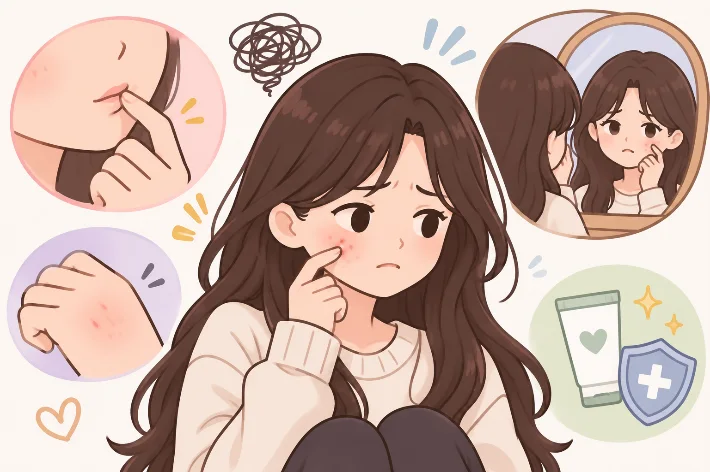
JurnalPost.com - Peeling dry lip skin, popping pimples, or picking at the skin around nails when feeling restless are behaviors frequently encountered in daily life. Because they are considered normal, these actions are often dismissed as mere habits, without realizing that in certain conditions, such behavior may be linked to psychological issues.
A brief survey we conducted via Instagram among 63 respondents shows that while these behaviors are familiar, they are not necessarily understood correctly. A total of 48 respondents claimed to have heard the term skin-picking, but 23 respondents were mistaken about its meaning. Furthermore, 37 respondents believed that such behavior is not a psychological disorder.
In fact, Diagnostic and Statistical Manual of Mental Disorders fifth edition (DSM-5) classifies skin-picking disorder or excoriation disorder within the category of obsessive-compulsive and related disorders. So, is skin-picking really just a habit?
What Is Skin-Picking?
Skin-picking is a psychological term referring to the behavior of picking, peeling, or squeezing the skin. When this behavior is performed repeatedly to the point of causing injury and meeting specific diagnostic criteria, the condition can be categorized as skin-picking disorder or excoriation disorder.
The most common target areas are the face, arms, and hands. In adolescents, this behavior may emerge during puberty, when the skin undergoes changes and acne begins to develop, leading to more frequent touching or picking.
In daily life, this behavior is more familiarly known as peeling or "picking at" the skin. However, skin-picking disorder has characteristics that differ from the general habit of peeling skin.
Distinguishing Habit from Disorder
Not everyone who has peeled their skin automatically has a psychological disorder. Peeling dry lip skin or popping a pimple is a common behavior for many. Such behavior does not always become a problem as long as it does not occur continuously, cause recurring wounds, or interfere with daily activities.
What distinguishes a common habit from a disorder is the pattern of behavior and the resulting impact.
According to DSM-5, skin-picking disorder is characterized by the repeated act of picking at the skin until it causes wounds, accompanied by repeated, unsuccessful attempts to reduce or stop the behavior.
The American Psychiatric Association (2013) also explains that this behavior can cause significant emotional distress or interfere with daily functioning. Furthermore, the symptoms must not be caused by substance use, a specific medical condition, or be better explained by another mental disorder.
Therefore, determining whether a behavior meets the criteria for a psychological disorder cannot be done based solely on personal observation, but requires a professional assessment from a psychologist or psychiatrist.
Why Does the Urge Arise?
The behavior of skin-picking is often preceded by certain sensations, such as itching, tension, or anxiety. In daily life, this urge can be related to stress, nervousness, annoyance, or boredom. Skin conditions that feel uneven, dry, or acne-prone can also trigger the desire to touch and pick at them.
Generally, this behavior can occur through two patterns. First, behavior that occurs automatically without full awareness, such as when someone is daydreaming or performing other activities. Second, behavior performed consciously, usually as a response to felt tension or anxiety.
After picking at the skin, a person may feel temporary relief. However, that feeling can be followed by guilt, shame, or regret due to the resulting wounds.
This recurring pattern helps explain why skin-picking behavior is not always easy to stop through personal intention or willpower alone.
Impacts That Are Not Always Visible
The behavior of skin-picking not only leaves marks on the skin but can also affect a person's psychological state.
Physically, skin that is constantly picked can experience impaired healing processes, leave scars, and increase the risk of infection.
Meanwhile, psychologically, visible scars can make a person feel ashamed, uncomfortable, or lack confidence in their appearance. Some individuals even try to cover the injured skin or avoid social interaction for fear of receiving questions or judgment from others.
The guilt that arises after engaging in the behavior can also add to psychological pressure and make the habit of picking at the skin increasingly difficult to control.
Therefore, the impact of skin-picking needs to be understood as an issue that can relate to both physical and psychological health, not just a matter of skin appearance.
Stories from the Field
Based on the survey and brief interviews conducted, it was found that the behavior of peeling or picking at the skin is quite familiar in the daily lives of the respondents.
Many respondents admitted to having seen the behavior in people around them, while others stated they had done it themselves. However, understanding of the term skin-picking remains varied.
A similar situation was seen in interviews with three teenagers. All three recognized the behavior of picking or peeling skin, but it was their first time hearing the term skin-picking.
Findings from this small-scale survey and interviews cannot be used to conclude that the behavior experienced by respondents constitutes a psychological disorder. Nevertheless, the results provide an overview that the behavior is relatively well-known, while the term and understanding of the condition are not yet fully grasped.
Thus, education regarding skin-picking is important so that the public can distinguish between common behaviors and conditions that require professional attention.
What Can Be Done?
The first step is to recognize the situations when the urge to peel or pick at the skin usually arises, such as when feeling anxious, bored, or while working on tasks.
By understanding this pattern, one can start looking for alternative activities to divert the urge, such as engaging in other tasks, light exercise, or sharing stories with close friends or family.
Additionally, keeping the skin moisturized and trimming nails regularly can help reduce the risk of injury from picking.
However, these steps may not be enough to overcome skin-picking for every individual. If the behavior is difficult to control, wounds recur, or it begins to interfere with daily activities and emotional well-being, consulting a psychologist or psychiatrist may be the right choice.
In treatment, there are several psychological approaches that can be used. One of them is Habit Reversal Training (HRT), a technique that helps individuals recognize the urge to pick at the skin and replace it with a more adaptive response or action.
Additionally, Cognitive Behavioral Therapy (CBT) can help individuals identify and change thought patterns and behaviors associated with the habit.
Another approach is Acceptance and Commitment Therapy (ACT), which helps individuals develop the ability to accept uncomfortable urges or emotional experiences without having to respond to them through skin-picking behavior (Anusuya & Gayatridevi, 2025).
Seeking professional help is not a sign of weakness, but part of an effort to understand oneself and maintain physical and psychological health.
Understanding Without Judging
Ultimately, both simple steps in daily life and professional help begin with the same thing: understanding.
The behavior of peeling or picking at the skin may already be familiar to many. However, understanding of skin-picking disorder still needs to be improved so that the public does not rush to judge individuals who experience it.
Understanding this behavior means viewing it more objectively, without mocking, labeling, or judging, whether toward others or oneself.
For some, the behavior of peeling skin may just be a habit that does not cause significant problems. However, if the behavior is difficult to control or begins to interfere with daily life, seeking help from a professional is the right step without having to wait for the condition to worsen.
With increased public understanding, it is hoped that the term skin-picking disorder will no longer be unfamiliar, and individuals experiencing difficulties related to this behavior can receive appropriate support.
Note: This article is educational and is not a diagnostic tool. Assessment of a person's psychological condition needs to be performed by a psychologist or psychiatrist. If you have difficulty stopping the behavior of picking at your skin, do not hesitate to consult a professional.
References
American Psychiatric Association. (2013). Diagnostic and statistical manual of mental disorders (5th ed.). American Psychiatric Publishing.
Anusuya, S. P., & Gayatridevi, S. (2025). Acceptance and commitment therapy and psychological well-being: A narrative review. Cureus, 17(1), Article e77705.
Azrin, N. H., & Nunn, R. G. (1973). Habit-reversal: A method of eliminating nervous habits and tics. Behaviour Research and Therapy, 11(4), 619–628.



Comments 0
Write a Comment Share your response