

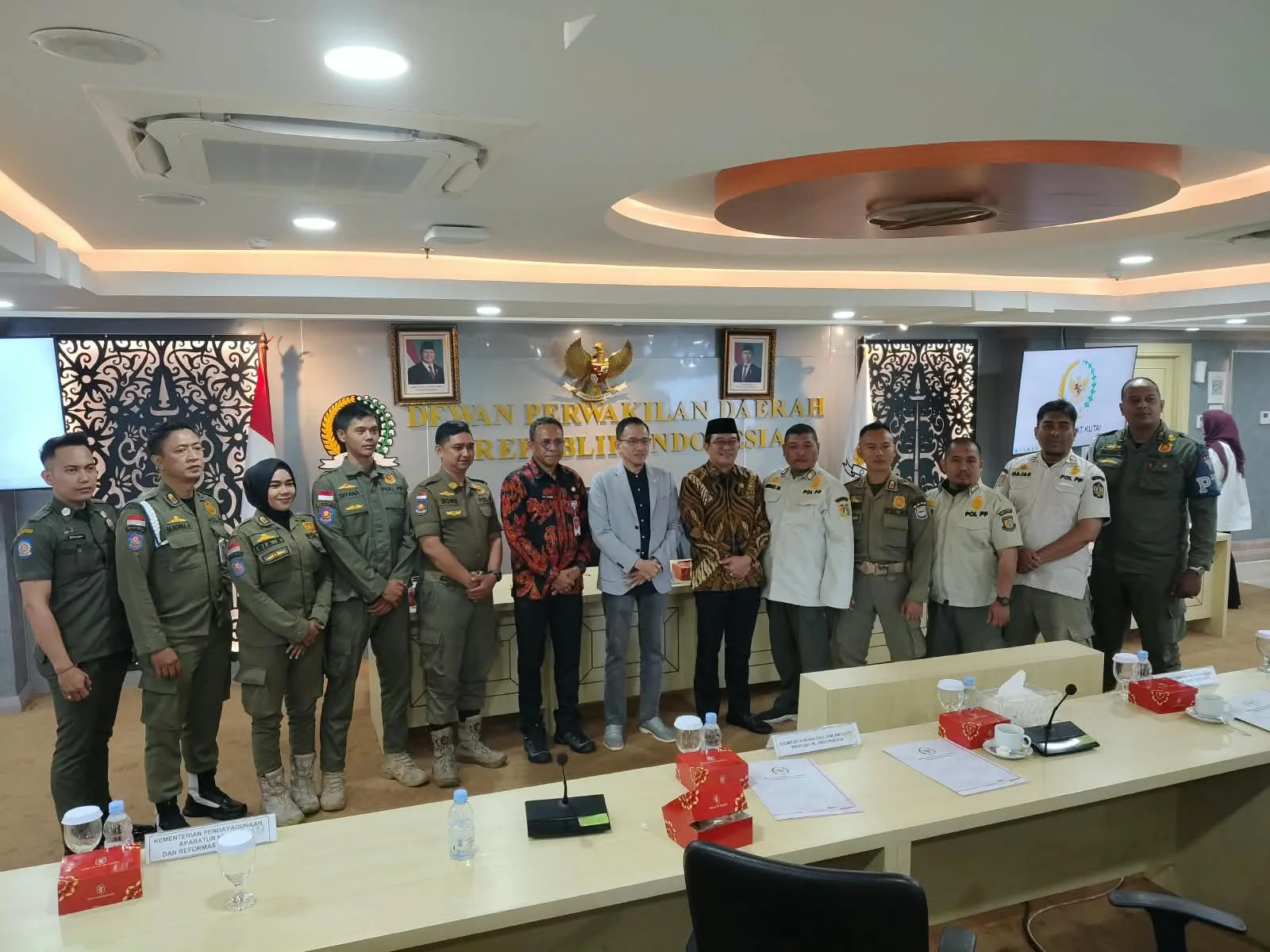
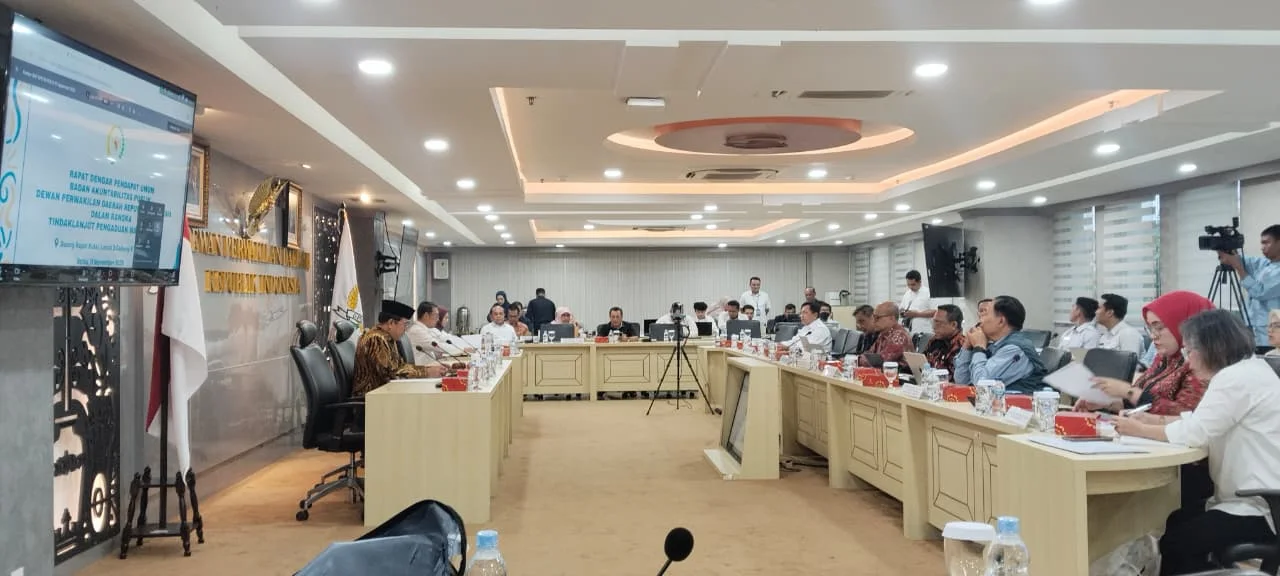
JAKARTA — The struggle of Public Order Agency (Satpol PP) personnel serving as part-time and full-time Government Employees with Work Agreements (PPPK) regarding the certainty of their authority to enforce Regional Regulations (Perda) and Regional Head Regulations (Perkada) was brought to the fore during a Public Hearing (RDPU) at the DPD RI BAP on Wednesday (11/11/2026).
They are calling on the state not only to demand the execution of enforcement duties in the field but also to provide a clear legal foundation, legal protection, and equal employment status for personnel who face the public daily.
In the RDPU forum, representatives of the complainants stated that Satpol PP PPPK personnel are in a dilemma. On one hand, they wear uniforms, conduct enforcement operations, maintain public order and tranquility, and carry out orders from regional leaders. On the other hand, their status and authority in enforcing regional laws are frequently questioned by both violators and within administrative and judicial processes.
“[Thamrin, SH]” said the Legal Division of the Indonesian Bureaucrat Professionals Association, during the RDPU.
According to the complainants, this ambiguity directly impacts the effectiveness of Perda and Perkada enforcement. Personnel in the field are hesitant to take firm action for fear that such actions might be considered exceeding their authority. Conversely, when they do not act, they are seen as failing to perform their duties.
Normatively, the Satpol PP is established to enforce Perda and Perkada, maintain public order and tranquility, and provide community protection. This is affirmed in Article 255 paragraph (1) of Law Number 23 of 2014 concerning Regional Government.
However, the issue arises in Article 256 of the same Law, which states that Public Order Police (Pol PP) are functional positions for Civil Servants (PNS). This provision is the basis for the demand that Satpol PP personnel not merely be transitioned into PPPK through selection mechanisms, but be established as functional PNS positions in accordance with the mandate of the legislation.
In practice, judicial enforcement of regional regulations can only be carried out by qualified personnel, including through the Civil Servant Investigator (PPNS) mechanism. Meanwhile, personnel with honorary or non-PNS status can only assist PPNS, rather than conducting enforcement independently.
This condition, according to the complainants, creates inequality. Many Satpol PP PPPK personnel have served for years, possess enforcement experience, and have undergone official education and training, yet their formal authority remains disproportionate to the duties they carry out.
In the RDPU, the complainants presented several core demands, including:
- Certainty of authority: A written affirmation that qualified Satpol PP PPPK personnel possess the same authority in enforcing Perda and Perkada, including non-judicial enforcement actions.
- Equality of status: A review of the policy transitioning Satpol PP into PPPK to ensure alignment with Article 256 of Law Number 23 of 2014.
- Legal protection: Guarantees of legal protection for personnel performing duties according to procedure, as well as clarity on the PPNS mechanism for eligible personnel.
- Welfare and career path: Certainty regarding career paths, credit scores, and welfare that is proportional to the risks of field duties.
The complainant representatives emphasized that this struggle is not just about employment status, but about legal certainty for the public. Perda enforcement conducted by officials without clear authority has the potential to trigger lawsuits, field conflicts, and weaken the authority of regional governments.
The RDPU included representatives from the Ministry of Finance, the Ministry of Administrative and Bureaucratic Reform, the Ministry of Home Affairs, the Ministry of Manpower, the BUMN Regulatory Body, the National Civil Service Agency (BKN), PT DANANTARA INDONESIA, and the complainants to follow up on the public grievances.
The DPD RI is expected to act as a bridge through this forum so that the aspirations of the Satpol PP PPPK do not end as mere complaints, but are followed up in the form of policy recommendations to the central government.
For the Satpol PP PPPK personnel, this struggle is about justice and legal certainty. They want to work with peace of mind, act according to their authority, and be protected by the same laws they enforce every day in the community.





Comments 0
Write a Comment Share your response