

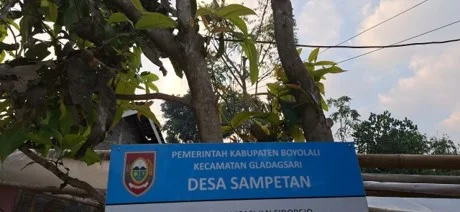
BOYOLALI, JurnalPost.com — A team of lecturers from the Semarang State Polytechnic (Polines) carried out a Competitive Community Service (PMK) program in Sampetan Village, Gladagsari District, Boyolali Regency, Central Java, on Thursday (13/8/2026).
The activity was realized through the implementation of an Internet of Things (IoT)-based solar public street lighting (PJU) system, involving the "ARSIS" youth organization of Sampetan Village as project partners. Internet of Things (IoT) with the involvement of the "ARSIS" youth organization of Sampetan Village as project partners.
This program stems from the limited state of village street lighting. Some street lights still rely on conventional electricity, posing a risk of outages during power grid disruptions.
In addition to increasing village operational costs, the existing lighting system lacked real-time monitoring technology. Consequently, damage or malfunctions were often only discovered after reports from residents.
Sampetan Village is located in Gladagsari District, Boyolali Regency, approximately 56 kilometers from the Polines campus in Semarang, with a travel time of about one hour via the toll road.
According to the service team, the area possesses solar energy potential that can be utilized more optimally, particularly to meet street lighting needs.
The use of solar power is expected to maintain lighting availability without increasing dependence on the conventional power grid or the village's electricity bill burden.
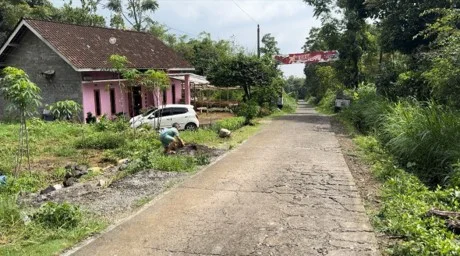
Renewable Energy Education for Residents and Youth Organizations
Beyond limited lighting infrastructure, another issue faced is the public's limited understanding of solar energy and the application of IoT technology.
Therefore, this service activity focuses not only on device installation but also on providing education regarding the operation, maintenance, and functionality of the solar street lighting system.
Members of the "ARSIS" youth organization served as the primary partners in this activity. They received training to gain the skills necessary to manage and monitor the devices independently.
From an educational perspective, this activity also serves as a hands-on learning opportunity for students from the Polines Electrical Engineering Department involved in the system's installation and monitoring.
Field experience is expected to strengthen students' understanding of course materials, particularly those related to electronic circuits, IoT technology, and renewable energy development.
The series of activities included site surveys, socialization, system operation training, and device installation alongside the community on village roads.
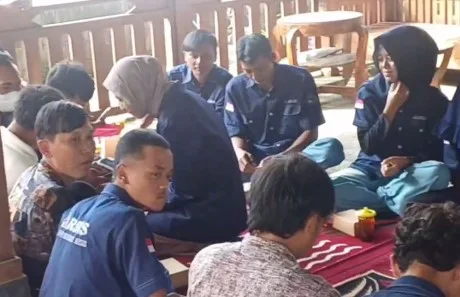
During the socialization session, the team explained the working principles of solar panels, which convert sunlight into electrical energy to be stored in batteries and used as a power source for lighting at night.
Residents were also introduced to remote monitoring technology that allows the status of the lighting system to be checked via digital devices.
Street Lights Utilizing Solar Energy and IoT Monitoring
The PJU system implemented consists of several main components: solar panels, batteries, inverters, and LED lights.
Solar panels function by converting sunlight into electrical energy, which is then used to charge the batteries.
The stored energy is then channeled through an inverter to convert direct current electricity into alternating current at 220 volts as a power source for the lights.
This system uses a battery with a voltage of 24 volts and is designed to operate without relying on the conventional power grid.
IoT technology is applied through a data collection device connected to a Wi-Fi network.
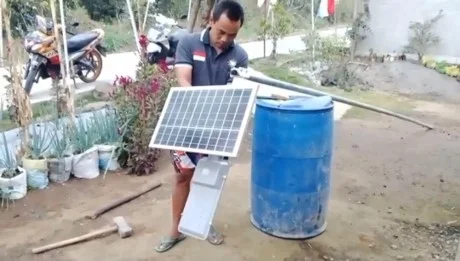
The device sends information regarding solar panel voltage, battery voltage, battery capacity, and electrical load to a cloud-based monitoring platform cloud at intervals of approximately five minutes.
Through this system, managers can monitor lighting conditions from a smartphone or computer without having to visit the installation site.
The monitoring platform also provides data history and malfunction alerts, allowing the system's condition to be evaluated more easily.
In addition to remote monitoring capabilities, the lights are designed to turn on automatically at night based on sensor readings.
With this mechanism, residents do not need to turn the lights on and off manually. The energy stored in the battery can be used when lighting is needed.
Monitoring Over 31 Days Records 8,549 Data Points
Following installation, the team monitored system performance for 31 days, from 2 October to 1 November 2026.
Monitoring results recorded 8,549 data points describing the device's operational status during that period.
Based on observations, electrical output at night was recorded as active with an average duration of about eight hours each night.
However, the team identified several conditions requiring further evaluation. On some nights, particularly during the period of 23–29 October 2026, battery capacity was observed to deplete earlier than expected.
These findings serve as evaluation material for the team to review the suitability of battery and solar panel capacity relative to the lights' energy requirements.
This evaluation is expected to form the basis for system improvements, ensuring that street lighting performance is more optimal and sustainable.
Involving Polines Lecturers and Students
This service activity was carried out by a team of lecturers from the Electrical Engineering Department of the Semarang State Polytechnic, consisting of Dr. Ir. Eko Supriyanto, S.T., M.T., IPM., Tulus Pramuji, B.Eng., M.T., and Tri Raharjo Yudantoro, S.Kom., M.Kom.
In addition to lecturers, a number of students were involved in the activity, ranging from device preparation and installation to system monitoring.
The program received funding support through the Polines Competitive Community Service (PMK) scheme for the year 2026.
Through this activity, the team hopes that the use of solar energy can help reduce the village's dependence on conventional electricity for street lighting needs.
On the other hand, the application of IoT technology is expected to improve the community's ability to monitor and manage devices more effectively.
Future system management is planned to be handled by a local technical team from the youth organization with periodic guidance from Polines.
Promoting Smart Village Development in Sampetan
This service program is not only aimed at producing street lighting infrastructure but also serves as part of an effort to introduce appropriate technology to the community.
Beyond the application of devices in the field, the activity is targeted to produce outputs in the form of appropriate technology, copyrights, scientific publications, and activity documentation videos.
Moving forward, this IoT-based solar street lighting system has the potential to be developed through the addition of more PJU installation points and integration with other village services.
Such development is expected to support the implementation of a smart village concept (smart village) that optimizes the use of technology to improve the quality of services and community life.
Through the active involvement of residents, the youth organization, lecturers, and students, this activity serves as an example of collaboration between higher education institutions and the community in providing technological solutions tailored to village needs.
With sustainable management, the IoT-based solar street lighting in Sampetan Village is expected to provide long-term benefits while encouraging public awareness regarding the importance of renewable energy and digital transformation in rural environments.






Comments 0
Write a Comment Share your response