

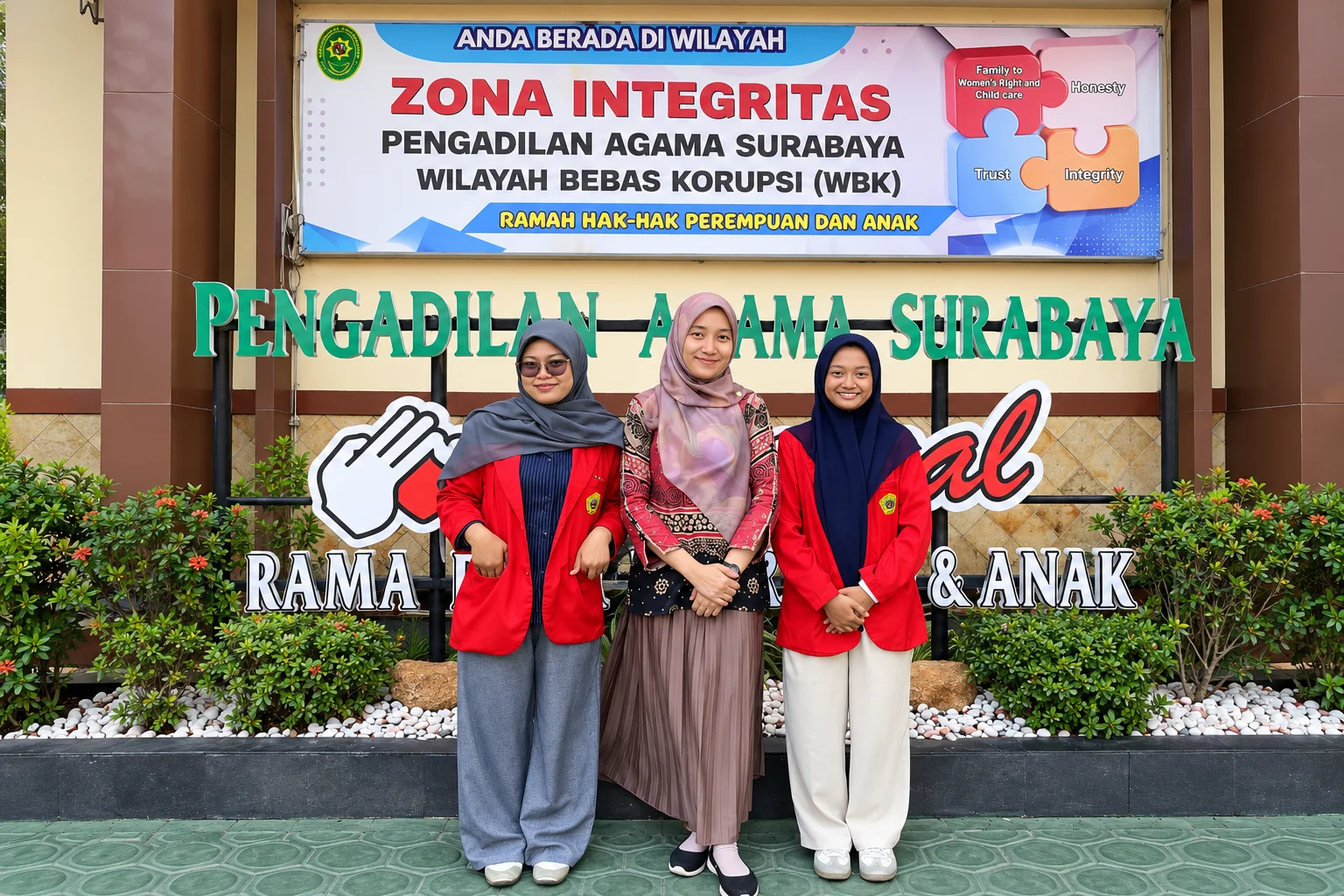
SURABAYA, JurnalPost.com — When discussing the judicial process, public attention is generally focused on judges, courtroom proceedings, and verdicts. However, there is another equally vital task in ensuring the process runs in an orderly manner: case administration. Accurate record-keeping, file completeness, and the proper summoning of parties are essential components of the legal process that cannot be overlooked.
This was among the key lessons learned by Nabila Saharani, a student at the Faculty of Law, University of 17 Agustus 1945 Surabaya, during her internship at the Clerk's Office of the Surabaya Religious Court from July 6 to August 28, 2026.
Over the course of 40 working days, this experience within the judicial environment demonstrated that law is not only studied through statutes but also executed through administrative tasks that demand precision and accountability.
When Law Meets Practice
The implementation of procedural law within the religious court system has a clear legal basis. Article 54 of Law Number 7 of 1989 concerning Religious Courts, as amended by Law Number 3 of 2006 and Law Number 50 of 2009, stipulates that the civil procedural law applicable in general courts also applies to religious courts, except where specifically regulated otherwise in those laws.
However, understanding legal provisions is not enough by simply reading article by article. Their application can be observed through various tasks in the Clerk's Office, ranging from recording case data and managing documents to organizing archives.
Every task is linked to the effort of maintaining administrative order and supporting the smooth operation of the judicial process.
One experience that provided direct insight into this process was observing court hearings.
In divorce cases, hearings are held in closed sessions as stipulated in Article 68 paragraph (2) and Article 80 paragraph (2) of the Law on Religious Courts, depending on the type of case.
This provision shows that resolving domestic cases is not only about applying the law but also requires protecting the privacy of the parties involved.
The experience demonstrated that the judicial process cannot be separated from the responsibility of maintaining information confidentiality.
For students studying legal practice, this serves as a reminder that legal understanding must be accompanied by an awareness of ethical boundaries when handling case information.
Behind the Files, There is a Legal Process to Protect
Outside the courtroom, case administration management is a crucial part of daily activities.
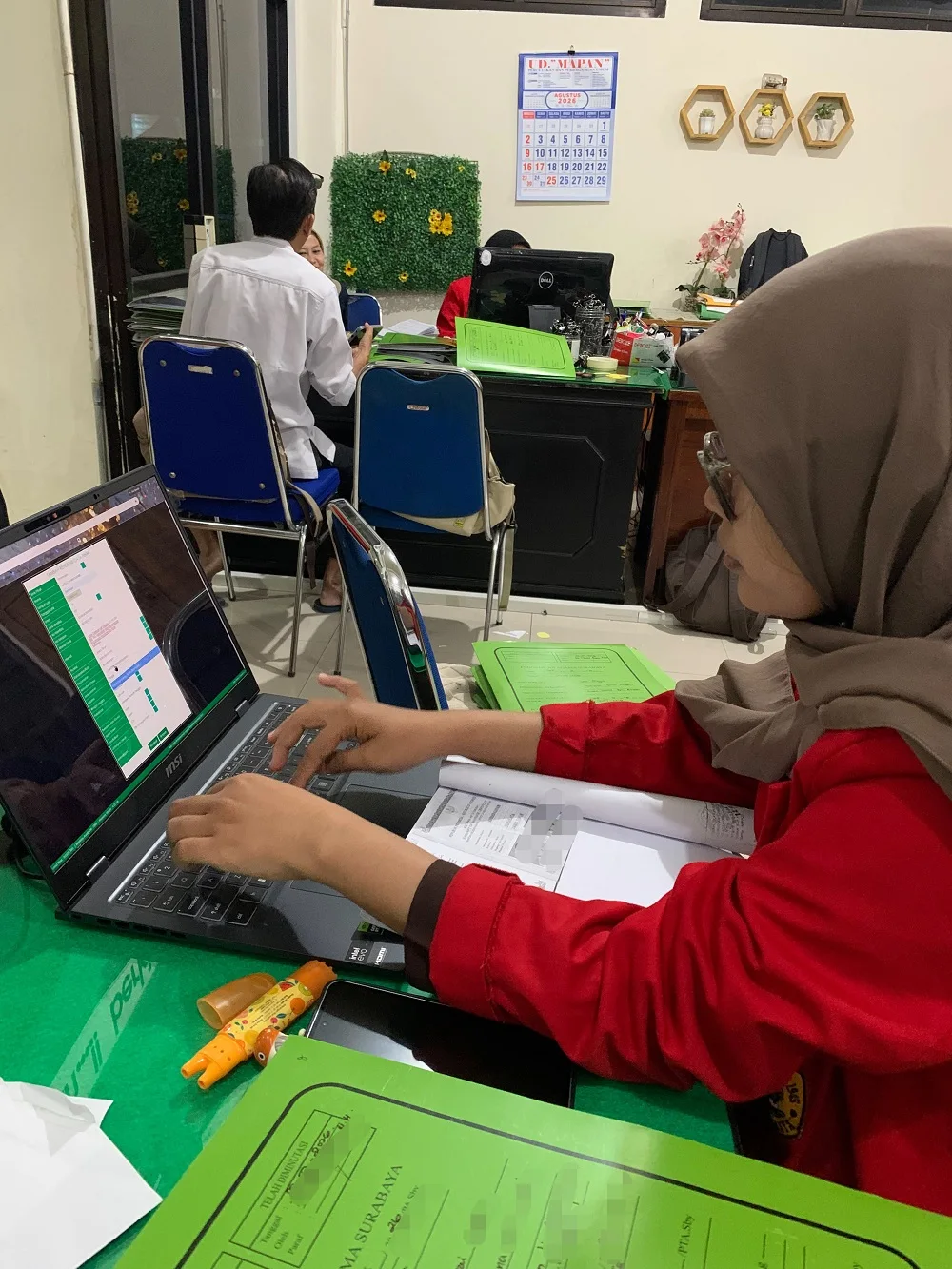
Students were involved in scanning documents for electronic archiving, organizing files, standardizing file names, and uploading documents to the Case Tracking Information System (SIPP).

Case numbers and types are also recorded in archive books to assist in document retrieval.
At a glance, these tasks might seem simple. However, errors in file naming, recording case numbers, or placing documents can hinder the process of searching for and reviewing files.
Therefore, administrative work requires the same level of precision as understanding the applicable legal procedures.
The use of information technology also supports changes in case management at the court.
Supreme Court Regulation Number 1 of 2019 concerning Electronic Case Administration and Court Proceedings, as amended by Supreme Court Regulation Number 7 of 2022, forms part of the regulatory framework for electronic judicial administration.
Through the use of information systems and electronic archiving, case documents can be managed in a more structured manner.
However, digitalization does not automatically eliminate the risk of errors. Data must still be verified, documents must be placed according to the relevant case, and confidential information must be protected.
Thus, the success of digitalization is determined not only by the availability of technology but also by the precision of the people using it.
Summons (Relaas) and the Rights of Parties in Court
Among the various administrative activities, recording the 'relaas' (official summons) was one experience that highlighted the tangible link between administrative work and procedural law.
A 'relaas' is a document related to the execution of summons or notifications to parties in a case.
In carrying out this activity, students recorded the summons number in the available logbook, inserted the letter into the case file, and verified the document's consistency with the relevant case.
Summoning the parties is not merely a formal stage before the hearing.
Properly executed summons relate to the rights of the parties to be informed of the examination process and to have the opportunity to attend the hearing.
Therefore, the accuracy of summons administration is significant in maintaining the order of the proceedings.
This understanding shows that the work performed behind the Clerk's desk can be directly related to fulfilling the rights of the parties.
Inconsistent documents or incorrect recording can potentially cause issues in the case examination process.
Conversely, orderly administration helps ensure that procedural stages can be tracked and reviewed if necessary.
The development of judicial administration also demands an understanding of increasingly diverse summoning mechanisms.
Regulations regarding electronic case administration open the door for the use of technology in summoning and notifying parties in accordance with applicable provisions.
These changes confirm that judicial staff need to understand legal procedures while simultaneously adapting to developments in administrative systems.
Administrative Precision and Trust in the Judiciary
The internship experience at the Surabaya Religious Court showed that the implementation of law is not determined solely by what happens in the courtroom.
There is a series of tasks behind the scenes that support the regularity of the judicial process, from recording to document storage.
From a law student's perspective, this experience clarifies the relationship between theory and practice.
In the classroom, procedural law is studied through regulations, principles, and procedural stages. In the court environment, that understanding is tested through concrete work that requires precision, discipline, and responsibility.
This also shows that the quality of judicial service cannot be judged solely by the conduct of the hearing or the verdict alone.
Administrative order is a supporting element that needs attention because it relates to information management, document retrieval, and the execution of legal procedures.
At the same time, the use of information technology brings additional responsibility in maintaining data security and confidentiality.
Especially in divorce cases involving the private lives of the parties, document management must be handled with caution.
Ease of access to case information must go hand-in-hand with compliance with applicable access rules and information protection.
Ultimately, the internship experience provided the understanding that administration is not just a supplementary task in the judicial system.
Accurate recording, document completeness, and compliance with procedures are part of the effort to keep the legal process orderly and accountable.
For law students, the most important lesson is not only knowing how a provision is regulated but also understanding how that provision is executed in practice.
Because law enforcement requires not only clear rules and accurate verdicts but also an orderly, meticulous, and responsible process.










Comments 0
Write a Comment Share your response