

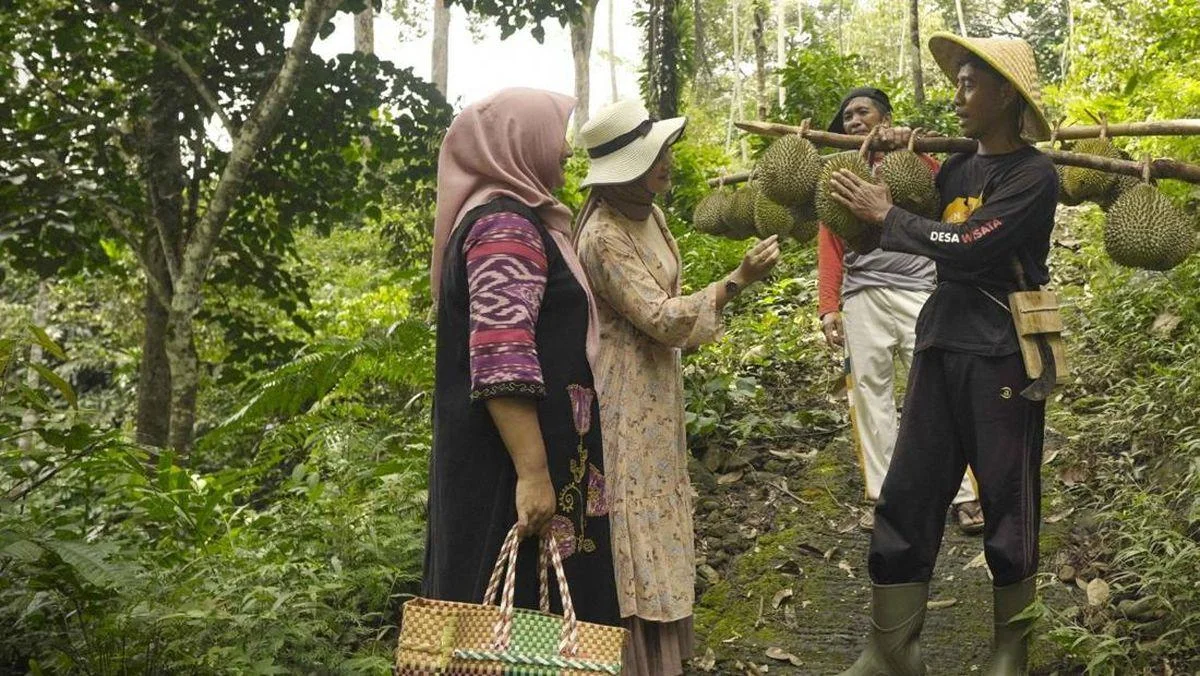
JurnalPost.com - Tourism villages represent a form of tourism development with significant potential to drive economic growth in rural communities. By leveraging natural wealth, culture, traditions, and the creativity of local residents, tourism villages are expected to create business opportunities while preserving local identity and wisdom.
In general, a tourism village is a tourism concept that integrates various attractions—whether natural, cultural, or man-made—with the daily life of the village community. This concept positions the community as the primary actor in managing tourism activities, known as community-based tourism .
In practice, the community does not merely act as a service provider but is also involved in the planning, decision-making, management, and evaluation of tourism activities. Consequently, the resulting economic benefits are expected to be felt directly by the local population.
However, developing a tourism village is no simple task. The existence of beautiful natural potential or unique cultural wealth does not always guarantee the success of a tourism village. Many villages with promising attractions struggle to maintain the sustainability of their tourism activities.
There are several challenges that require serious attention to ensure that the development of tourism villages can be sustainable.
1. Quality and Capacity of Human Resources
Human resources (HR) are a critical factor in determining the success of tourism village management. In the community-based tourism concept, villagers play the primary role as planners, managers, operators, and decision-makers.
The issue is that every village community has a different background in terms of education, skills, and experience. This condition can affect the community's ability to provide services to tourists or manage tourism businesses professionally.
Some of the skills required in tourism village development include communication, foreign language proficiency, digital technology usage, marketing, financial management, and technical skills in the tourism sector.
Therefore, increasing community capacity through training and mentoring is a vital necessity. Training programs in tour guiding, homestay management, tourist services, and digital marketing can help improve service quality while strengthening the competitiveness of the tourism village.
2. Institutional and Governance of Tourism Villages
The next challenge relates to the institution or organization responsible for managing tourism activities in the village.
Tourism village institutions have different characteristics from tourism business organizations in urban areas. For example, hotels in urban areas generally have a division of labor across several departments with specific responsibilities and standard operating procedures.
Meanwhile, the management of accommodation in tourism villages, such as homestays and guest houses, is usually carried out on a smaller scale involving families or community groups.
These differences mean that the management system for tourism villages must be adapted to the social and cultural conditions of the local community.
Various problems can arise if the institution is not well-formed, ranging from unclear division of tasks and conflicts of interest to weak leadership and organizational legality issues.
To overcome these conditions, the formation of institutions needs to be carried out through a deliberative process involving various elements of the community.
Additionally, mentoring from academics, the government, and professionals can assist managers in establishing organizational structures, work mechanisms, internal rules, and more transparent decision-making systems.
3. Limited Access to Capital
Capital is an essential requirement for building and developing tourism support facilities. Tourism village development requires funding to improve infrastructure, enhance facility quality, conduct training, and carry out promotional activities.
Unfortunately, limited access to capital remains a challenge for some tourism village managers.
Village budgets and government support are not always able to meet all development needs. On the other hand, revenue from the tourism sector is often unstable due to seasonal fluctuations, economic conditions, and changing tourist interests.
Access to financing through banking institutions can also be an obstacle, especially if the manager does not have adequate business administration, financial reports, or financing requirements.
In facing these conditions, tourism village managers need to strengthen cooperation networks with various parties.
Cooperation can be built with the government, universities, business players, non-governmental organizations (NGOs), and financing institutions.
The support obtained does not always have to be in the form of cash (in cash), but can also be in the form of goods, equipment, training, mentoring, or promotional facilities (in kind).
By expanding networks, the opportunities for tourism villages to obtain supporting resources for development will be more open.
4. Lack of Diversification and Uniqueness of Tourism Products
One of the challenges frequently found in the development of tourism villages in Indonesia is the tendency to present similar attractions from one village to another.
Some examples easily found are photo spots in the shape of bird nests, hanging bicycles, and heart-shaped decorations created as photo backgrounds.
Although these attractions can attract tourists' attention, the repeated use of the same concept has the potential to reduce the uniqueness of a destination.
This problem becomes more complex when tourism villages located close to each other offer almost identical products and experiences.
As a result, tourists do not have a strong enough reason to choose one destination over another. In the long term, this condition can weaken the identity and brand image (branding) of the tourism village.
To overcome this problem, managers need to develop tourism products based on the characteristics and advantages of each village.
Cultural potential, traditional culinary delights, agricultural activities, local crafts, village history, and the experience of interacting directly with the community can be developed into tourism products that have distinct value.
Product development also needs to consider creativity, market needs, and environmental and cultural sustainability.
Thus, the tourism village not only offers a place to visit but also provides a memorable experience for tourists.
Collaboration is Key to Tourism Village Development
These various challenges show that the success of a tourism village requires more than just natural and cultural potential.
Professional management, strong institutions, capital support, and the ability to create innovative tourism products are essential elements that must be developed simultaneously.
Increasing human resource capacity can be done through training, competency certification, and continuous mentoring according to community needs.
On the institutional aspect, managers need to build a clear organizational system by prioritizing deliberation, transparency, and proportional division of responsibilities.
Meanwhile, the problem of limited capital can be overcome gradually through strengthening networks and strategic partnerships with various stakeholders.
The role of academics, the government, business players, and non-governmental organizations is also important in helping tourism villages identify potential, formulate development strategies, and create products that have uniqueness and competitiveness.
Ultimately, the development of tourism villages must continue to place the community as the center of tourism activities. Success is not only measured by the number of tourists who visit but also by the extent to which these activities can improve community welfare, maintain environmental sustainability, and preserve local cultural values.
With proper management and sustainable collaboration, tourism villages can grow into competitive destinations while providing tangible benefits for the lives of rural communities.






Comments 0
Write a Comment Share your response