


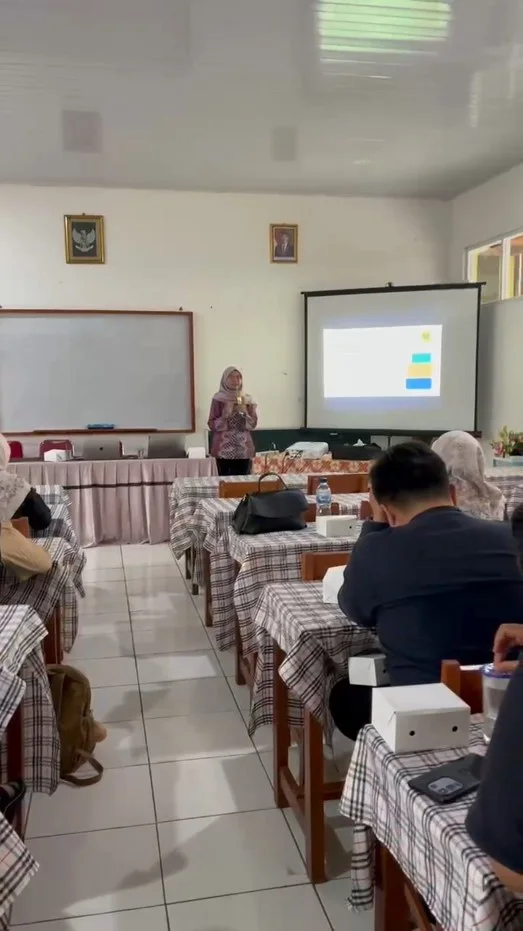
SOUTH TANGERANG, JurnalPost.com – Lecturers from the Universitas Pamulang Faculty of Law held a community service event providing legal counseling on the dangers of illegal abortion at Stella Maris School BSD, South Tangerang City, on Friday (13/11/2026).
This activity aimed to improve the understanding of students and educators regarding health risks, legal consequences, and the importance of reproductive health education in preventing actions that could endanger adolescent safety.
The session featured three speakers from the Universitas Pamulang Faculty of Law: Agus Purwanto, S.KM., S.H., M.H., Mohamad Kholid, S.H., M.H., and Dr. James Davidta Ginting, S.H., M.H.
Through this event, the speakers explained the criminal law provisions governing abortion in Indonesia, the factors that may lead to illegal abortion, and the importance of the role of family and the educational environment in providing guidance to adolescents.
Understanding Legal Provisions on Abortion
During the session, the lecturers explained that abortion in Indonesia is strictly regulated by law. These provisions are contained in Law Number 1 of 2023 concerning the Criminal Code (KUHP) and Law Number 17 of 2023 concerning Health.
Article 463 of the Criminal Code stipulates that a woman who undergoes an abortion outside of legal provisions can be sentenced to a maximum of four years in prison.
However, legislation also provides exceptions in certain conditions, including medical emergencies and pregnancies resulting from rape or other sexual violence, provided that specific requirements are met.
Meanwhile, Article 464 of the Criminal Code sets out criminal penalties for parties who perform an abortion on a woman. The penalty can reach five years in prison if performed with the woman's consent and 12 years if performed without her consent.
Criminal penalties can be more severe if the act results in the death of the woman concerned.
Medical personnel and health workers also bear legal responsibility in carrying out their professional practice. Abortion procedures must meet medical standards, the authority of health workers, and the applicable requirements for health service facilities.
Understanding these provisions is considered important so that the public not only knows about criminal threats but also understands their rights to health services and legal protection, especially for victims of sexual violence.
Factors Underlying Illegal Abortion
In addition to discussing legal aspects, the counseling session highlighted various social and psychological conditions that can influence a person's decision-making when facing an unplanned pregnancy.
Unintended pregnancy, social pressure, lack of family support, fear regarding future education, and limited understanding of reproductive health were among the issues discussed.
At a teenage age, pressure from peer groups and concerns about social judgment can worsen the psychological state of someone facing such a situation.
In a state of panic, some teenagers are at risk of seeking information from unreliable sources, including the internet, social media, or parties offering drugs without medical examination.
Therefore, the speakers emphasized the importance of education and support that is not only oriented toward imposing sanctions but also toward prevention, protection, and access to accurate information.
Health Risks of Unsafe Abortion Practices
Health aspects were also a focus of the session. Unsafe abortion practices, performed without examination and handling by authorized medical personnel, can lead to serious complications.
Risks that may occur include severe bleeding, infection, damage to reproductive organs, and conditions that threaten life.
The speakers also warned of the dangers of using drugs indiscriminately, especially those obtained from illegal sellers or marketed with misleading claims as menstrual-inducing drugs.
The use of drugs without proper diagnosis and medical supervision can increase the risk of complications, especially when a person does not know their pregnancy status or health condition.
Therefore, teenagers are advised not to easily trust information regarding drugs circulating on social media or recommendations from parties without medical competence.
If facing reproductive health problems or an unplanned pregnancy, the right step is to seek support and consult with authorized health workers.
The Importance of the Role of Parents and Schools
During the event, the lecturers emphasized that preventing risky behavior in adolescents requires the involvement of various parties.
Parents play a crucial role in building open communication with their children, particularly regarding changes during adolescence, reproductive health, personal boundaries, and responsibility in social interactions.
Meanwhile, schools are expected to be safe educational environments for students to obtain accurate information and express the problems they face.
Teachers, especially guidance and counseling teachers, have a role in providing initial support while helping students obtain professional services when needed.
Adolescents also need to be equipped with the ability to make responsible decisions, recognize peer pressure, maintain personal boundaries, and understand the importance of consent and respect for the rights of others.
Appropriate reproductive health education is expected to help students understand the consequences of risky behavior while encouraging them to seek help when facing problems.
Increasing Legal Awareness from School Age
This community service activity organized by the Universitas Pamulang Faculty of Law is a form of higher education's contribution to improving legal literacy in the educational environment.
Through this counseling, students are expected to gain knowledge about the dangers of illegal abortion practices, the legal consequences that may arise, and the importance of maintaining reproductive health.
This activity also confirms that legal understanding needs to be provided from an early age so that the younger generation can consider risks and consequences before making decisions.
With the support of schools, families, health workers, and the community, legal education is expected not to stop at understanding prohibitions and sanctions, but also to build awareness to protect the safety, health, and future of adolescents.
Through collaboration between universities and educational institutions, such counseling is expected to be continuously developed as part of efforts to shape a younger generation that possesses legal knowledge, health awareness, and social responsibility.






Comments 0
Write a Comment Share your response