

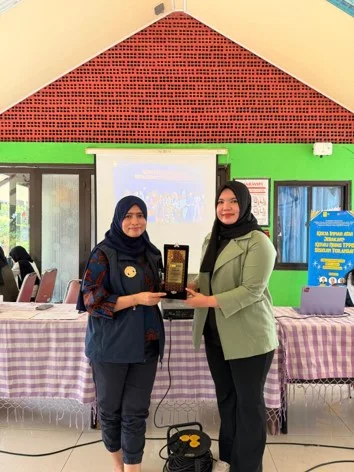
JAKARTA, JurnalPost.com — The threat of human trafficking has become a serious concern, particularly for young people who are vulnerable to falling victim to fraudulent job offers and various forms of exploitation. To increase awareness, the Faculty of Law at the University of Indonesia (FH UI), in collaboration with the Jakarta Youth Community Against Human Trafficking and Child Sexual Violence (KOMPAK Jakarta), held a legal education event at RPTRA Planet Senen, Central Jakarta, on 19 September 2026.
This community service initiative targeted young people aged 17–25 years old. Participants were equipped with an understanding of human trafficking modus operandi, legal protections for victims, and preventive measures through a practical and interactive approach.
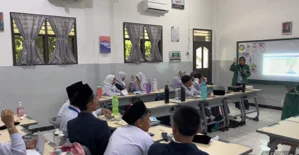
Unlike traditional legal counseling that relies solely on lectures, this event combined discussions, educational games, and case simulations, allowing participants to learn firsthand how to recognize and navigate high-risk situations.
This program is part of the FH UI community service initiative titled Human Trafficking Prevention Strategy: Innovation and Legal Approaches Through Interactive Simulations to Realize Justice for Young Workers and Children in Central Jakarta.
Involving Academics and Child Protection Communities
The event was led by FH UI lecturer Dr. Febby Mutiara Nelson, S.H., M.H., who serves as the head of the community service team.
The team also involved several academics and legal practitioners, namely Hasril Hertanto, S.H., M.H., and Handayani Primandiri, S.H., M.H., from FH UI, as well as Erwin Ubwarin, S.H., M.H., from Pattimura University.
Additionally, the event was supported by Melva Retta R. Simanjuntak, S.H., M.H., a doctoral student at FH UI; Abni Nur Aini, S.H., a master's student at FH UI; and Priska Putri Andini, S.H., an alumna of FH UI.
The collaboration with KOMPAK Jakarta was established to bridge academic legal understanding with practical experience in advocacy and human trafficking prevention within the community.
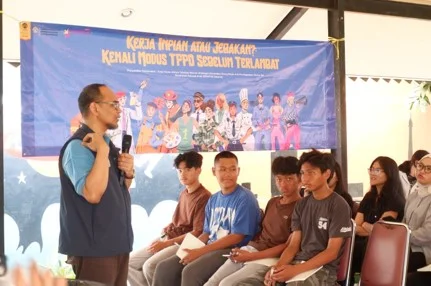
Senen Sub-district Secretary E. Erna Ratnasari, who opened the event, expressed her appreciation for FH UI's initiative in providing legal education to the younger generation in her area.
She hopes the knowledge gained by participants will serve as a tool to identify various forms of job-related fraud and increase vigilance against human trafficking crimes that may involve cross-regional or international networks.
Recognizing Human Trafficking Modus Operandi Early
During the event, participants received explanations regarding various forms of human trafficking and the protection mechanisms available to victims.
The material was presented by representatives of KOMPAK Jakarta and the FH UI community service team, referencing Law Number 21 of 2007 concerning the Eradication of the Crime of Human Trafficking.
The discussion did not focus solely on legal provisions but also highlighted how human trafficking can begin in seemingly ordinary situations, including job offers that promise attractive earnings.
Young people need to understand that job offers do not always come from well-intentioned parties. Information regarding the recruiter's identity, the company, the work location, the contract, and working conditions are essential details that must be verified before accepting any offer.
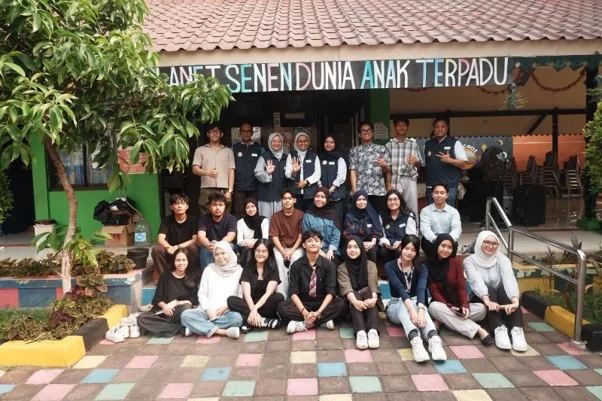
Through this education, participants were also encouraged to recognize the importance of seeking help when encountering suspected human trafficking, whether experienced personally or by others.
Interactive Simulations: Participants Face Case Scenarios
A key component of the event was simulation-based training or roleplay combined with gamification methods.
Participants were divided into groups to solve scenarios designed based on situations potentially linked to human trafficking.
One scenario featured the theme "Job Offer: Trap or Opportunity?" which challenged participants to evaluate a job offer and identify red flags.
Through these simulations, participants were trained to think critically before making decisions, understand potential risks, and determine self-protection steps when facing suspicious conditions.
In addition to recognizing recruitment tactics, participants were introduced to a referral system to help victims access protection and recovery services.
This approach allowed participants to understand that addressing human trafficking is not only about law enforcement against perpetrators but also requires providing psychosocial support for the safety and recovery of victims.
This experiential learning method is expected to make legal concepts more accessible, especially for young people who encounter diverse information and job offers through digital media and daily interactions.
Participant Understanding Evaluated Through Pre-test and Post-test
To measure the effectiveness of the counseling, the FH UI team implemented an evaluation through pre-test and post-testassessments.
The pre-test was conducted before the material was presented to gauge participants' initial knowledge of human trafficking, while the post-test was administered after the education and simulation sessions were completed.
The results of both evaluations were designed to assess the extent to which participants understood the material presented.
Through this mechanism, the community service team could gain insights into participant understanding while evaluating the educational methods used.
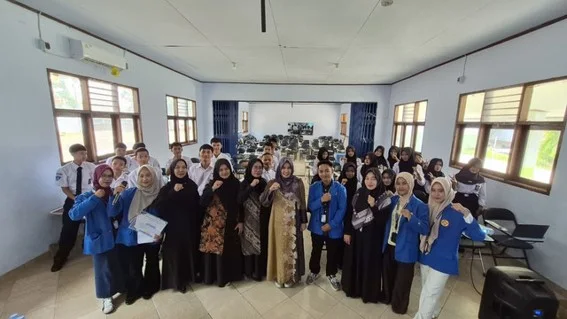
The event concluded with the awarding of prizes to the best-performing groups in the simulation session, followed by a group photo session.
Encouraging Youth to Become Agents of Human Trafficking Prevention
This activity serves as a contribution from higher education institutions to expand public access to legal education and understanding, particularly regarding the protection of vulnerable groups.
Efforts to prevent human trafficking are considered to require the involvement of various parties, ranging from educational institutions and local governments to communities and the general public.
For the younger generation, the ability to recognize high-risk situations is a crucial part of protecting themselves and their surroundings.
Through the collaboration between FH UI and KOMPAK Jakarta, the knowledge gained by participants is expected to extend beyond the event, reaching peers, families, and the wider community.
In this way, human trafficking prevention education not only provides an understanding of legal regulations but also fosters a social environment that is more vigilant, caring toward victims, and capable of responding to potential human trafficking early on.



Comments 0
Write a Comment Share your response